
Reviewed · ZANZIBAR TOURS
Welcome Zanzibar : A Journey through time for the Old Town
Stone Town rewards slow footsteps. I like this tour for its local guide, Ally, and its close look at carved doors, old lanes, markets, forts, and the city’s layered past. I also like the small-group format, which lets you stop for questions instead of marching behind a flag.
The main consideration is that this is a walking tour through narrow streets, with a moderate fitness requirement and some entrance fees not included. At $20 per person, it offers strong value, but you should budget extra for the Old Slave Market and the Swahili house rooftop view if you want to enter them.
In This Review
- Key points to know before you book
- Meeting Ally at Forodhani Gardens
- The first look at Stone Town’s winding lanes
- Old Fort and the changing rulers of Zanzibar
- Darajani Bazaar and everyday Stone Town
- The Old Slave Market and a difficult chapter
- Rooftop views and optional extra stops
- What Ally does particularly well
- Is two to three hours enough?
- What the $20 price really covers
- Who should book this Stone Town walk?
- Should you book Welcome Zanzibar?
- FAQ
- Where does the tour start?
- Where does the tour end?
- How long does the tour last?
- How much does the tour cost?
- Is pickup available?
- Is this a private tour?
- What is included in the price?
- Are entrance fees included?
- Are food and drinks included?
- Can I cancel for a full refund?
Key points to know before you book
- Ally is the main attraction: He is praised for clear explanations, patience, humor, and a friendly manner.
- Stone Town is explored on foot: Expect narrow lanes, uneven walking, busy market areas, and frequent stops.
- The tour lasts about two to three hours: That is enough for an orientation and major sights, but not for an in-depth visit inside every building.
- The history crosses continents: African, Arab, Indian, Portuguese, Omani, and European influences appear in the streets and buildings.
- The price is low for a private experience: Your group participates alone, rather than joining a large shared party.
- Bring extra money for entry fees: The Old Slave Market and Swahili house rooftop view cost extra, while food, drinks, tips, and personal purchases are also separate.
Meeting Ally at Forodhani Gardens
The tour begins at Forodhani in Stone Town, a practical starting point near the waterfront and central old city. The activity ends back at the same meeting point, so you can plan a meal, hotel return, or another walk afterward without arranging a second pickup.
Pickup is offered, but the details matter. Transport to other parts of Zanzibar is not automatically included, so you need to contact the operator ahead of time if you are staying outside Stone Town or want a different pickup point. For many people already based in the old city, meeting at Forodhani keeps things simple.
Ally is repeatedly praised for his calm manner and easy communication. He has met people at the ferry, responded quickly through WhatsApp, and adjusted the pace when needed. One especially useful detail is his ability to help visitors practice Swahili along the way. That small personal touch can turn a standard sightseeing walk into a more relaxed introduction to local life.
This is a private activity, meaning only your own group takes part. That is valuable in Stone Town, where a narrow lane can feel cramped when several tour parties arrive at once. You can ask about a carved door, pause for a photograph, or request more detail about a subject without holding up a large crowd.
A few more trips of this kind worth comparing:
- From Zanzibar: Mikumi Safari Day Trip with Flights and Meal
★ 4.7 · 1,470 reviews - Zanzibar: Quad Bike Adventure departing from Kendwa or Nungwi
★ 4.9 · 1,233 reviews - Zanzibar: Stone Town, Spice Tour, Prison Island with Lunch
★ 4.4 · 1,219 reviews
The first look at Stone Town’s winding lanes
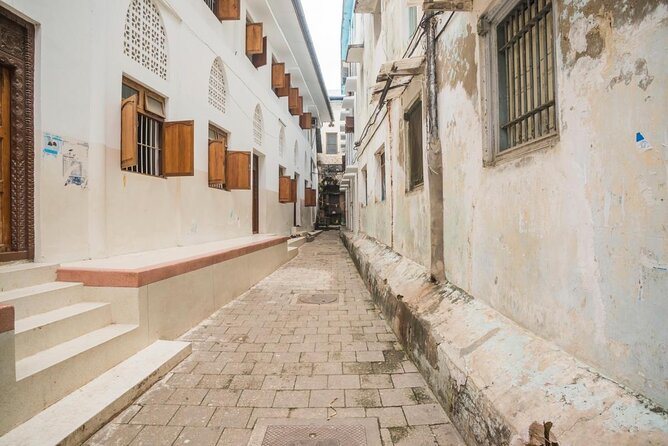
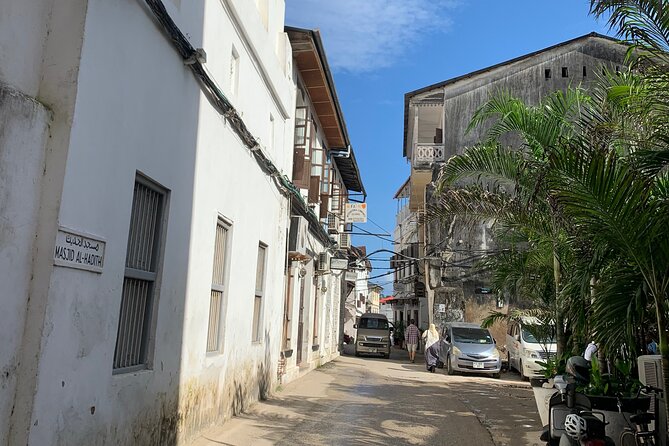
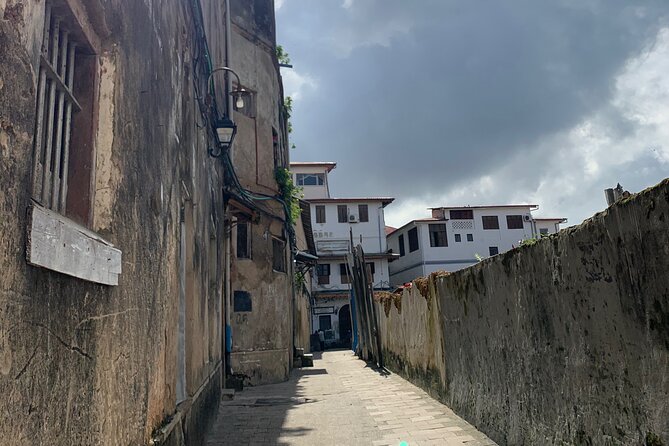
Stone Town makes more sense when you walk it slowly. Its old quarter is formed by tight streets and alleyways, with colorful buildings, small shops, historic houses, and doors that deserve your attention. The route is not about covering a long distance. It is about noticing details that are easy to miss from a taxi.
Look up as often as you look ahead. The wooden doors are among Stone Town’s most distinctive features, and their carvings reflect the city’s links with African, Arab, and Indian traditions. A guide adds value here because the doors can look decorative at first glance, while their patterns, scale, and placement tell you something about the wealth and identity of the people who lived behind them.
The streets also show how several cultures met in one port city. Zanzibar’s story includes African communities, Arab rulers, Indian merchants, Portuguese influence, and later European involvement. Ally’s role is to connect those pieces without making you work through a textbook while walking.
I would treat the first part as an orientation rather than a formal architectural lecture. You may stop at major houses, churches, the House of Wonders, and other sites depending on the route and your interests. The tour can be shaped around questions, which is helpful if you care more about daily life, architecture, colonial events, religion, or trade than a fixed list of monuments.
Old Fort and the changing rulers of Zanzibar
The Old Fort gives the walk a solid historical anchor. The Portuguese built it in the 17th century, and the Omani Arabs later used it. Its walls reflect the strategic importance of Zanzibar and the repeated changes in power that shaped the island.
The fort is important even if you are not interested in military architecture. It helps explain why Stone Town developed as a major center on the western coast of the island. The building connects the city’s Portuguese period with the later Omani era, two chapters that are easy to separate in a guidebook but much easier to understand when you are standing among the old defenses.
Do not expect this short tour to function as a full fort visit with hours of independent exploration. The wider walk includes the fort as one part of a larger route. The benefit is context: you see it alongside old homes, markets, waterfront spaces, and religious or civic buildings rather than as an isolated stop.
Ally’s strength, based on the experience described by past customers, is explaining these transitions in plain language. He is also praised for answering extra questions instead of rushing to the next stop. If you want more detail about Portuguese and Omani control, ask directly. A private guide gives you room to steer the conversation.
Darajani Bazaar and everyday Stone Town
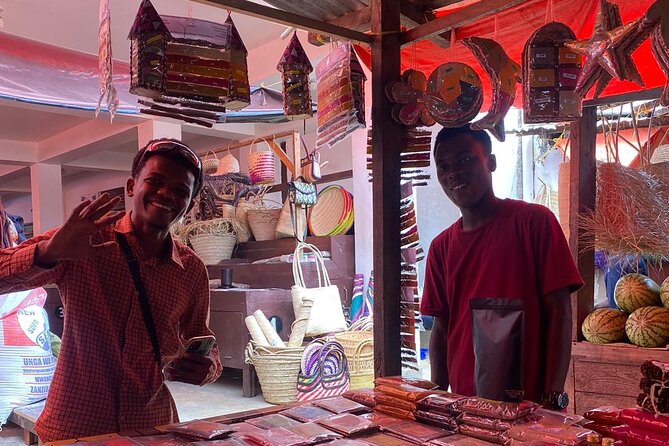
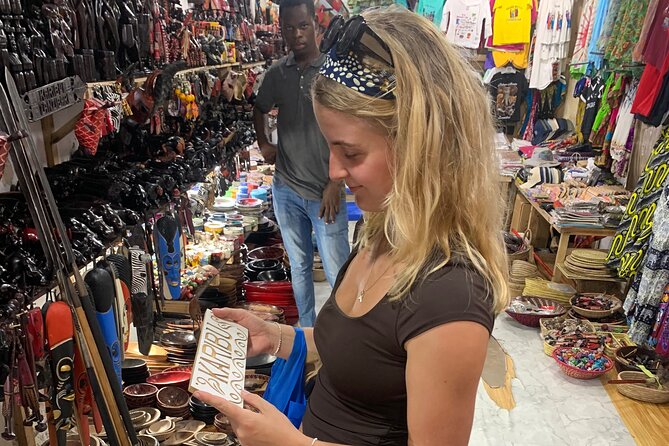
Darajani Bazaar brings a different mood from the old fort and grand houses. This is where the tour shifts from formal history to daily commerce, local products, spices, and souvenir shopping. The market is useful because it shows Stone Town as a living town, not just a collection of preserved buildings.
You can browse for spices and small local products, but the tour is not presented as a dedicated shopping trip. That is a good balance. You get a look at the market and a chance to buy something, while the main purpose remains understanding the city.
I would keep your shopping expectations practical. Prices, product quality, and personal preferences vary, and food or purchases are not included in the tour price. If you see something you like, ask Ally about it before buying. His local perspective may help you understand what you are looking at and whether it is a useful souvenir.
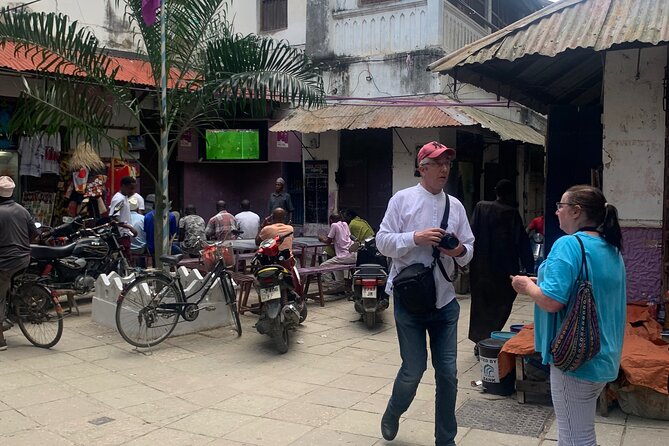
Markets can also be the least comfortable section for anyone who dislikes crowds or close quarters. The route uses narrow streets and busy public areas, so wear comfortable shoes and keep your belongings secure. The provided information does not promise a quiet market visit, and Stone Town is best approached with patience rather than a rigid schedule.
A completely different kind of day out from Zanzibar:
- From Kendwa: Mnemba Boat Trip and Dolphin Snorkel Adventure
★ 4.8 · 1,043 reviews - From Zanzibar: Day Selous Game Reserve Safari with Flights
★ 4.7 · 1,025 reviews - Zanzibar: Prison Island and Nakupenda Boat Trip with Lunch
★ 4.1 · 882 reviews - Skydive Zanzibar | Tandem Skydive
★ 5.0 · 877 reviews
The Old Slave Market and a difficult chapter
The Old Slave Market adds serious weight to the experience. This stop addresses the history of slavery in Zanzibar, a subject that should not be treated as a quick photo opportunity. The tour includes the site in its historical route, but entry is not included in the $20 price.
That extra fee is worth knowing before you arrive. The information provided does not give a fixed admission amount, so you should confirm the current cost when booking or at the meeting point. Food, drinks, personal purchases, and tips are also separate.
A local guide is especially useful here because the site can be difficult to process without context. You can ask Ally to explain how the slave trade fits into Zanzibar’s wider connections with East Africa, the Arabian Peninsula, India, and Europe. The tour description indicates that the city’s story is shaped by all of these contacts, not by one culture alone.
This may be the most emotionally demanding portion of the walk. If you prefer to take your time at places connected with painful history, tell the guide. The private format should make that easier than a large scheduled group, although the tour still has a limited two to three hour window.
Rooftop views and optional extra stops

A Swahili house rooftop view is available at an additional admission cost. The rooftop offers a different way to read Stone Town, since you can see the old city from above rather than only from its lanes. It may also be a good place to pause after the denser historical material.
This stop is not included in the base price, so treat it as an optional add-on rather than a guaranteed part of the $20 experience. Ask at the start whether the rooftop visit fits the day’s route, the timing, and your interests.
Past customers also describe sunset views during an afternoon Stone Town walk. The exact timing is not guaranteed, so do not book this tour solely for a sunset. Still, if your start time is suitable, you can ask Ally if the route can finish near a good viewpoint before returning to Forodhani.
The guide may also show smaller alleyway details and less obvious places between the major sights. The tour’s value is not just the Old Fort or the market. It is the way those places are linked by ordinary streets, old houses, doors, and stories that you could pass without noticing.
What Ally does particularly well
The strongest part of this experience is the guide. Ally is described as polite, warm, patient, and easy to reach, with a good sense of humor. He has guided solo visitors, couples, and small groups, and he appears comfortable adapting the pace and subject matter.
That flexibility matters in Stone Town. One person may want architecture, another may care about slavery and trade, and someone else may simply want help finding restaurants or planning the next day. Past customers received advice about restaurants, future Zanzibar trips, and other excursions, including snorkeling options. Those recommendations are separate from this tour, but they can be useful when you are still finding your way around the island.
Several practical touches also show up in the experience. Ally has helped with umbrellas during rain, adjusted the walk to suit people’s needs, and made solo visitors feel secure. You should not treat those examples as a guarantee of specific equipment or services, but they suggest a guide who pays attention rather than delivering a memorized speech.
English appears to be clear enough for visitors who do not speak it as a first language. If you have a question, ask it. The private setup and Ally’s patient style are well suited to travelers who prefer conversation over a fixed lecture.
Is two to three hours enough?
For a first look at Stone Town, yes. Two to three hours gives you time to walk the main lanes, see the Old Fort, visit or view Darajani Bazaar, discuss the Old Slave Market, and stop at several architectural landmarks.
It is not enough for a slow examination of every building or a long market visit. You also may not have time to enter every site, shop at length, stop for food, and linger on a rooftop. Think of this as a well-priced introduction that helps you decide where to return later.
The length also works well on a busy Zanzibar schedule. You could use it early in a Stone Town stay to get your bearings, on a short stop before or after the ferry, or during a day when you want history without committing to a full-day program.
The pace is described as comfortable, but you still need moderate physical fitness. Stone Town involves walking through narrow streets and alleyways, and the information provided does not promise a fully step-free route. If mobility is a concern, contact the operator before booking and explain what you need.
What the $20 price really covers
At $20 per person, this is inexpensive for a private walking tour with a local guide. You are paying mainly for Ally’s time, explanations, route planning, and local perspective. There is no food or drink included, and several entry fees are extra, so the final cost depends on how many sites you enter.
The value is strongest if you want a personal introduction rather than a self-guided walk. You could see the outside of many Stone Town landmarks for free, but you would miss much of the connection between the Portuguese fort, Omani rule, carved doors, markets, slavery history, and Swahili architecture.
The cost is less attractive if you want a long museum visit, a food tour, or a full-day city program. This is a focused walking experience, not an all-inclusive sightseeing package. Tips are not included, and they are optional, but you may want to budget one if Ally’s guidance is useful.
The booking terms are straightforward. You can cancel for a full refund up to 24 hours before the start time. Cancellations or changes made within 24 hours are not refunded or accepted, based on the stated policy.
Who should book this Stone Town walk?
I would recommend it to first-time visitors who want a clear introduction to Stone Town, especially if you prefer a private guide and an unhurried pace. It also suits solo visitors, couples, and small groups who want to ask plenty of questions.
It is a good match for people interested in architecture and history, particularly the carved doors, Portuguese and Omani periods, local trade, Swahili houses, and the history of slavery. The option to practice a little Swahili also adds a friendly local touch.
You may want another type of experience if shopping, food, or extensive indoor sightseeing is your main goal. The market is included as part of the walk, but meals and drinks are not. Entry to the Old Slave Market and Swahili house rooftop also costs extra.
Rain should not automatically put you off. Ally has adjusted tours during wet weather and helped with umbrellas, but conditions can still affect walking comfort. Wear shoes suited to uneven streets, carry water, and leave room in your schedule for stops.
Should you book Welcome Zanzibar?
Book this tour if you want a low-cost, private introduction to Stone Town led by Ally, whose calm manner, historical explanations, flexibility, and personal recommendations are its biggest strengths. The 4.8 rating from 39 reviews and 97 percent recommendation rate support the idea that the experience is consistently well received.
Go in with realistic expectations. You are not buying a full-day museum program or a package with every admission included. You are buying a two to three hour walk that connects Stone Town’s doors, streets, fort, market, difficult history, and Swahili architecture.
For the best experience, meet at Forodhani, confirm any pickup request in advance, ask which optional sites are planned, and keep extra cash for admissions and tips. If you want to understand Stone Town before exploring Zanzibar’s beaches, this is a sensible first step.
FAQ
Where does the tour start?
The tour starts at Forodhani, Zanzibar, Tanzania.
Where does the tour end?
The activity ends back at the meeting point at Forodhani.
How long does the tour last?
The tour lasts approximately two to three hours.
How much does the tour cost?
The listed price is $20 per person.
Is pickup available?
Pickup is offered, but pickup to areas outside Stone Town is not automatically included. You should send a message in advance if you need a different pickup location.
Is this a private tour?
Yes. Only your own group participates in the activity.
What is included in the price?
A local tour guide, Zanzibar history, and passage by major historical sites are included.
Are entrance fees included?
No. Entrance to the Old Slave Market and the Swahili house rooftop view is not included.
Are food and drinks included?
No. Food and drinks are not included.
Can I cancel for a full refund?
Yes, if you cancel at least 24 hours before the experience start time. Cancellations or changes made less than 24 hours before the start time are not refunded or accepted.
Just added around Zanzibar
- Spice Tour of Zanzibar★ 4.5 · 3 reviews
- Zanzibar : Stone Town Tour,history without transport★ 4.8 · 3 reviews
- Zanzibar: 3-Day Northern Safari with Flights Included★ 4.8 · 3 reviews
- Jozani Forest, kuza cave and mtende beach★ 5.0 · 3 reviews
- Starfish Beach; The Rock; Kuza Cave; Paje Beach; Salaam Cave Tour★ 4.5 · 3 reviews
- ZANZIBAR: Stone Town and Jozani Forest Guided Tour★ 4.0 · 3 reviews
- Zanzibar: African Sunset Boat Party in Zanzibar Music, Views★ 4.3 · 3 reviews
- Joazani forest & Spice farm with lunch★ 5.0 · 3 reviews
Zanzibar Tours, compared.

Mikumi Safari Day Trip with Flights and Meal
Read our review →
Quad Bike Adventure departing from Kendwa or Nungwi
Read our review →
Stone Town, Spice Tour, Prison Island with Lunch
Read our review →
Mnemba Boat Trip and Dolphin Snorkel Adventure
Read our review →

Prison Island and Nakupenda Boat Trip with Lunch
Read our review →