
Reviewed · STONE TOWN TOURS
3-Hour Private Stone Town Walking Tour
Stone Town rewards slow walking. This private tour brings together Zanzibar’s Arab, Indian, Persian, and British influences while leading you through lanes that are easy to miss on your own. I like the personal format, and I like that the route includes both famous landmarks and everyday places such as Darajani Bazaar and Jamat Khana.
The strongest part is the guide service. Guides named Ahmad, Hassan, and Hasan have been praised for clear English, strong local knowledge, friendly manners, and the ability to adjust the walk to your interests. The main drawback is the pace: seven stops in three hours leaves limited time at each one, and the narrow streets, market crowds, heat, and serious subject of the former slave market may not suit everyone.
In This Review
- Key points to know before booking
- Why Stone Town works best on foot
- Starting at the Old Fort and Forodhani Gardens
- The Old Customs House and the waterfront story
- One hour through Stone Town’s narrow lanes
- Darajani Bazaar: the everyday side of Zanzibar
- The former slave market and Anglican Cathedral
- Freddie Mercury’s Zanzibar connection
- What $35 per person gets you
- Who will enjoy this walk most
- Should you book the Stone Town walk?
- FAQ
- Where does the tour start?
- Where does the tour end?
- How long is the walking tour?
- Is the tour private?
- How much does the tour cost?
- What landmarks are included?
- Are admission tickets included?
- Is food included at Forodhani Gardens or Darajani Bazaar?
- Can I cancel for a full refund?
- Is the tour suitable for most people?
Key points to know before booking
- Private walking format: Only your group takes part, so you can ask questions and request extra attention at particular sites.
- A useful Stone Town overview: The route covers the Old Fort, Forodhani Gardens, Darajani Bazaar, the former slave market, Freddie Mercury Museum, and lesser-known streets.
- Strong architectural focus: Look for carved doors and the blend of Arab, Indian, Persian, and European design.
- Good local context: The walk includes food culture, market life, religious buildings, and the difficult story of the East African slave trade.
- Three hours for $35 per person: The price is reasonable for a private guide, though admission arrangements should be confirmed if you want to enter paid interiors.
- Free cancellation until 24 hours before departure: Changes or cancellations inside that period are not accepted for a refund.
Why Stone Town works best on foot
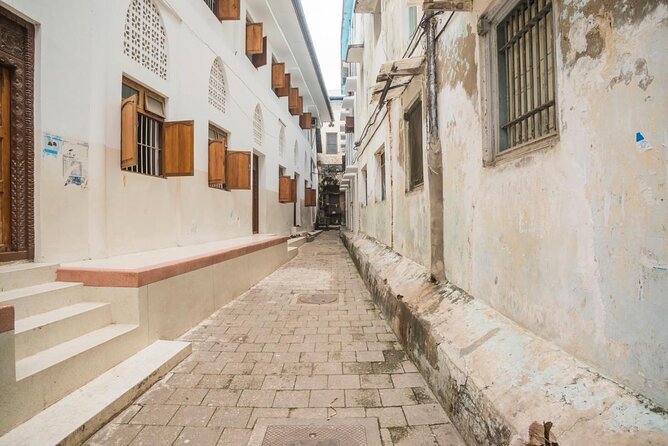
Stone Town is compact, but it is not simple. Its lanes twist, narrow, widen, and change character within a few minutes. A large road map will show you the main points, but it will not explain why a doorway has Indian-style details, why a building faces the sea, or how the town’s Swahili identity grew from several outside influences.
This is where a private walk earns its keep. You are not being driven from one sight to another. You are moving through the old city at street level, with time to notice carved wood, small courtyards, shopfronts, religious buildings, and the daily rhythm of the market.
I especially like the balance between famous landmarks and less polished corners. The Old Fort and Forodhani Gardens give you an easy introduction, while the narrow streets, city center, and Ismail Khoja Jamat Khana add a more local side of Stone Town.
The walk begins and ends at the Old Fort on Mizingani Road. Since there is no transport between stops, wear comfortable shoes and expect the full three hours to be spent outdoors or inside open public areas. The route is suitable for most people, and service animals are allowed. The experience is also near public transportation.
More Private Tours in Zanzibar
- Stone Town Private Walking Tour
★ 5.0 · 371 reviews - Zanzibar: 3 Hours Private Stone Town walking Tour with Guide
★ 4.6 · 301 reviews - Full-Day Private Stone Town +Spice Farm and Prison Island Tour
★ 4.5 · 216 reviews
Starting at the Old Fort and Forodhani Gardens

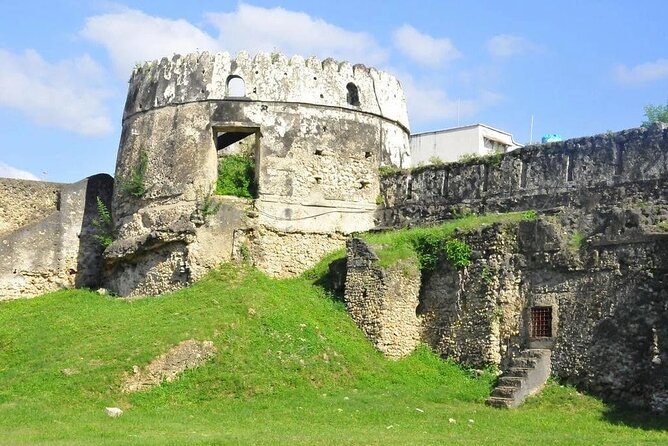
The Old Fort is a logical meeting point. It is also known as the Arab Fort and is described as the oldest building in Stone Town. Its position beside the former House of Wonders and opposite Forodhani Gardens gives you several major landmarks within a short walk.
You have about 18 minutes here. That is enough for an introduction, photographs, and a look at the fort’s role in the city, but not enough for a slow architectural study. I would use this first stop to ask your guide to explain how Zanzibar’s rulers, merchants, and foreign powers shaped the waterfront.
From the fort, the walk moves to Forodhani Gardens. The gardens sit along Stone Town’s main seafront and are especially active after sunset, when a food market draws local people and visitors.
The food here is part of the point. You might hear about grilled seafood, samosas, cassava, sweet potatoes, Zanzibar pizza, and urojo, also called Zanzibar mix. The tour does not state that food tastings are included, so think of this as an introduction to the setting and local dishes rather than a promised meal.
The timing matters. An 18-minute stop during daylight will feel different from an evening visit, when the food market is at its busiest. If you want to eat at Forodhani Gardens, ask your guide if the schedule allows it. Three hours is tightly planned, so you may need to return later on your own.
The Old Customs House and the waterfront story
The Old Customs House sits on Mizingani Road facing the sea. It was built in the 18th century, and the building is linked to the proclamation of the Sultan in 1896.
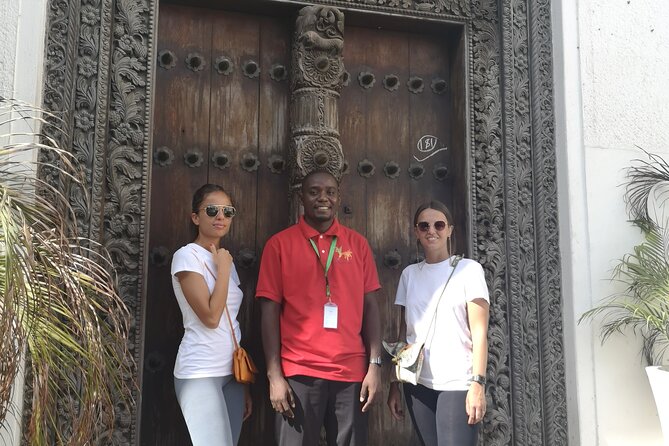
The main detail to watch is the carved wooden door, decorated with fish, lotus, and anchor motifs. This is a small stop, but it shows why Stone Town should not be judged only by its biggest monuments. Doors are among the city’s most memorable features, and the guide can help you read the symbols and design influences.
Again, the planned 18 minutes keeps the walk moving. That is good if you want a broad first look at Stone Town. It is less suitable if you enjoy lingering at one building or taking many photographs.
I would ask your guide to point out how the waterfront buildings relate to the town behind them. The sea helped make Stone Town an important commercial center, while the interior lanes reveal the private, religious, and market sides of the city.
One hour through Stone Town’s narrow lanes
The longest section of the tour lasts about 1 hour and 12 minutes, and this is where the experience has the most personality. Stone Town became a UNESCO World Heritage site in 2000 because its 19th-century architecture reflects the many influences behind Swahili culture.
You will move through narrow streets and see the town as more than a collection of monuments. The route includes carved Zanzibar doors, the city center known as Jaws Corner, and the Ismail Khoja Jamat Khana.
Jaws Corner is a useful place to understand the social life of Stone Town. It is not presented as a grand monument. Its value comes from seeing a city meeting point and learning how residents use the old center.
The Jamat Khana adds another layer to the town’s religious and cultural story. Along with the Arab and European elements, Indian influence is a major part of Stone Town’s identity. A good guide can connect the buildings to the people and communities who helped shape the city.
This section is also where a private tour has a clear advantage. You can stop to ask about a doorway, a street, or a building that catches your eye. Guides associated with this walk have been praised for answering questions patiently and explaining architectural features clearly. Hassan, also written Hasan, has been singled out for his strong presentation of Zanzibar’s past and his ability to tailor the route. Ahmad has also been praised for friendly, professional guiding and clear communication.
One practical point: narrow streets are part of the charm, but they can make the walk feel confined and busy. You will want to keep your group together and stay alert around corners. The description does not provide a route suitable for every mobility need, although most people can participate.
More Walking Tours in Zanzibar
- Zanzibar: Stone Town Historical Cultural Walking Guided Tour
★ 4.5 · 179 reviews - Stonetown: Food Markets and Street Food Walking Tour
★ 4.7 · 151 reviews - Zanzibar Stone Town Walking Tour
★ 5.0 · 145 reviews - Stone Town Historical Walking Tour
★ 5.0 · 143 reviews
Darajani Bazaar: the everyday side of Zanzibar
Darajani Bazaar is also called the spice market or local market. It sells fresh fruit, fish, and spices, giving you a direct look at shopping in Stone Town.
This is one of the most useful stops for anyone who wants more than architecture. Forts and palaces explain power. A market explains daily life. You can see the produce and seafood that support local cooking, and the spices connect Zanzibar to the trade routes that helped shape its economy.
The planned stop is 18 minutes. That is enough to walk through a section and get your bearings, but you should not expect a full market tour or a relaxed shopping session. The market can also feel intense if you prefer quiet spaces.
I would avoid treating Darajani as a quick photo stop. Pay attention to what is being sold, how the stalls are arranged, and how different the market feels from the polished waterfront. If you want to buy spices or food, ask the guide about suitable places and keep the time limit in mind.
The former slave market and Anglican Cathedral
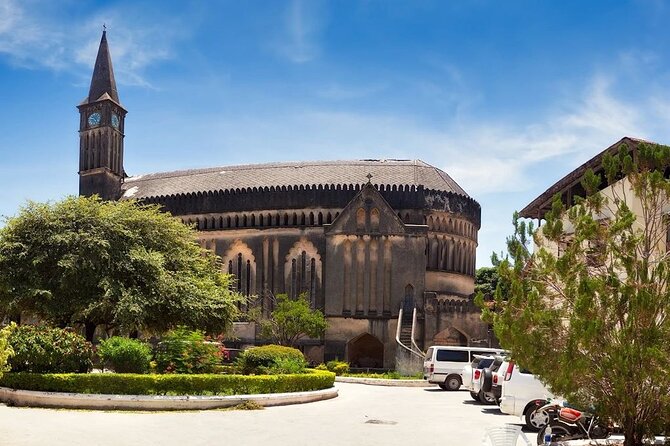
The Old Slave Market and Anglican Cathedral are among the most serious stops on the route. For centuries, Zanzibar was a center of political and economic power in East Africa, and the island was also tied to the region’s slave trade.
People captured on the mainland were brought to Zanzibar in chains and sold in the city market. The market closed on the Sultan’s orders in 1873. The site also connects to the wider history of the abolition of slavery in Africa and beyond.
The tour allows about 18 minutes here. That is a short period for such a difficult subject, so your guide’s explanation matters greatly. The site may feel emotionally heavy, and I would not rush through it simply to stay on schedule. At the same time, the walk is only three hours, so you should understand that this is an introduction rather than a full study of slavery in Zanzibar.
This stop gives the tour moral and historical weight. It prevents Stone Town from becoming only a charming collection of old doors and seaside buildings. You see how wealth, trade, religion, and human suffering were connected.
The experience description lists admission as free at the stops. If you want access to a particular interior or exhibition area, confirm what is included when booking, since the details provided do not spell out separate entry arrangements.
Freddie Mercury’s Zanzibar connection

The Freddie Mercury Museum is the final listed stop. Freddie Mercury was born in Zanzibar and moved to England around 1963. The museum presents his birthplace, Zoroastrian roots, childhood, schooling in Panchgani, India, and later rise to international fame.
This is a sharp change of subject after the former slave market. That contrast can work well, because it shows Zanzibar’s connection to a modern global figure as well as its older political and commercial past.
The museum is located in the heart of Stone Town, and the planned stop lasts 18 minutes. That gives you a quick introduction to Mercury’s Zanzibar connection, but it is unlikely to satisfy serious fans who want a long museum visit.
I would treat this as a final cultural note, not the main reason to book the tour. If Freddie Mercury is your priority, ask how much time will actually be spent inside. The tour ends back at the Old Fort meeting point, so you can decide afterward if you want to return to the museum or explore nearby on your own.
What $35 per person gets you
At $35 per person, this is a fair price for a private three-hour walk in one of East Africa’s most historically important old cities. You are paying for a guide who can connect separate sites into one story, not for transport, a meal, or a long list of included admissions.
The private format improves the value. You are not locked into a large group’s questions or pace, and you can ask for more detail about architecture, local culture, the slave trade, or Freddie Mercury. The route also covers enough ground to help you decide where to return later.
The value is lower if you want slow photography, extended market shopping, or long visits inside museums. Seven stops in three hours means the schedule moves briskly. I would book it as a first Stone Town orientation, then use the rest of your time in Zanzibar to revisit the places that interest you most.
The tour is commonly booked about 26 days ahead on average. That suggests planning early if your dates are fixed, especially if you want a private guide at a particular time. Confirmation is provided when booking, and free cancellation is available up to 24 hours before the start time. Inside that window, the amount paid is not refunded and changes are not accepted.
Who will enjoy this walk most
I would recommend this experience to first-time visitors who want a clear introduction to Stone Town without arranging several separate visits. It suits couples, families, and small private groups who prefer to ask questions as they go.
It also fits history-minded visitors who want the slave-trade site treated as part of the city’s full story, not ignored in favor of picturesque streets. Architecture fans will appreciate the mix of carved doors and Arab, Indian, Persian, and European details.
Food-focused visitors will like the Forodhani Gardens and Darajani Bazaar stops, though food is not stated as included. Freddie Mercury fans may enjoy the museum connection, but the short stop means the tour is not designed as a dedicated music pilgrimage.
You may want another plan if you dislike walking in narrow streets, need a highly specific accessibility arrangement, or prefer spending an hour or more at each attraction. The listing says most people can participate, but it does not provide detailed information about step-free access or walking distances.
Should you book the Stone Town walk?
Book it if you want a private, well-paced introduction to Stone Town, with architecture, markets, food culture, religious history, the former slave market, and Freddie Mercury in one route. The strongest reason to choose it is the guide. Ahmad, Hassan, and Hasan have earned praise for friendly service, clear English, careful explanations, and tailoring the walk to individual interests.
Do not book it expecting a slow museum tour or a long food crawl. The 18-minute stops are short, and the most substantial part of the experience comes from walking through the streets between landmarks.
For $35 per person, I think it offers good value, especially for a first visit. Wear comfortable shoes, allow for heat and crowded lanes, ask questions early, and tell your guide what matters most to you. That is how you will get the best from a compact but thoughtfully chosen look at Zanzibar’s old city.
FAQ
Where does the tour start?
The tour starts at the Old Fort on Mizingani Road in Zanzibar, Tanzania.
Where does the tour end?
The experience ends back at the Old Fort meeting point.
How long is the walking tour?
The tour lasts approximately three hours.
Is the tour private?
Yes. Only your group participates in the activity.
How much does the tour cost?
The listed price is $35 per person.
What landmarks are included?
The route includes the Old Fort, Forodhani Gardens, the Old Customs House, Stone Town streets, Darajani Bazaar, the Old Slave Market and Anglican Cathedral, and the Freddie Mercury Museum.
Are admission tickets included?
The listed stops show free admission. The provided details do not specify separate entry arrangements for every interior, so confirm this when booking if access inside a museum or site is important to you.
Is food included at Forodhani Gardens or Darajani Bazaar?
Food is not listed as included. The tour introduces local dishes and markets, including grilled seafood, samosas, Zanzibar pizza, urojo, fruit, fish, and spices.
Can I cancel for a full refund?
Yes. You can cancel at least 24 hours before the experience start time for a full refund.
Is the tour suitable for most people?
The experience states that most people can participate. It also allows service animals and is near public transportation, but detailed accessibility information is not provided.
More Walking Tours
- Walking City Tour in Zanzibar Island
★ 5.0 · 122 reviews - Zanzibar: Spice Tour & Stone Town Walking Tour
★ 4.8 · 115 reviews - Stone Town’s Hidden History: Private Guided Walking Tour
★ 4.6 · 94 reviews - Zanzibar: Jozani nature walk and wildlife tour
★ 4.5 · 89 reviews
More Stone Town Tours
- Zanzibar: Stone Town, Spice Tour, Prison Island with Lunch
★ 4.4 · 1,219 reviews - Zanzibar: Prison Island, Stone Town, & Spice Farm Tour
★ 4.5 · 579 reviews - Zanzibar; Prison Island, Nakupenda, StoneTown Tour with BBQ
★ 4.3 · 457 reviews - Zanzibar: Stone Town, Spice tour & Prison Island with Lunch
★ 4.6 · 453 reviews
Just added around Zanzibar
- Spice Tour of Zanzibar★ 4.5 · 3 reviews
- Zanzibar : Stone Town Tour,history without transport★ 4.8 · 3 reviews
- Zanzibar: 3-Day Northern Safari with Flights Included★ 4.8 · 3 reviews
- Jozani Forest, kuza cave and mtende beach★ 5.0 · 3 reviews
- Starfish Beach; The Rock; Kuza Cave; Paje Beach; Salaam Cave Tour★ 4.5 · 3 reviews
- ZANZIBAR: Stone Town and Jozani Forest Guided Tour★ 4.0 · 3 reviews
- Zanzibar: African Sunset Boat Party in Zanzibar Music, Views★ 4.3 · 3 reviews
- Joazani forest & Spice farm with lunch★ 5.0 · 3 reviews
Stone Town Tours, compared.

Stone Town, Spice Tour, Prison Island with Lunch
Read our review →

Prison Island, Nakupenda, StoneTown Tour with BBQ
Read our review →Stone Town, Spice tour & Prison Island with Lunch
Read our review →

3 Hours Private Stone Town walking Tour with Guide
Read our review →
Full-Day Private Stone Town +Spice Farm and Prison Island Tour
Read our review →
Stone Town Historical Cultural Walking Guided Tour
Read our review →Browse the lists this tour appears in