
Reviewed · SERENGETI SAFARIS
8 Days Safari (Lake Manyara /Tarangire/Serengeti/Ngorongoro)
The big five are only part of it. This eight-day circuit links Tanzania’s most famous parks with a strong chance of seeing the wildebeest migration, including the northern Serengeti and Mara River area. I like the wide range of habitats, from Arusha’s cool forest to the crater floor, and the chance to spend several full days in the Serengeti rather than rushing through it.
I also like the practical setup: airport transfers, two nights in Arusha, a pop-up-roof 4×4, an English-speaking guide, camping, and meals are included. The main caution is that this is a busy route with several long drives, and the displayed price of $0 per person is not a real usable fare. You must confirm the actual cost, camping arrangements, group size, and migration route before booking.
In This Review
- Key things to know before booking
- Why this eight-day route works
- Day 1: Arusha National Park’s forest and crater
- Day 2: Tarangire’s elephants and baobab country
- Day 3: The long road to central Serengeti
- Days 4 and 5: Chasing the migration in the Serengeti
- Day 6: Sunrise, another game drive, and the road to the crater
- Day 7: Ngorongoro Crater and Mto wa Mbu
- Day 8: Lake Manyara and the return to Arusha
- Camping, meals, and the level of comfort
- Is the displayed $0 price good value?
- Who should book this safari?
- Final verdict: a strong safari plan, once the details are confirmed
- FAQ
- How long is the safari?
- Which national parks and areas are included?
- Is airport pickup included?
- Is accommodation in Arusha included?
- What type of vehicle is used?
- When is the best time to see the wildebeest migration?
- Are meals included?
- What is not included?
Key things to know before booking
- Four full Serengeti days give you time for wildlife: The schedule includes central and northern Serengeti, with special attention to the Mara River area.
- Migration sightings depend on the month: July through September offers the best stated chance for river crossings, while January through March is calving season.
- The route includes five major parks and areas: Arusha National Park, Tarangire, Serengeti, Ngorongoro Crater, and Lake Manyara.
- Camping is part of the experience: Nights are planned at Seronera and Simba campsites, with Jambo Lodge used on some nights.
- A private vehicle is promised, but the wording is mixed: The details describe a private activity, while the tour summary also refers to joining-group camping safaris.
- The guide can make or break the safari: Past guests repeatedly praised guides including Jacob, Nuru, Samwel, Benson, Douglas, Mohamed, Iddy, and Jerome Hotti.
Why this eight-day route works
This is a classic northern Tanzania safari with one important advantage: it gives the Serengeti more time than many short circuits. You begin near Arusha, visit Tarangire, cross the Ngorongoro area, spend four days around the Serengeti, then return through Ngorongoro and Lake Manyara.
That sequence covers a lot. You get elephants and baobabs in Tarangire, forest monkeys in Arusha National Park, open plains and predators in the Serengeti, a dense concentration of animals in Ngorongoro Crater, and lake birds and tree-climbing lions at Manyara.
I like the variety because no two days are built around quite the same setting. The trade-off is time on rough roads. You should expect early breakfasts, long hours in the vehicle, dusty stretches, and a safari rhythm that favors wildlife over rest.
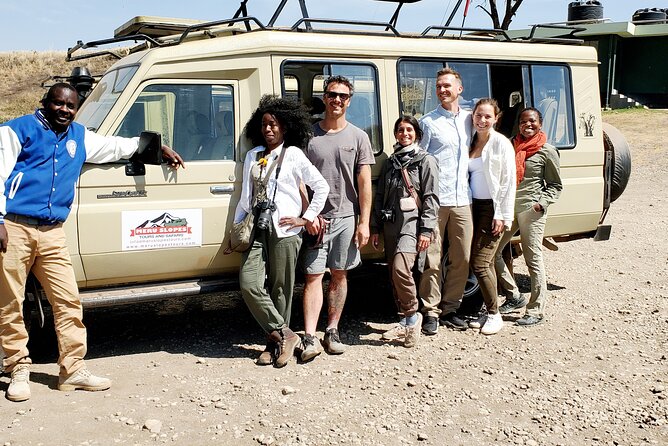
The itinerary is described as a private tour, meaning only your party should participate. Yet the overall wording also refers to joining-group camping safaris. Ask for a clear answer before paying: will you have your own vehicle and guide, or will you share them with other people? That detail affects comfort, flexibility, and value.
More Safaris in Arusha
- Serengeti Balloon Safari and authentic bush breakfast
★ 5.0 · 2,480 reviews - Balloon Safari & Bush Breakfast in Serengeti – Miracle Experience
★ 5.0 · 1,646 reviews - 4 Days Group Camping Safari
★ 5.0 · 1,101 reviews
Day 1: Arusha National Park’s forest and crater
The safari begins with a pickup from your Arusha hotel around 8 a.m., followed by a roughly 40-minute drive to Arusha National Park. This is a sensible first day because the park is close to town and offers a gentler introduction than an immediate long drive toward the western parks.
The entrance road passes through montane forest. Blue monkeys are a key sight, and the park is one of the northern circuit’s better places to see black-and-white colobus monkeys. Colorful turacos and trogons add interest for anyone who enjoys birdlife.
The main geographic feature is Ngurdoto Crater. Its steep sides surround a marshy floor where buffalo and warthogs may be seen. The planned visit lasts about eight hours, so you should have time for a proper game drive rather than a quick stop.
Arusha National Park is not included because it offers the largest herds or the most famous predator encounters. Its value is contrast. You start among trees, cool air, birds, and monkeys before moving into the more open country later in the trip.
Day 2: Tarangire’s elephants and baobab country
Day two begins around 8 a.m. with a drive of about three hours from Arusha to Tarangire National Park. The park lies roughly 115 kilometers from Arusha and covers about 2,800 square kilometers.
The schedule calls for a full-day game drive, followed by dinner and an overnight stay at Jambo Lodge. One timing note deserves attention: the published duration says eight minutes, which is clearly inconsistent with the promised full-day visit and three-hour transfer. Confirm the actual plan with the operator.
Tarangire takes its name from the Tarangire River, an important water source for wildlife. Elephants are the headline attraction, but the park also offers baobab trees, lions, leopards, and the possibility of seeing pythons climbing trees.
I like this stop because it has a strong visual identity. The baobabs give the park a different feel from the Serengeti plains, and elephants are often the animals people most hope to see early in a safari.
The drive from Arusha is not especially long by safari standards, but you will still spend much of the day in the vehicle. Your pop-up roof should give you a better view than a closed minibus, especially when animals are close to the road.
Day 3: The long road to central Serengeti
After breakfast, you pack your luggage into the safari vehicle and begin the journey toward Serengeti National Park. Lunch is carried in the vehicle, which keeps the day moving.
The route includes views of the Rift Valley and Ngorongoro Crater. You are expected to reach the Serengeti around 3 p.m., then continue with an evening game drive in the central area before dinner and a night at Seronera campsite.
This is a long transition day, but it is not empty travel. The changing scenery helps you understand how the parks connect, and reaching the Serengeti by afternoon gives you a chance to begin wildlife viewing before sunset.
Central Serengeti is known for its broad plains and strong year-round wildlife appeal. The great wildebeest migration passes through different areas at different times, so the central zone can be useful even when the herds are not near the Mara River.
You should pack your patience for this day. The road distance, game viewing, and campsite arrival make it a full eight-hour schedule. Keep your camera and binoculars within reach, not buried in your luggage.
More ways to see the Ngorongoro Crater:
- 3 Days Serengeti & Ngorongoro Group Camping Safari
★ 5.0 · 574 reviews - 5 Days Camping Tarangire, Serengeti & Ngorongoro crater & Visiting Maasai
★ 5.0 · 229 reviews - 4 Days Join Group tour Tarangire Serengeti and Ngorongoro crater
★ 5.0 · 219 reviews - 4-Day Safari from Arusha: Tarangire, Serengeti and Ngorongoro
★ 5.0 · 173 reviews
Days 4 and 5: Chasing the migration in the Serengeti
These are the heart of the safari. Both days are planned as full game-drive days, with the guide taking you toward key areas of the Serengeti and, during the migration season, toward the northern section.
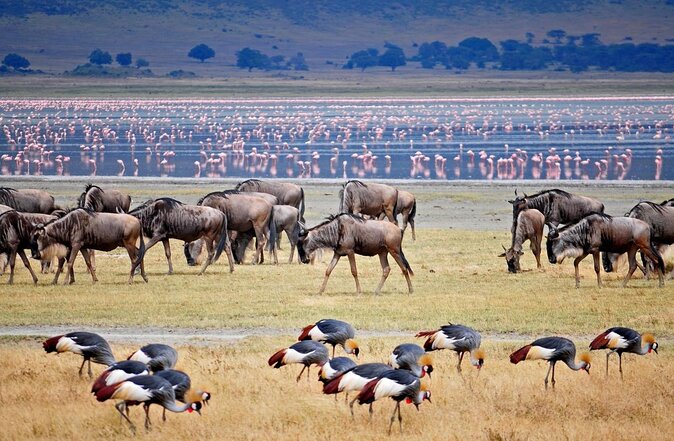
The northern Serengeti is especially important from July through October, when the wildebeest may gather near the Mara River. The schedule highlights Kogatende as a river-crossing area and notes that crossings can begin in July. The herds may cross back and forth, so there is no simple one-way timetable.
That uncertainty matters. A river crossing is a natural event, not a scheduled show. Even in the right month, you may spend time waiting, relocate to another viewing point, or see the herds near the river without witnessing a crossing. A good guide will need to adjust the day according to animal movement and park conditions.
The best stated period for seeing the migration is June through September. January through March is associated with calving. Those seasons offer different experiences: the first favors movement and possible river action, while the second focuses on young animals and predator activity around the calving areas.
I value the two full days because they give you more than one chance. If weather, animal movement, or road conditions reduce the payoff on one day, you still have another. The downside is distance. Central Serengeti to northern Serengeti can involve long drives, so ask exactly where you will camp on these nights and how much time will be spent driving each day.
The vehicle’s pop-up roof is useful here. You can stand or sit higher for a broad view, while the guide’s wildlife knowledge helps you understand animal behavior rather than simply collecting sightings. Past guests placed particular emphasis on guides such as Jacob, Nuru, Samwel, Benson, Douglas, Mohamed, Iddy, and Jerome Hotti. Requesting an experienced guide by name may not be possible, but you can ask about the assigned guide’s background.
Day 6: Sunrise, another game drive, and the road to the crater
Day six starts early, with breakfast at about 5:45 a.m. You then take an early morning game drive until around 11:30 a.m. This is a worthwhile start because sunrise hours offer a different mood from an afternoon drive, and the schedule specifically places you inside the Serengeti for the morning light.
After a hot lunch at the campsite, you pack the vehicle and continue with another game drive while heading toward Ngorongoro Crater. Dinner and overnight accommodation are planned at Simba campsite.
The day is listed at about ten hours, making it one of the more demanding sections. You should be comfortable with early starts and limited downtime. This is not a relaxed lodge holiday, but it does give you another substantial wildlife period before leaving the Serengeti.
Day 7: Ngorongoro Crater and Mto wa Mbu
The day begins around 5:30 a.m. After breakfast, you descend into Ngorongoro Crater for six to seven hours of game viewing. The crater is often described as a natural garden because animals gather in a relatively contained area with grassland, water, and varied habitats.
This is one of the stronger days for seeing a wide mix of wildlife. The plan specifically includes the big five, black rhino, birds, and flamingos. Lunch is served inside the crater, so you can remain close to the action instead of returning to camp halfway through the day.
The crater’s concentration of animals makes it a good counterpoint to the Serengeti. In the Serengeti, the reward often comes from distance, scale, and the possibility of a dramatic hunt. In Ngorongoro, you have a more compact setting where several types of wildlife may appear during one game drive.
After ascending, you return to Jambo Lodge for dinner and an overnight stay. The day also includes a walking tour in Mto wa Mbu village, with banana plantations, local food tasting, and a look at daily life. This is an important change of pace after several days of vehicle-based wildlife viewing.
The village visit is also one of the more grounded parts of the trip. You are not only moving between protected areas and camps. You get a little time with the communities and farms around the safari route. Ask how long the walk will last and what food tasting includes, since the schedule gives no further detail.
Day 8: Lake Manyara and the return to Arusha
After breakfast, you head to Lake Manyara National Park for a full-day game drive. The park is known for tree-climbing lions, flamingos attracted by algae in the lake, and a hot spring.
The tree-climbing lions are the headline sight, but they are not guaranteed. You might also spend time watching birds and searching the trees rather than seeing lions immediately. That is part of the appeal, but it is worth keeping expectations realistic.
The hot spring adds another small point of interest, while the lake gives the final day a different setting from the crater and open plains. After the park visit, the schedule includes a Maasai boma visit, where you can learn about local traditions and daily life, before returning to Arusha.
The final day is listed at about eight hours and is followed by dinner and an overnight stay in Arusha. Because the tour includes a night before and after the safari, this arrangement can make airport planning easier. Transfers in both directions between the international airport and Arusha are included.
One practical question remains: if you have a flight on the final evening, confirm the expected return time before booking. The schedule includes both a full game drive and a cultural stop, so you should not assume an early airport arrival.
Camping, meals, and the level of comfort
This is a camping safari, but it is not described as a bare-bones trip. You travel in an extended 4×4 safari jeep with a pop-up roof, use a professional English-speaking guide, and receive unlimited drinking water.
Breakfast, lunch, and dinner are included. The supplied details count eight breakfasts, eight lunches, and nine dinners, although the numbers do not perfectly match the eight-day schedule. Ask the operator to provide a day-by-day meal and accommodation chart so you know exactly what is included.
The camping nights at Seronera and Simba put you close to the parks and reduce the need to leave the area each evening. That saves time for game drives, but camping also means you should be ready for simple conditions and early mornings.
Several people praised the cooks, with Dula and Eric specifically mentioned in past feedback. One account described three homemade meals per day, while others praised the organization, food, and handling of the safari. Those details suggest that meals are treated as an important part of the trip, not an afterthought.
The included airport transfers and two Arusha nights add real value, especially if you are arriving internationally or want help with the first and last hotel arrangements. Visa costs, laundry, telephone use, beverages, tips, and gratuities remain your responsibility.
Is the displayed $0 price good value?
The advertised price is $0 per person, but that figure cannot be used to judge value. It is almost certainly a placeholder or incomplete price, so contact Meru Slopes Tours and Safaris for the real amount before making plans.
Once you have the actual quote, compare what it includes. The package covers park fees and taxes, airport transfers, two Arusha hotel nights, a 4×4 vehicle, guide, water, and meals. Those inclusions can make a quoted price more useful than a cheaper-looking safari that adds park fees, transfers, food, or accommodation later.
Ask for four details in writing:
- The final total price and currency
- Whether the safari is private or shared
- The exact camps and Arusha hotels
- Any extra charges for cultural visits, beverages, or changes to the route
The stated rating is five out of five from 32 ratings, with 100 percent recommending the experience. The strongest praise focuses on organization, responsive communication, guides, cooks, and the ability to see a wide range of animals. That is encouraging, but your own result will still depend on season, animal movement, road conditions, and the guide assigned to your vehicle.
Who should book this safari?
I would recommend it to you if you want a broad northern Tanzania circuit and do not mind moving camp several times. It suits people who want a serious chance at the migration, but also want Tarangire, Ngorongoro, Lake Manyara, and Arusha National Park in the same trip.
It is also a good fit for couples, families with older children, and first-time safari visitors who value having airport transfers and Arusha accommodation arranged. Past accounts include honeymoon trips, families, teenagers, and returning customers.
I would hesitate if you want a slow lodge holiday, dislike early breakfasts, or need a tightly timed schedule. The migration section can require long drives, and the route includes several full days in the vehicle.
Cancellation is free if you cancel at least 24 hours before the local start time. A cancellation inside that window is not refundable, and poor weather may result in a different date or a full refund.
Final verdict: a strong safari plan, once the details are confirmed
I like the structure of this safari. You get a gentle start in Arusha National Park, elephants and baobabs at Tarangire, four substantial Serengeti days, a focused Ngorongoro visit, and a final stop at Manyara. The combination gives you both famous wildlife and a few more personal touches, especially Mto wa Mbu and the Maasai boma.
The strongest reason to book is the time in the Serengeti. The strongest reason to pause is the unclear pricing and the mixed wording about private versus group travel.
Ask those questions, confirm the camps and meals, and choose your season carefully. If the final quote is fair and the safari is genuinely private as stated, this can be a very good-value way to see northern Tanzania in one well-filled week.
FAQ
How long is the safari?
The safari lasts approximately eight days, beginning and ending in the Arusha area.
Which national parks and areas are included?
The route includes Arusha National Park, Tarangire National Park, Serengeti National Park, Ngorongoro Crater, and Lake Manyara National Park. It also includes visits to Mto wa Mbu village and a Maasai boma.
Is airport pickup included?
Yes. Transfers in both directions between the international airport and Arusha are included.
Is accommodation in Arusha included?
Yes. Two nights of accommodation in Arusha are included, one before the safari and one after it.
What type of vehicle is used?
The safari uses an extended 4×4 vehicle with a pop-up roof for game viewing.
When is the best time to see the wildebeest migration?
The best stated chance for the migration is from June through September. For Mara River crossings in northern Serengeti, July through October is highlighted. Wildebeest calving is associated with January through March.
Are meals included?
Yes. Breakfast, lunch, and dinner are included in the package. The supplied meal counts should be confirmed with the operator because they list eight breakfasts, eight lunches, and nine dinners.
What is not included?
Tanzania visa costs, personal expenses such as laundry, telephone use, and beverages, plus tips and gratuities for the guide and cook, are not included.
More Tarangire Safaris
- 2 Days Tarangire and Ngorongoro Group Camping Safari
★ 5.0 · 146 reviews - 4 Days Tarangire Serengeti Ngorongoro Crater
★ 5.0 · 117 reviews - 3 Days Tarangire, Ngorongoro & Lake Manyara Group Camping Safari
★ 5.0 · 102 reviews - Tarangire Day Tour
★ 5.0 · 95 reviews
More Serengeti Safaris
- 5-Day Highlights mid-Range Crater, Serengeti, Tarangire
★ 5.0 · 296 reviews - 3-Day Classic Serengeti Safari
★ 5.0 · 263 reviews - Private 6-Day Tarangire Manyara Crater and Serengeti with Mid-Range Lodges
★ 5.0 · 238 reviews - 10-Day Serengeti Wildebeest Migration Safari from Arusha
★ 5.0 · 218 reviews
Just added around Arusha
- 5 Days Safari Tarangire, Serengeti, and Ngorongoro Crater★ 5.0 · 3 reviews
- Love lives in Africa★ 5.0 · 3 reviews
- 5 Days of Safari, Culture & Hot Springs – Tour from Arusha★ 5.0 · 3 reviews
- Arusha National Park Safari by Jeep★ 4.5 · 3 reviews
- 5Days Family _Group Tour Lodging Mid-Range in the Jungle★ 5.0 · 3 reviews
- Serengeti & Ngorongoro 3 Days Budget Safari★ 5.0 · 3 reviews
- 2 Days Tarangire and Ngorongoro Crater Tour★ 5.0 · 3 reviews
- 7 Days PRIVATE Best of Tanzania Safari *Departing everyday*★ 5.0 · 3 reviews
Serengeti Safaris, compared.

Serengeti Balloon Safari and authentic bush breakfast
Read our review →
Balloon Safari & Bush Breakfast in Serengeti – Miracle Experience
Read our review →
3 Days Serengeti & Ngorongoro Group Camping Safari
Read our review →
5-Day Highlights mid-Range Crater, Serengeti, Tarangire
Read our review →


Private 6-Day Tarangire Manyara Crater and Serengeti with Mid-Range Lodges
Read our review →
5 Days Camping Tarangire, Serengeti & Ngorongoro crater & Visiting Maasai
Read our review →Browse the lists this tour appears in