
Reviewed · NORTHERN CIRCUIT SAFARIS
Kilimanjaro Northern Circuit Route 8 Days
Eight days can change your view of mountains. This Kilimanjaro Northern Circuit climb appeals to me for two clear reasons: quiet northern slopes and a slow, careful altitude plan. You begin on the Lemosho side, then leave the busier paths behind and circle Kibo before joining the summit route. The main drawback is the length and cost: at $3,000 per person, with a 13 to 16-hour summit day, this is a serious commitment rather than a casual holiday add-on.
I also like the level of mountain support here. You get trained guides, porters, cooks, emergency oxygen, a Gamow bag, medical monitoring, purified water, private camp toilet facilities, and evacuation cover through AMREF Flying Doctors. The route’s longer schedule gives your body more time to adjust, but no itinerary can remove altitude risk or guarantee the summit.
In This Review
- Key points to know before booking
- Why the Northern Circuit takes eight days
- Day 1: Lemosho forest and the first camp
- Day 2: Crossing toward the Shira Plateau
- Day 3: Shark’s Tooth and the high desert
- Day 4: Remote valleys on Kibo’s northern face
- Day 5: Completing the northern traverse
- Day 6: The steep climb to School Hut
- Day 7: A very long route to Uhuru Peak
- Day 8: Mweka forest and the park gate
- Camp comfort and safety equipment
- What the $3,000 price really covers
- Who should choose this route
- Should you book the Northern Circuit?
- FAQ
- How long is the Kilimanjaro Northern Circuit climb?
- What is the price per person?
- Is this a private climb?
- What route does the climb use?
- What is included in the package?
- Is personal trekking equipment included?
- What happens if I need to cancel?
Key points to know before booking
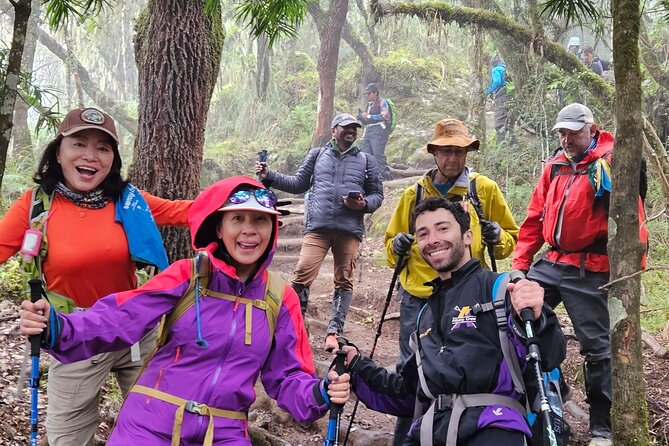
- The quietest route profile: After beginning on Lemosho, you cross the remote northern side of Kilimanjaro, away from the more crowded southern trails.
- Seven nights on the mountain: The route uses expedition tents, a mess tent, hot washing water, fresh meals, and a private flush toilet tent.
- The summit day is extreme: Expect to hike for 13 to 16 hours, reach 5,895 meters, and descend to about 3,100 meters.
- Strong safety provisions: A wilderness first responder trained guide, pulse oximeter, vital-sign checks, emergency oxygen, radio contact, and a Gamow bag are included.
- Private group format: Only your own party participates, with pickup offered and group discounts available.
- Porter care is addressed: Bags are weighed at the gate, and each porter’s load is limited to 20 kilograms.
Why the Northern Circuit takes eight days
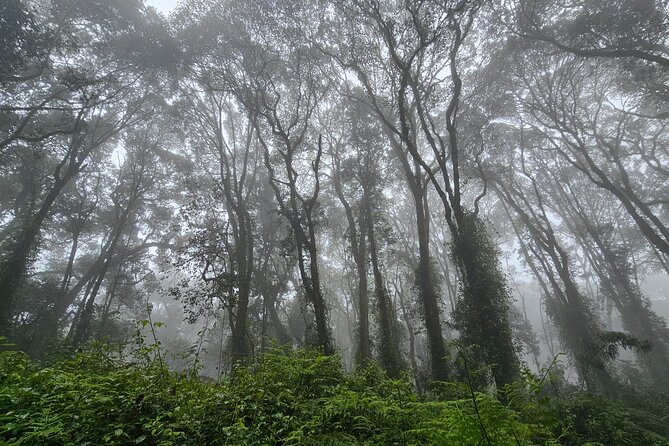
Kilimanjaro is not a technical climb in the usual mountaineering sense, but altitude makes it demanding. The Northern Circuit takes a broad arc around the mountain, building height gradually before the final push to Uhuru Peak.
That extra time is the route’s main selling point. You spend several days walking high, sleeping at different elevations, and giving your body a better chance to adjust. The itinerary also gives you scenery that many shorter routes do not offer, including the northern face of Kibo, views of Mawenzi, the Shira Plateau, lava formations, and the Northern Ice Field.
The trade-off is simple. You pay more in time, camp nights, food, staff, and park fees. You also spend more days carrying fatigue. I would choose this route for acclimatization and solitude, not because every day is easy.
More Kilimanjaro routes and climbs:
- Kilimanjaro climb by Lemosho Route (7-day)
★ 5.0 · 651 reviews - Kilimanjaro climb, Machame Route (7-day)
★ 5.0 · 262 reviews - Kilimanjaro Climbing Lemosho Route 8 Days.
★ 5.0 · 186 reviews
Day 1: Lemosho forest and the first camp
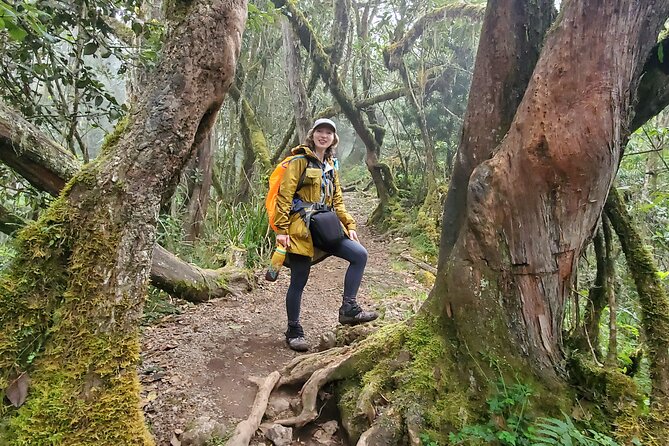
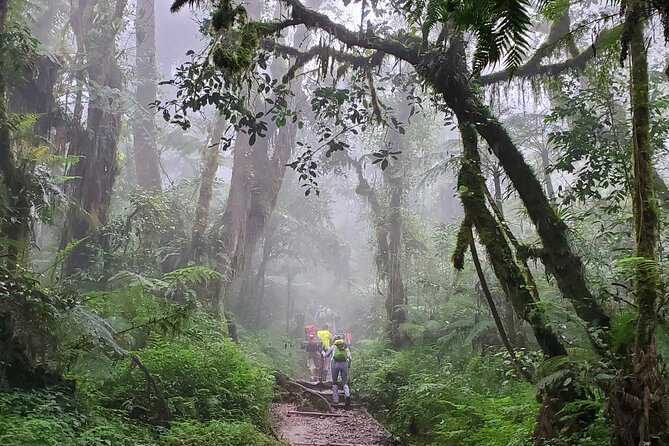
After breakfast, a four-wheel-drive vehicle takes you toward Londrossi Gate. This is where your guides and mountain crew handle national park registration and weigh the duffle bags. The 20-kilogram porter limit matters. It protects the crew and also forces you to pack sensibly.
From the gate, the vehicle continues for about 11 kilometers on narrow dirt roads through pine plantations to the Lemosho Glades. The hike then begins in montane rain forest.
You walk about 7 kilometers in four to five hours, rising from roughly 1,981 meters to 2,780 meters. This is a gentle opening by Kilimanjaro standards, but it is wise to treat the first day as a pacing lesson. You are not trying to prove anything yet. Walk slowly, drink regularly, and save your legs.
Day 2: Crossing toward the Shira Plateau
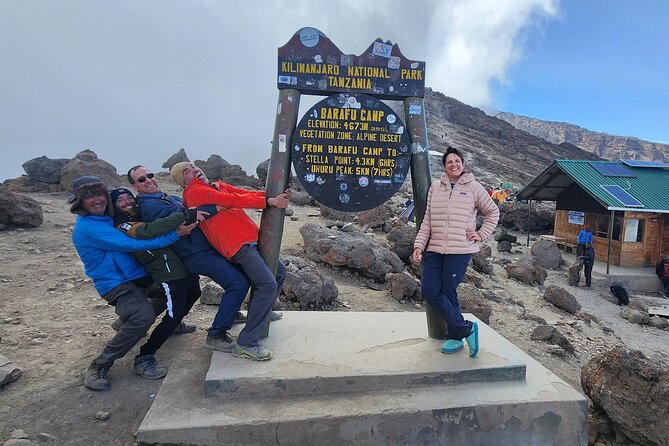
Day two is longer, with about 12 kilometers and seven hours of walking. The trail winds along narrow ridges as the forest gives way to moorland.
The plant life becomes more unusual as you climb. Giant heather and erica appear first, followed by giant lobelia and giant groundsel. These large, strange-looking plants make Kilimanjaro feel less like an ordinary hiking trip and more like a journey through several climate zones in one week.
You rise from 2,780 meters to about 3,511 meters. The route’s instruction is pole pole, Swahili for slowly slowly. Take it literally. A fast second day may feel satisfying, but it does little for your summit chances if it leaves you tired or headachy.
Day 3: Shark’s Tooth and the high desert
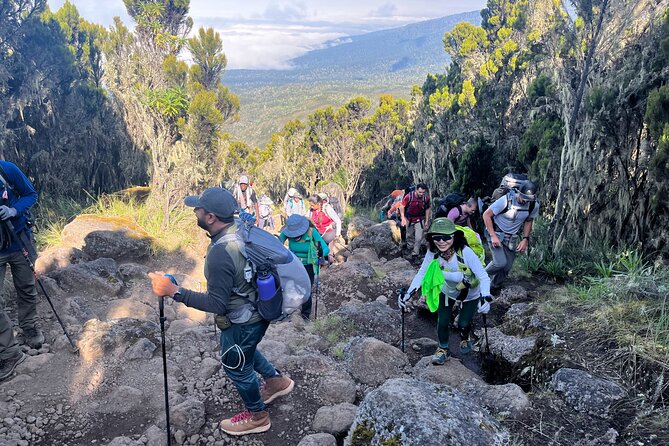
The third day covers roughly 9 kilometers in five to six hours. You head north through heather and into an alpine desert, ending at around 4,175 meters.
The natural landmark called Shark’s Tooth gives the day a clear focus. You can expect a stark setting of rock, dust, hardy everlasting flowers, and small senecios. Above you, a broad glacier-carved bowl rises toward the Kibo Massif and Northern Ice Field. Below, the Shira Plateau opens out in wide views.
This is an excellent acclimatization day because you gain height steadily without rushing. It is also the point where the mountain begins to feel severe. The air is thinner, vegetation is sparse, and the scenery can be beautiful without offering much shelter from sun or cold.
More northern circuit safaris:
- Kilimanjaro climb, Northern Circuit route (8-day)
★ 5.0 · 40 reviews - Private 4-Days Northern Circuit National Parks in Tanzania
★ 4.5 · 26 reviews - 6 Days Tanzania Northern Circuit Safari
★ 4.5 · 7 reviews - 9 Days Kilimanjaro Hiking or Climbing via Northern Circuit route
★ 5.0 · 5 reviews
Day 4: Remote valleys on Kibo’s northern face
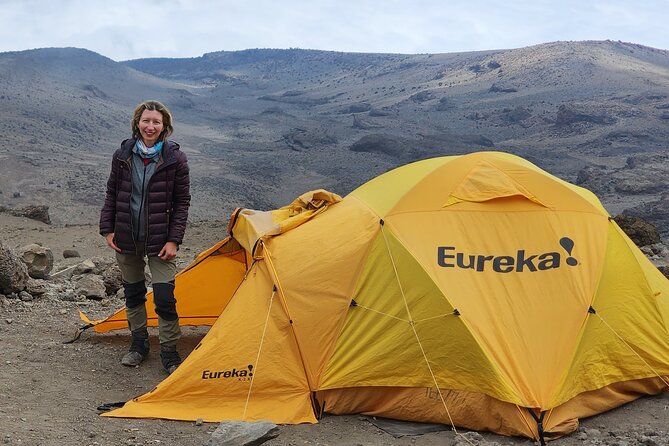
Day four is one of the more strenuous walking days. You cover about 12 kilometers in seven to eight hours, moving from 4,175 meters to a camp near 4,020 meters.
The numbers can look reassuring because you finish slightly lower than you started. Do not mistake that for an easy day. You climb and descend repeatedly through valleys below Kibo, gaining and losing height as you cross the northern face.
This constant up-and-down walking is the price of the Northern Circuit’s quiet setting. Each ridge gives a new view, and vegetation changes from valley to valley, but the repeated climbs can wear you down. Pofu Campsite is remote and rocky, with a spare, barren feel. It is not a place for comfort, but it gives you the solitude this route promises.
Day 5: Completing the northern traverse
You continue through rocky alpine desert and thin moorland for about 7 kilometers. The six-hour day begins at approximately 4,020 meters and ends near 3,960 meters at Third Cave Camp.
Kibo and Mawenzi dominate the view. Seeing both peaks from this side helps you understand Kilimanjaro as a volcanic massif rather than just a single summit. The path still rises and falls, but the shorter distance gives you time to focus on your breathing and conserve energy.
Reaching Third Cave Camp marks the end of the Northern Circuit portion. From here, the climb turns toward the summit preparation phase. A good camp routine matters now: eat what you can, organize your summit clothing, refill water, and rest even if sleep is difficult.
Day 6: The steep climb to School Hut
Day six is short in distance but sharp in altitude gain. You hike about 6 kilometers in around five hours, climbing from 3,960 meters to roughly 4,790 meters at School Hut.
The gain is approximately 780 meters. You should expect a slow pace, frequent stops, and a strong reminder that the summit is close but not yet earned. The high desert scenery is open and severe, with views toward Kibo Peak.
School Hut is used as a training facility for park rangers and sits in an impressive position. The practical purpose of this day is to put you near the summit while leaving enough time to rest before the midnight departure. Your guide should monitor how you are coping. The included pulse oximeter, vital-sign checks, and emergency equipment are particularly relevant here.
Day 7: A very long route to Uhuru Peak
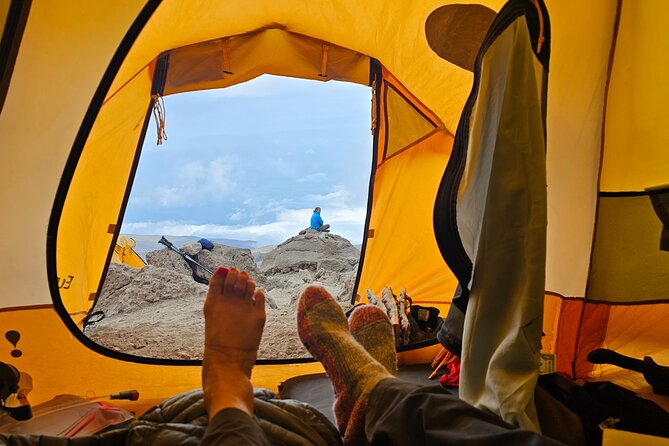
Summit day begins around midnight. After a warm drink and light snack, you start toward Gilman’s Point and Stella Point. The total day lasts 13 to 16 hours, covers about 19 kilometers, reaches 5,895 meters, and ends near 3,100 meters.
This is the day to judge the climb honestly. The ascent comes in darkness, cold, thin air, and stone scree. Progress can feel slow. The support of your guide and crew matters more here than on any earlier day.
The route reaches Gilman’s Point first, then Stella Point on the crater rim. At Stella Point, you have time to rest, eat, and look across the clouds. The final two-hour push to Uhuru Peak is often snow-covered and physically punishing. The last section may be short on a map, but altitude makes every step count.
At Uhuru Peak, the highest point is 5,895 meters. The itinerary includes wine and champagne for the summit, a small celebration after a very large effort. If you reach Stella Point but cannot continue to Uhuru, the stated certificate distinction is gold for Uhuru Peak and green for Stella Point.
The descent is not an afterthought. After the summit, you continue down to the camp around 3,100 meters. Your knees and feet will likely feel the strain, and the long descent can be as tiring as the climb.
Day 8: Mweka forest and the park gate
The final day takes three to four hours and covers about 8 kilometers. You descend from about 3,100 meters to 1,800 meters through Mweka rain forest.
The trail is steep in places and can become slippery when wet. It follows the crest of a broad ridge between two river valleys before reaching a road for the final 40-minute walk to Mweka Park Gate.
At the gate, you stop for a picnic lunch and successful climbers receive certificates from the Kilimanjaro National Park Authority. After the ceremony, a transfer takes you back to your hotel. Your legs may still be complaining, but the change from alpine rock to wet forest is a welcome final chapter.
Camp comfort and safety equipment
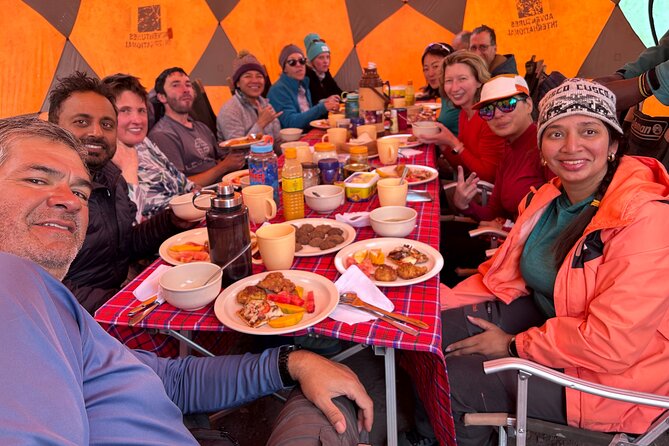
This is not a bare-bones camping trip. Two clients share a three-person expedition tent, giving you more room for equipment than a tight two-person shelter. The package includes a mountaineering mattress, walk-in mess tent, lightweight tables, luxury chair with backrest, shower and washing facilities, and a private tented flush toilet.
You also receive a bowl of hot washing water morning and evening, plus a hot towel at camp. Those details sound minor before the climb. At altitude, they can make camp feel far more manageable.
Food is another strong point. The package promises large portions of fresh, healthy meals, with breakfast, lunch, and dinner provided during the route. Purified water is supplied on the mountain. A cook and porters are included, so you are not carrying camp equipment or preparing meals yourself.
Safety provisions are unusually detailed for a trekking package. The equipment and services include:
- Emergency oxygen
- A Gamow bag, a portable hyperbaric chamber
- An expedition medical kit
- Pulse oximeter and vital-sign monitoring
- Two-way radio and mobile phone
- Medical evacuation through AMREF Flying Doctors
- A professional guide trained as a wilderness first responder, or an equivalent assistant guide
These tools do not make altitude sickness harmless. They do show that the operator has planned for serious problems instead of treating them as an unlikely nuisance.
What the $3,000 price really covers
At $3,000 per person, the price is high beside shorter Kilimanjaro routes. The value comes from the eight-day design and the amount of support included.
Your fee covers Kilimanjaro National Park entrance, camping or hut fees, rescue fees, government taxes, and 18 percent VAT on park entrance fees. It also pays the guides, cooks, and porters. Airport transfers and return transfers between the Arusha hotel and park gate are included, along with two hotel nights on bed and breakfast at either Ameg Lodge or Salinero Hotels.
You are also paying for a private trip, rather than joining a mixed party. That can matter if your group wants its own pace and a more personal relationship with the guide team. Group discounts are available, which may improve the value for families or friends climbing together.
The price does not cover international airfare, visas, personal trekking equipment, laundry, room service, souvenirs, communication charges, immunizations, staff tips, or extra medical and evacuation costs. Meals caused by illness or a change in your planned itinerary are also excluded. Add these costs before you decide that $3,000 is your full trip budget.
The company’s wider service record includes praise for staff members named Joseph, Kisali, Goodluck, and Samuel. That feedback points to friendly organization, strong meal service, help with practical needs, and good arrangements around travel testing. Staff quality can vary by departure, so it is sensible to ask who will lead your climb.
Who should choose this route
I would recommend the Northern Circuit to a fit hiker who values time, quieter trails, and a measured approach to altitude. It also suits families with older teenagers who can manage long days. One past group included two 18-year-olds, and the longer route was valued for its extra acclimatization time.
You should be comfortable with basic camping, long walking days, steep descents, cold conditions, and the possibility of poor sleep. The summit day is the main test. If a 13 to 16-hour day sounds unreasonable, choose a different mountain plan rather than hoping enthusiasm will carry you through.
This is less suitable for someone with limited time or a strong dislike of repeated ascents and descents. It is also not a good choice if you want a soft adventure with a guaranteed summit. Most people can participate, but the climb still requires good physical preparation and honest communication with the guide.
The booking terms are practical. Confirmation is provided at booking, pickup is offered, and the activity is private. You can cancel at least 24 hours before the local start time for a full refund. Poor weather may lead to a different date or a full refund.
Should you book the Northern Circuit?
Book it if you want the longest and quietest standard route on Kilimanjaro, and if you value acclimatization more than speed. The northern traverse, unusual plant zones, remote camps, full mountain crew, and detailed emergency provisions make the $3,000 price easier to justify.
Think twice if you have only a few spare days, dislike camping, or are not ready for the summit-day schedule. The route improves your preparation, but it does not remove the demands of altitude.
For a committed climber who wants more time on the mountain and fewer crowded sections, this is one of the strongest choices offered by Jaribu Africa Adventures. Pack lightly, walk pole pole, and treat the summit as the goal, not a promise.
FAQ
How long is the Kilimanjaro Northern Circuit climb?
The experience lasts approximately eight days. The route includes seven nights on the mountain before the final descent and transfer to your hotel.
What is the price per person?
The listed price is $3,000 per person. Group discounts are available.
Is this a private climb?
Yes. Only your own group participates in the activity.
What route does the climb use?
The climb begins on the Lemosho side, crosses the Shira Plateau, then follows the northern slopes of Kilimanjaro before joining the summit route through Gilman’s Point and Stella Point.
What is included in the package?
The package includes park entrance, camping and rescue fees, airport transfers, hotel accommodation on bed and breakfast, tents, mattresses, meals on the mountain, purified water, guides, cooks, porters, emergency oxygen, medical equipment, communication devices, and AMREF Flying Doctors evacuation cover.
Is personal trekking equipment included?
No. Personal trekking equipment is not included. International airfare, visas, immunizations, laundry, souvenirs, room service, staff gratuities, and some extra medical or communication costs are also excluded.
What happens if I need to cancel?
You can cancel at least 24 hours before the local start time for a full refund. Cancellations or changes made less than 24 hours before the start are not accepted for a refund. If poor weather causes the experience to be canceled, you are offered another date or a full refund.
Just added around Moshi
- Moshi: Lake Chala Tour: Hiking &/or Kayaking★ 4.5 · 3 reviews
- 3 Days Tanga Exclusive Beach Holiday★ 5.0 · 3 reviews
- Serengeti Wildebeest Migration.★ 5.0 · 3 reviews
- Chemka Hotpsrings E-Bike Day Trip★ 5.0 · 3 reviews
- Explore 1 day Ngorongoro Crater Budget Group Safari from Arusha★ 5.0 · 3 reviews
- Explore the 360° of Kilimanjaro★ 5.0 · 3 reviews
- Affordable Short Tanzania Safari (2 Days Camping Safari)★ 5.0 · 3 reviews
- Rongai Route 7 Days★ 5.0 · 3 reviews
Northern Circuit Safaris, compared.
5 Days Best of Tanzania Luxury Safari Northern Circuit
Read our review →
Kilimanjaro climb, Northern Circuit route (8-day)
Read our review →
Private 4-Days Northern Circuit National Parks in Tanzania
Read our review →
7 Days Classic Safari Central Northern Circuit
Read our review →
5 Days Best of Northern Circuit Budget Safari in Tanzania
Read our review →
6 Days Luxury Northern Circuit Safari – A Glimpse of Tanzania Adventure
Read our review →Browse the lists this tour appears in