
Reviewed · KILIMANJARO TREKS
5 Days cheapest Kilimanjaro Marangu Route
Africa’s highest summit is no small walk. This five-day Marangu Route climb gives you Kilimanjaro’s most direct path, hut sleeping instead of tents, and a private trip arranged by Moorland Safari and Trekking. I like the simple logistics and the chance to sleep in dormitory huts, especially if carrying camping gear sounds less appealing.
I also like the route’s changing scenery, from rainforest to open moorland and then the stark saddle below Kibo. The main concern is the schedule: five days is a tight acclimatization plan, so the gradual trail does not remove the risk of altitude sickness. You also walk the same route up and down, and Marangu is usually the busiest Kilimanjaro route.
In This Review
- Key Points Before You Book
- Why Choose Marangu for a Five-Day Kilimanjaro Climb?
- Day One: Marangu Gate to Mandara Hut
- Day Two: Moorland Views on the Way to Horombo
- Day Three: Crossing the Saddle to Kibo Hut
- Day Four: Gilman’s Point and Uhuru Peak
- Day Five: The Long Descent to Marangu Village
- The Huts, Meals, and Basic Mountain Comforts
- What the $1,869.24 Price Buys You
- Moorland Safari and Trekking: Personal Service Matters
- Who Should Book This Route?
- Should You Book the Five-Day Marangu Climb?
- FAQ
- Where does the Kilimanjaro climb begin?
- How long does the Marangu Route experience last?
- Do I sleep in tents on this route?
- Are mattresses and pillows provided?
- Is an extra acclimatization day available?
- How high is Uhuru Peak?
- Is this a private tour?
- What is the cancellation policy?
Key Points Before You Book
- Hut accommodation instead of camping: Mandara and Kibo Huts have 60 bunk beds each, while Horombo Hut has 120. Mattresses and pillows are supplied, but you still need a sleeping bag.
- A direct southeast approach: The Marangu trail is known for a steady path and gentler slopes, making it one of the more approachable routes physically.
- Five days means limited acclimatization: Horombo is often used for an extra rest day, but that additional night costs extra and must be requested.
- The summit push begins around 11:30 p.m.: You climb through the cold and darkness toward Gilman’s Point, then continue to Uhuru Peak.
- Private group format: Only your group takes part, with pickup offered and return transport to your Arusha hotel.
- Strong practical praise for the operator: Nasir, the host and owner, helped one couple choose and plan the Marangu route, while other comments praise the organization and service.
Why Choose Marangu for a Five-Day Kilimanjaro Climb?
Marangu is Kilimanjaro’s oldest and best-established route. It comes up from the southeast and follows one clear trail through forest, moorland, high desert, and finally the volcanic upper slopes of Kibo.
Its nickname, the Coca-Cola Route, reflects its popularity and relatively straightforward path. The trail has a gradual feel compared with some other routes, and you sleep inside basic huts rather than pitching a tent each night. That can make a real difference after a long day at altitude.
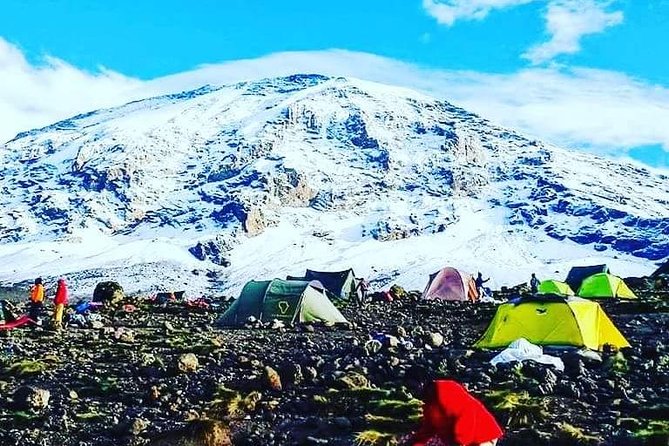
The hut setup is practical, not luxurious. Mandara and Kibo each have 60 bunk beds, while Horombo has 120. Mattresses and pillows are provided, but you must bring or rent a sleeping bag. Dining halls are communal. Washrooms range from flushing toilets and running water at the lower huts to long-drop toilets and bucket water higher up.
I see two clear advantages here. First, you avoid the extra work and discomfort of tent camping. Second, the route is easy to understand. You are not zigzagging across several valleys or changing trails repeatedly. You follow the mountain upward, then return by the same path.
That same simplicity creates the route’s main weaknesses. Marangu is crowded, and the ascent and descent use the same trail, so you see less variety than on routes that return by another path. The five-day schedule is also short for a climb to 5,895 meters. A steady trail helps your legs, but it cannot fully prepare your body for thin air.
More Kilimanjaro routes and climbs:
- 8-Day Small-group Lemosho Kilimanjaro Summit Trekking
★ 5.0 · 186 reviews - 7-Day Machame Kilimanjaro Summit Tour from Arusha
★ 5.0 · 125 reviews - Mountain Kilimanjaro Day Hike
★ 5.0 · 102 reviews
Day One: Marangu Gate to Mandara Hut
The day begins with breakfast and a briefing, followed by a drive of about 45 minutes to Marangu village and the Kilimanjaro National Park gate. Park registration comes first. Then you begin walking through the rainforest toward Mandara Hut.
The first day covers about 8 kilometers, or 5 miles, and takes roughly three to four hours. The listed altitude gain is given as 840 meters, although the accompanying feet figure is inconsistent, so you should treat the numbers as an approximate guide rather than a precise measurement.
The rainforest is a pleasant opening to the climb. The path feels greener and more enclosed than the upper sections, and the air is usually less severe than it will be later. Even so, do not race this first section. A slow pace gives you time to settle into the rhythm of walking uphill with a pack.
Mandara Hut sits at about 2,740 meters, or 9,000 feet. It is the first night in the dormitory system. The accommodation is basic, with bunk beds, mattresses, and pillows. Bring a sleeping bag, as one is still required despite the bedding provided.
If you have enough energy, ask about the side walk to Maundi Crater. It is a useful extra stop because it offers views toward northern Tanzania and gives you a first sense of the open country beyond the forest. This is one of the best small additions to the first day, especially if the weather is clear.
Day Two: Moorland Views on the Way to Horombo
After breakfast, the walk to Horombo Hut begins at about 8:30 a.m. The distance is around 12 kilometers, or 7.2 miles, and the walking time is estimated at five to seven hours.
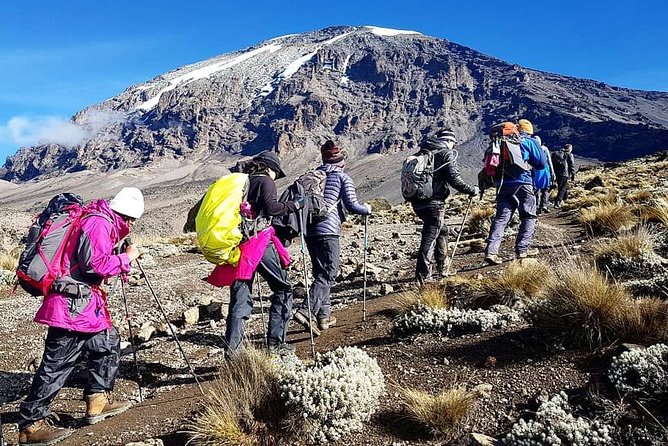
After roughly an hour, you leave the forest behind and enter open moorland. This change is one of the memorable parts of the route. The trees thin out, the views expand, and Kilimanjaro begins to feel less like a forest walk and more like a high mountain climb.
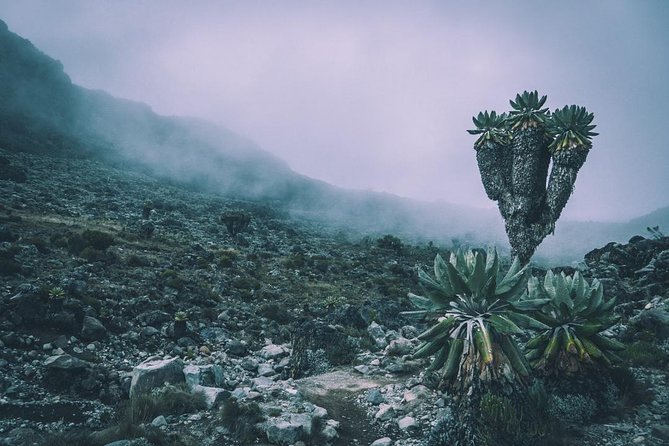
On clear days, you can see both Kibo and Mawenzi. Kibo is the main summit cone, while Mawenzi has a more jagged shape. Giant lobelias and groundsels may appear beside the trail, adding unusual plant life to the broad, open slopes.
Horombo Hut is at about 3,720 meters, or 12,200 feet, and is a major stopping point on Kilimanjaro. Many climbing plans use it for an extra acclimatization night. This five-day schedule does not include that extra day, but it can be added on request for an additional cost.
I would take that option seriously. The route may feel moderate underfoot, yet the altitude keeps increasing quickly. An extra day at Horombo can make the summit plan less rushed and gives you more time to notice how your body is responding. The supplied price and schedule cover five days, so confirm the cost and revised plan before booking an extra night.
Horombo also has the largest hut capacity on this route, with 120 bunk beds. That makes it a social and busy stop. If you value a quiet mountain night, keep your expectations modest. This is dormitory lodging, not a private mountain cabin.
Day Three: Crossing the Saddle to Kibo Hut
Day three takes you from Horombo toward Kibo Hut. The walk is about 9.5 kilometers, or 5.7 miles, and takes five to seven hours. The trail reaches the last water point before crossing the saddle between Mawenzi and Kibo.
The vegetation becomes thinner as you climb. Upper moorland gives way to a dry, desert-like area, with little shelter and fewer signs of plant life. This section can feel stark after the forest and moorland, but it gives you a clear sense that the summit is now close.
Kibo Hut is at about 4,750 meters, or 15,580 feet. The hut has 60 bunk beds and basic facilities. Water is more limited here, and washrooms are simpler, with long-drop toilets and bucket water. You should expect the most basic conditions of the trip at this point.
Dinner comes at Kibo, followed by a short rest before the midnight climb. The schedule calls for preparing around 11:30 p.m. That timing matters. You are not simply walking a few hours after breakfast. You will try to sleep in the afternoon or evening, eat, then get up while most people are still in bed.
Keep your summit clothing, headlamp or flashlight, sunglasses, camera, and warm layers ready before resting. The supplied program specifically calls for a flashlight, camera, sunglasses, and warm clothes. Organizing them early saves time when you are tired and the hut is dark.
A few more trips of this kind worth comparing:
- 5 Days Group Camping Safari
★ 5.0 · 730 reviews - 5-Day Highlights mid-Range Crater, Serengeti, Tarangire
★ 5.0 · 296 reviews - 5 Days Camping Tarangire, Serengeti & Ngorongoro crater & Visiting Maasai
★ 5.0 · 229 reviews - Tanzania Simba Safari – 5 Days
★ 5.0 · 217 reviews
Day Four: Gilman’s Point and Uhuru Peak
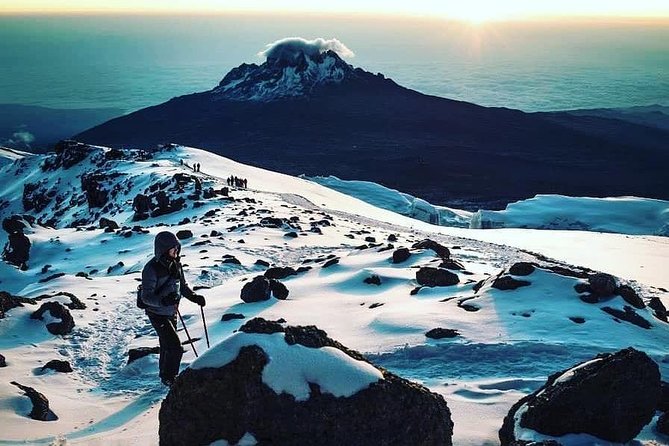
Summit day is the hardest part of the climb. You wake very early for coffee, tea, or hot chocolate and a small snack, then begin the steepest section under the night sky.
The walk to Gilman’s Point is listed at about 5.5 kilometers, or 3.5 miles, and takes four to seven hours. Gilman’s Point sits on the crater rim at approximately 5,681 meters, or 18,640 feet. The supplied itinerary gives a slightly different altitude figure, so treat all summit elevations as approximate.
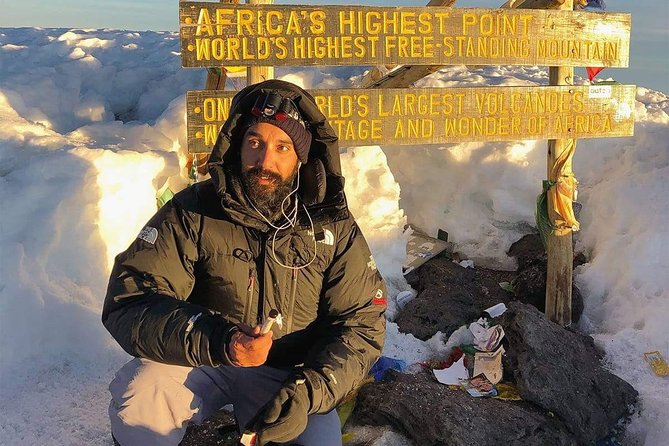
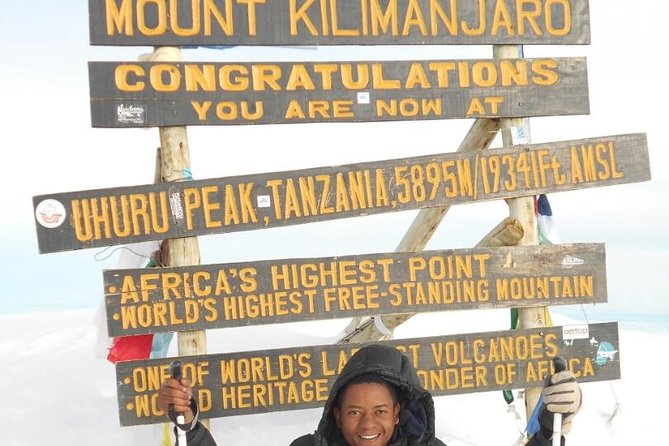
From Gilman’s Point, the route continues toward Uhuru Peak. The final section takes another one to two hours and reaches 5,895 meters, or 19,340 feet, the highest point in Africa.
This is where the short schedule matters most. You have already gained altitude on three consecutive days, and the summit attempt begins after a brief rest rather than a full acclimatization day. The route’s moderate slope does not make the air easier to breathe. You need to follow your guide’s pace, monitor how you feel, and understand that reaching the summit is never guaranteed.
At the top, you have time for photographs before descending to Kibo Hut. You return there for breakfast and a rest, then continue down to Horombo Hut for dinner and the night. This makes for a very long day. The distance described for the summit section is only part of the day’s total movement, since you go from Kibo to the crater rim, back to Kibo, and then onward to Horombo.
The reward is a full summit attempt rather than a partial high point. Gilman’s Point is already a major achievement, but Uhuru Peak is the goal for those who can safely continue. Pack patience as carefully as you pack warm clothing.
Day Five: The Long Descent to Marangu Village
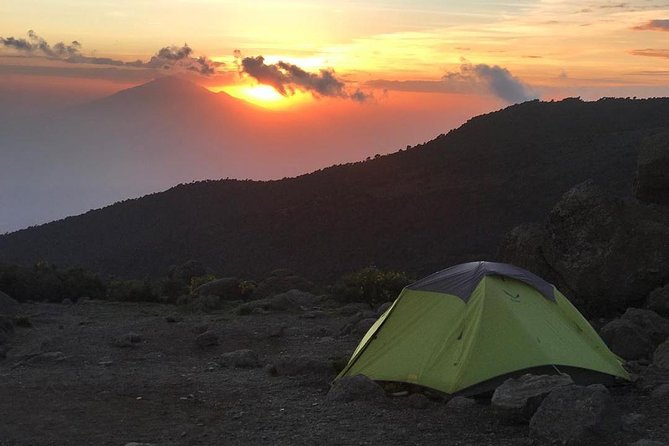
The final day is a steady downhill walk through moorland and forest. You leave Horombo after breakfast, descend to Mandara Hut at about 2,700 meters, then continue through the lush forest to the national park gate at Marangu, about 1,830 meters.
The walking distance is listed as 20 kilometers, or 12.5 miles, with about five hours on the trail. The itinerary also shows an altitude gain of 1,840 meters, or 6,040 feet, but this is a descent, not a gain. The distance and descent are the useful figures for planning.
Downhill walking can sound easy after summit day, but tired knees and feet may disagree. Use trekking poles if you have them, keep your pace controlled, and do not treat the last day as a race. The forest section gives you a pleasant change from the bare upper mountain, but the long descent still requires stamina.
A vehicle meets you at Marangu village and drives you back to your hotel in Arusha. That return transfer is valuable after five days of walking. It also means the experience begins and ends with arranged transport rather than leaving you to organize your own connection from the gate.
The Huts, Meals, and Basic Mountain Comforts
Marangu’s huts are the feature that makes this route different. You sleep in bunk rooms rather than tents, and mattresses and pillows are supplied. You still need a sleeping bag, so do not assume the huts provide complete bedding.
Mandara and Kibo each have 60 beds. Horombo has 120, making it the largest overnight stop. The communal dining halls provide a shared setting for meals, but the arrangement is functional rather than private.
Facilities become more basic as you climb. Lower huts have flushing toilets and running water. Higher huts use long-drop toilets and buckets of water. This is not a route for someone expecting hotel-style bathrooms at altitude. It is a route for someone who values a roof, a bed, and a simple place to eat.
I would pack wet wipes, hand sanitizer, and a warm sleeping bag suitable for high-altitude nights. Those items are practical responses to the hut conditions described in the program. The supplied details do not specify a full packing list, so ask Moorland Safari and Trekking what clothing, meals, water, and equipment are included before departure.
What the $1,869.24 Price Buys You
At $1,869.24 per person, this is not a cheap holiday, but a Kilimanjaro climb includes more than the walking itself. The package offers pickup, park admission, a private group format, hut accommodation, and transport back to Arusha. Those elements reduce the number of arrangements you must handle yourself.
The strongest value is the hut route. Camping can require more equipment and adds another layer of camp logistics. Here, you have fixed sleeping huts, communal dining spaces, and a direct trail. That does not make the climb easy, but it can make the trip feel more manageable.
The price is harder to judge without a full list of inclusions. Confirm whether meals, drinking water, transfers from a specific Arusha hotel, guide and support staff, park fees, rescue cover, and equipment rental are included. The experience information confirms admission tickets and transport support, but it does not spell out every service inside the price.
An extra acclimatization night at Horombo is available on request, with an additional charge. I would ask for that price before booking, then compare the revised total with the possible benefit of a slower altitude schedule.
Moorland Safari and Trekking: Personal Service Matters
The operator is Moorland Safari and Trekking. The available comments give particular credit to the service and planning, rather than only to the mountain itself.
Nasir, the host and owner, helped a couple select the Marangu route because of its medium-difficulty terrain and longer route profile. That is useful if you are unsure which path fits your ability. A pre-climb conversation can help you understand the difference between a gradual trail and a safe acclimatization plan.
Other comments describe the five-day experience as comfortable, well organized, and memorable, with special praise for the service received throughout the climb. The overall rating is 5 from three submitted ratings. That is encouraging, but it is still a small sample, so I would treat it as a positive signal rather than a guarantee.
Ask direct questions before paying. Confirm the pickup point, the exact start time, what happens if you need to stop before the summit, and how an extra Horombo night changes the schedule. Good planning is especially important on a five-day route because there is little spare time.
Who Should Book This Route?
I would recommend this climb to you if you want a direct Kilimanjaro route, prefer huts to tents, and have a moderate level of physical fitness. The private format suits a couple, family, or small group that wants the experience organized around its own pace and needs.
It may also suit you if you value a clear route more than changing scenery. The trail is easier to follow than a route with repeated valley crossings, and the gradual profile can feel friendlier underfoot.
I would be cautious if you are new to high-altitude walking or if you strongly prefer a slower acclimatization plan. Five days is compact. The extra Horombo night is the most important upgrade to investigate.
The route is also less suitable if you want a quiet or varied trail. Marangu is the most crowded Kilimanjaro route, and you return by the same path. For a more varied visual experience, another route may be worth comparing, though this package’s details do not provide prices or schedules for those alternatives.
Cancellation is flexible if your plans change early: you can receive a full refund by canceling at least 24 hours before the local start time. Cancellations or changes inside that 24-hour window are not refunded or accepted.
Should You Book the Five-Day Marangu Climb?
Book it if hut accommodation, a private group, and a straightforward trail matter most to you. The changing scenery is rewarding, the operator receives strong praise for service, and the return transfer to Arusha keeps the final logistics simple.
Before booking, ask for the full inclusions and seriously consider adding a night at Horombo. If you are fit, prepared for basic facilities, and realistic about the altitude, this can be a well-organized introduction to Kilimanjaro. If your main goal is the best possible summit odds, a longer schedule deserves your attention.
FAQ
Where does the Kilimanjaro climb begin?
The experience is based in Arusha, Tanzania. Pickup is offered, and the climb begins after a drive of about 45 minutes to Marangu village and the Kilimanjaro National Park gate.
How long does the Marangu Route experience last?
The climb lasts approximately five days. The activity begins at 6:30 a.m. and ends back at the meeting point after transport from Marangu village to your Arusha hotel.
Do I sleep in tents on this route?
No. Marangu uses dormitory-style mountain huts instead of camping. Mandara and Kibo Huts have 60 bunk beds each, while Horombo Hut has 120.
Are mattresses and pillows provided?
Yes. The huts supply mattresses and pillows, but you still need a sleeping bag.
Is an extra acclimatization day available?
Yes. Horombo Hut is commonly used for acclimatization, and an extra day is available on request for an additional cost.
How high is Uhuru Peak?
Uhuru Peak is approximately 5,895 meters, or 19,340 feet, above sea level. It is the highest point in Africa.
Is this a private tour?
Yes. Only your group participates in the private tour or activity.
What is the cancellation policy?
You receive a full refund if you cancel at least 24 hours before the experience start time. Cancellations and changes made less than 24 hours before the start are not refunded or accepted.
Just added around Arusha
- 5 Days Northern Circuit Adventure★ 5.0 · 3 reviews
- Tanzania: Big 5 Tour★ 4.6 · 3 reviews
- KILIMANJARO MACHAME ROUTE, (Climb 7days) “Whiskey” route★ 5.0 · 3 reviews
- Arusha National Park: Walking Safari and Game Drive★ 4.2 · 3 reviews
- Arusha: Maasai-style Beaded Jewelry Lesson★ 5.0 · 3 reviews
- Private Day Trip to Ngorongoro Crater★ 5.0 · 3 reviews
- 5 days Tanzania Camping Safari Tour★ 5.0 · 3 reviews
- Day 1 Arusha – Lake Manyara National Park★ 5.0 · 3 reviews
Kilimanjaro Treks, compared.



8-Day Small-group Lemosho Kilimanjaro Summit Trekking
Read our review →


Climbing Kilimanjaro through 7 days Machame Route
Read our review →

Browse the lists this tour appears in