
Reviewed · KILIMANJARO TREKS
8-Day Small-group Lemosho Kilimanjaro Summit Trekking
Africa’s highest summit rewards patience. This 8-day Lemosho trek appeals to me for two clear reasons: the route gives you extra time to adjust to altitude, and the small-group format should make it easier for guides to monitor your pace and health. I also like that the price includes camping equipment, park fees, meals, and hotel transfers, so fewer costly details are left to arrange yourself.
The main caution is simple: this is a serious high-altitude climb, not an ordinary walking holiday. You need strong physical fitness, and summit night includes a midnight start, a long ascent, heavy scree, cold conditions, and a descent to camp afterward. The advertised high summit rate is encouraging, but it cannot remove the effects of altitude or guarantee that you will reach Uhuru Peak.
In This Review
- The 8-Day Trek at a Glance
- Why Lemosho Is a Good Eight-Day Choice
- Day 1: Rainforest to Mti Mkubwa Camp
- Day 2: Heather Country and the Shira Plateau
- Day 3: Exploring Shira at 13,800 Feet
- Day 4: Lava Tower, Senecio Forest, and Barranco
- Day 5: Up the Barranco Wall to Karanga
- Day 6: Kosovo Camp and the Final Rest
- Day 7: Stella Point, Uhuru Peak, and Mweka Camp
- Day 8: Mweka Gate and a Hot Shower
- What the $2,895 Price Buys You
- Food, Support, and Camp Life
- Who Should Book This Trek
- Booking Details and Cancellation
- Should You Book the 8-Day Lemosho Route?
- FAQ
- How long is the Kilimanjaro trek?
- What route does this climb use?
- What time does the experience start?
- What is the highest point reached?
- How large is the group?
- Are meals included?
- Is camping equipment included?
- Are park or admission fees included?
- Do I need strong physical fitness?
The 8-Day Trek at a Glance
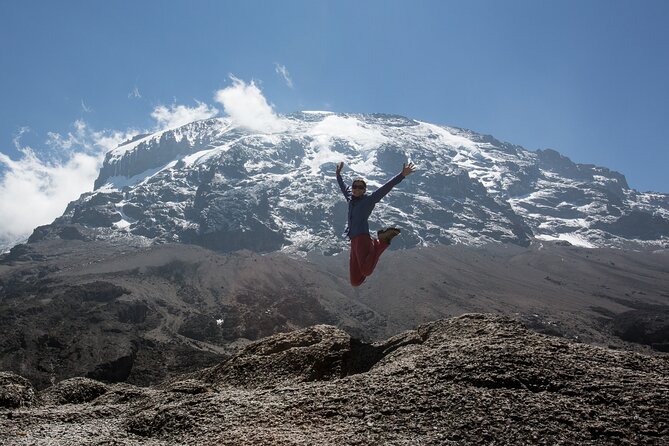
- Lemosho gives you a gradual route: You cross rainforest, heather, volcanic rock, high desert, giant senecio plants, and the arctic zone before summit day.
- The extra acclimatization time matters: Days 3 and 4 include higher walks followed by lower camping, helping your body adjust to thinner air.
- Small groups are capped at 15 people: That is a more personal setup than a large hiking convoy, though the support crew can still be substantial.
- The summit attempt begins around midnight: You reach Stella Point for sunrise, continue to Uhuru Peak, then descend to Mweka Camp.
- The price includes the major essentials: At $2,895 per person, camping gear, meals, park fees, and round-trip hotel transfers are included.
- The human support gets strong praise: Guides named in past trips include Goodluck, Amani, Isaya, Emmanuel, Raymond, Herment Mosha, Steve, Manny, Cinga, Dastan, and Jackson.
Why Lemosho Is a Good Eight-Day Choice
Kilimanjaro is not a technical mountain in the usual sense. You do not need ropes or climbing experience on this route. The hard part is the height, the long hours, the changing weather, and the need to keep moving when your body would rather stop.
That is why I like the eight-day schedule. Compared with a rushed climb, it gives you more time to walk high, sleep lower, and settle into the slow rhythm required at altitude. The route begins at the western side of the mountain and eventually joins the southern circuit before the summit attempt.
The first days are not merely filler. They help your body and mind get used to the work. You will also see far more than a bare summit trail. Lemosho moves through several ecological zones, and the change from wet forest to dry volcanic ground is one of the trip’s main rewards.
The maximum group size is 15. That is not the same as having a private guide, but it is still small enough to create a shared rhythm. Some past departures have had only a few climbers, while others included a larger guide and porter team. This matters because the support operation can feel more personal than the headline group limit suggests.
More Kilimanjaro routes and climbs:
- 7-Day Machame Kilimanjaro Summit Tour from Arusha
★ 5.0 · 125 reviews - Mountain Kilimanjaro Day Hike
★ 5.0 · 102 reviews - Private Full Day Hiking Experience to Marangu Route
★ 5.0 · 61 reviews
Day 1: Rainforest to Mti Mkubwa Camp
Your day begins with an 8:00 a.m. start and transport from your Arusha hotel. After checking in at Londorossi Gate, you walk roughly 3 miles, or 4.8 kilometers, over about three to four hours.
The trail rises gently through montane forest. This is a forgiving first day, at least compared with what comes later. The forest offers shade and a soft introduction to the mountain, though rain can make the trail damp and slippery.
You finish at Mti Mkubwa Camp, whose name means Big Tree in Swahili. Tents are set up before you arrive, and your personal belongings are placed inside. That small service makes a difference after the drive and first walk, since you do not need to arrive tired and then organize camp from scratch.
Your first night is still relatively low, at about 7,742 feet, or 2,360 meters. Do not expect the summit feeling yet. This is a day for settling into camp, eating well, checking your gear, and getting sleep.
Day 2: Heather Country and the Shira Plateau
Day 2 covers about 4.9 miles, or 8 kilometers, in five to six hours, finishing around 11,500 feet, or 3,505 meters.
The trail leaves the forest and enters open country covered with tall grasses, heather, volcanic rock, and pale lichen. The change is striking. You have moved from a shaded woodland into a broad, exposed mountain world where Kilimanjaro’s upper slopes begin to feel real.
The Shira Ridge brings the first major views toward Kibo, the main volcanic cone. Mawenzi, Kilimanjaro’s other great peak, also becomes part of the high-mountain scene as the route develops. The wide Shira Plateau gives you room to appreciate the scale of the mountain, but it also exposes you to more wind and weather.
Five or six hours of walking may sound modest on paper. At altitude, every climb takes longer. Your best strategy is to accept the guide’s slow pace and avoid racing ahead early in the trip. Save your energy for the upper mountain.
Day 3: Exploring Shira at 13,800 Feet
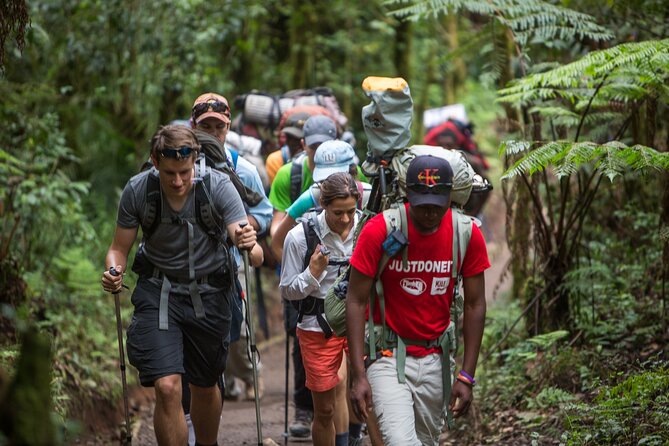
Day 3 is a longer acclimatization day. You walk about 8.7 miles, or 14 kilometers, for five to seven hours, reaching roughly 13,800 feet, or 4,206 meters.
The route crosses the Shira Plateau toward Kibo’s glaciated summit. There is an optional visit to the ancient collapsed Shira Cone, the oldest of Kilimanjaro’s three volcanoes. That option adds interest for hikers who want more than a direct march from camp to camp.
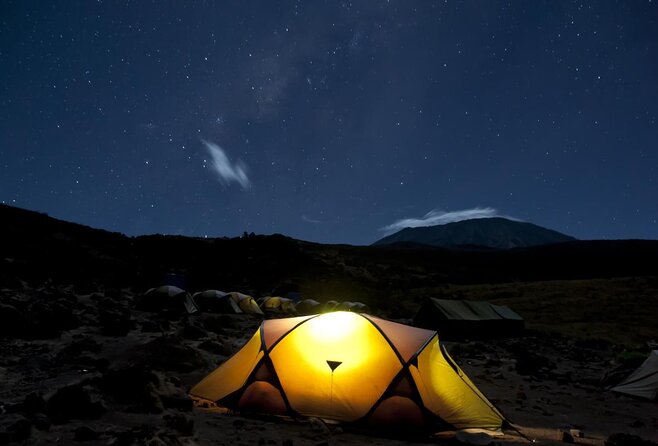
You finish at Moir Camp, set at the end of a dormant lava flow in a large gorge. The surroundings are much barer than the forest below. This is high volcanic country, with fewer plants and a stronger sense that you are approaching the mountain’s upper zones.
This day may be tiring because of the distance and altitude. That is also its value. The schedule gets you high before the summit push without asking you to climb all the way there. Pay attention to how you feel, drink regularly, and tell your guide about headaches, nausea, unusual fatigue, or trouble sleeping.
A few more trips of this kind worth comparing:
- 4 Days Mount Meru Trekking
★ 5.0 · 55 reviews - 4 days Best experience Kilimanjaro Hike, Serengeti &Ngorongoro
★ 5.0 · 54 reviews - From Arusha/Moshi: Kilimanjaro Hike Marangu Route Day Trip
★ 4.5 · 54 reviews - 6 Days Serengeti Safari(hiking waterfalls &coffee tour)
★ 5.0 · 48 reviews
Day 4: Lava Tower, Senecio Forest, and Barranco
Day 4 is the trek’s key acclimatization day. You climb to Lava Tower at about 15,000 feet, or 4,500 meters, then descend to Barranco Camp at roughly 13,000 feet, or 3,962 meters. The walking time is listed at four to six hours, with another estimate of six hours.
This high-point-then-lower-camp pattern is exactly what you want from a long route. You spend time at a higher elevation, then sleep lower than your maximum height. The gain is not comfort on the day itself. The gain is giving your body a better chance to adjust before summit night.
Near Lava Tower, the route offers a junction toward the Arrow Glacier. After resting, you descend through a giant senecio forest and pass a waterfall before reaching Barranco Camp.
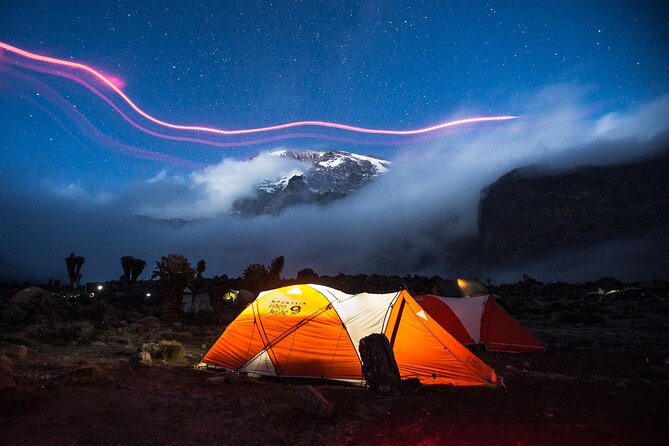
Barranco is one of the most memorable camps on the route. It sits below the huge Barranco Wall, with clouds often moving through the valley. You will probably look at the wall and wonder how tomorrow’s route can go up it. It does, and the climb is more adventurous than technical.
The itinerary lists several different elevation figures for this day, including the Lava Tower height and the lower camp elevation. Treat the figures as approximate, as you would expect in a mountain program.
Day 5: Up the Barranco Wall to Karanga
Day 5 is shorter in distance, about 2.2 miles, or 3.2 kilometers, and takes around four to five hours. It is not an easy day. The route climbs the Barranco Wall, then continues through the Karanga Valley to camp at about 13,100 feet, or 3,992 meters.
The Barranco Wall is a hands-on section of trail, though the route is described as non-technical. You use your feet and hands for balance in places, and the narrow route can feel exciting if you are comfortable with heights. Guides are especially valuable here because they help keep the group moving safely and patiently.
After the wall, the path enters the upper mountain’s more severe zone. The route crosses the Karanga Valley, and the vegetation becomes increasingly sparse as you approach the summit camps.
This is a good example of why distance alone does not tell you how hard a day will be. A short day can involve steep climbing and careful footing. Do not judge your progress by mileage. Judge it by how steadily you are moving and how well you are coping with the height.
Day 6: Kosovo Camp and the Final Rest
Day 6 takes five to six hours at a deliberately slow pace. You pass Barafu Camp and continue to Kosovo Camp, listed at about 16,000 feet, or 4,876 meters.
The route offers strong views of Kibo and Mawenzi. By now, the mountain feels stripped down and exposed. The surrounding terrain is less welcoming, but the views are broad and powerful.
Kosovo Camp sits on an exposed ridge, so you need to learn the immediate terrain before dark. The purpose of this day is not to collect another hard hiking achievement. It is to reach camp, rest, eat, organize your summit clothing, and prepare for the night ahead.
This is where an experienced guide team can make a real difference. Past climbers have singled out guides such as Goodluck, Raymond, Amani, Herment Mosha, and Steve for careful attention to pace, comfort, and safety. Other guide names tied to successful trips include Isaya, Emmanuel, Dastan, Jackson, Manny, and Cinga.
Do not leave your summit preparation until bedtime. Put warm layers, gloves, headlamp, water, snacks, and needed personal items where you can reach them quickly. The supplied information does not specify a personal equipment list, so you should ask Climb Kili what is provided and what you must bring yourself.
Day 7: Stella Point, Uhuru Peak, and Mweka Camp
Summit day is the physical and mental test of the trek. You begin around midnight and climb toward Stella Point, a route section described as one of the steepest non-technical parts of Kilimanjaro.
The ascent to Stella Point takes about six to seven hours. You move through heavy scree toward the crater rim, with the Rebmann and Ratzel glaciers nearby. The goal is to reach Stella Point around sunrise, when the light spreads across the upper mountain.
From Stella Point, Uhuru Peak is about another hour. The summit reaches 19,340 feet, or 5,895 meters. At that height, even a gradual trail can feel punishing. The last hour may be emotionally easier because the summit is visible, but your body will already have spent many hours working in thin air.
The full day is listed at about 11 hours, with five kilometers of ascent and 12 kilometers of descent. After the summit, you descend to Mweka Camp for dinner and a celebration. That descent is welcome, but do not underestimate it. Loose ground and tired legs can make the way down surprisingly demanding.
This is the day to follow your guides closely. The strongest praise connected to this operator centers on safety, encouragement, patience, food, and attention to individual energy levels. Those are not minor comforts at 5,895 meters. A guide who notices a problem early can help you make a safer decision.
Also remember that reaching Stella Point is a major achievement, even if altitude prevents you from continuing to Uhuru Peak. A responsible guide should put health before a summit photograph.
Day 8: Mweka Gate and a Hot Shower
The final morning is a downhill walk to Mweka Gate. The route covers about 6.4 miles, or 10.3 kilometers, and takes three to four hours.
The forest returns as you lose elevation. After the stark upper mountain, the trees and softer air should feel like a reward. At Mweka Gate, the Climb Kili vehicle waits to take you back to your hotel in Arusha.
The return transfer is more valuable than it sounds. After summit night, a planned ride means you can focus on food, rest, and a long shower instead of trying to solve transport while exhausted.
What the $2,895 Price Buys You
At $2,895 per person, this is a major purchase, but the package includes several expensive and important parts of a Kilimanjaro climb:
- Round-trip transfers from your Arusha hotel
- Camping equipment
- Park and admission fees
- Meals during the trek
- Guide and support services within the small-group operation
The value comes from having the core expedition arranged in one package. You are not simply paying for a walking route. You are paying for permits, camp support, food, transfers, and a team that manages the mountain logistics.
The price does not mean every possible expense is covered. The supplied details do not spell out airport transfers, hotel nights, personal gear, insurance, drinks, tips, or optional services. Ask for a written list of inclusions before paying. Also confirm how the small group works if you book alone, since the maximum is 15 but actual departures can be much smaller.
Food, Support, and Camp Life
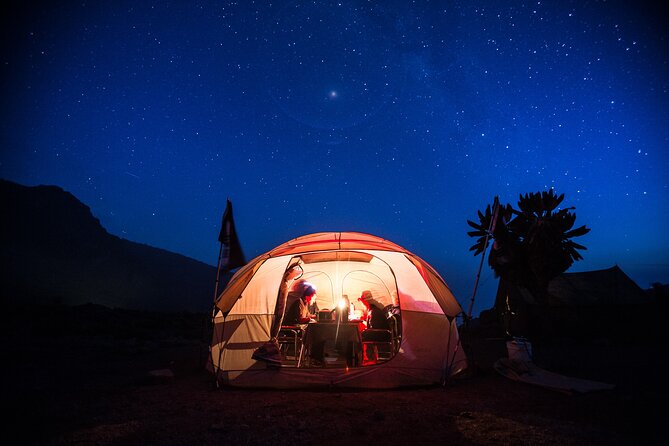
Meals are included, which is important because you need regular fuel on a long climb. The precise menu is not provided, but the support team has received strong praise for keeping climbers fed and comfortable.
Past trips have specifically highlighted chefs and crew members, including Simon, Thomas, Balthasar, Goodwin, and others. Personal touches have included coffee wake-up calls and attention to tent comfort. Small services become memorable when you are cold, tired, and preparing for another climb.
The porters are central to the operation, even though the itinerary naturally focuses on the hikers. You should ask how the company handles porter welfare, luggage limits, tipping guidance, and equipment sharing. Those details affect both the ethics and the quality of your trip.
Who Should Book This Trek
I would choose this trek if you want a structured Kilimanjaro experience with a sensible acclimatization schedule and direct support from a guide team. It suits first-time high-altitude climbers who are fit, patient, and willing to walk slowly.
It can also suit experienced hikers. Several people with serious mountain backgrounds have rated Kilimanjaro very highly, but the mountain tests different skills than a day hike or a collection of lower peaks. Altitude care matters more than speed.
You should think twice if you dislike camping, struggle with long uphill days, or want a relaxed safari-style holiday. The itinerary includes repeated days of five to seven hours, one midnight start, a summit above 19,000 feet, and a long descent. The word trek can make this sound gentler than it is.
Booking Details and Cancellation
Confirmation is sent within 48 hours of booking, subject to availability. Pickup is offered, the ticket is mobile, and the activity begins at 8:00 a.m.
You can cancel for a full refund if you do so at least 24 hours before the local start time. Cancellations or changes made inside that period are not accepted for a refund.
Should You Book the 8-Day Lemosho Route?
I would book it if your priority is a strong chance at a successful summit, a slower schedule, and a managed trip from Arusha hotel pickup through the return to Mweka Gate. The extra day, small-group limit, included meals, park fees, camping equipment, and highly praised guide support give the $2,895 price real substance.
I would not book it without first checking the exact gear list, hotel arrangements, tipping expectations, and medical planning. You also need to be honest about your fitness and your response to altitude.
For a first Kilimanjaro attempt, the eight-day Lemosho route is a sensible choice. It gives you scenery, time, and support. Just remember that the mountain makes the final decision, not the itinerary.
FAQ
How long is the Kilimanjaro trek?
The trek lasts approximately eight days, beginning with pickup from your Arusha hotel and ending with a transfer back after walking to Mweka Gate.
What route does this climb use?
The climb uses the Lemosho route, beginning on Kilimanjaro’s western side at Londorossi Gate and later joining the southern circuit toward the summit.
What time does the experience start?
The listed start time is 8:00 a.m.
What is the highest point reached?
The summit attempt reaches Uhuru Peak at 19,340 feet, or 5,895 meters.
How large is the group?
The activity has a maximum of 15 participants. Actual group sizes may be smaller.
Are meals included?
Yes. Meals during the trek are included in the price.
Is camping equipment included?
Yes. Camping equipment is included.
Are park or admission fees included?
Yes. The listed admission and park-related fees are included.
Do I need strong physical fitness?
Yes. The activity states that participants should have a strong physical fitness level. The trek includes long hiking days, high altitude, a midnight summit start, and a descent after reaching the summit.
Just added around Arusha
- 5 Days Safari Tarangire, Serengeti, and Ngorongoro Crater★ 5.0 · 3 reviews
- Love lives in Africa★ 5.0 · 3 reviews
- 5 Days of Safari, Culture & Hot Springs – Tour from Arusha★ 5.0 · 3 reviews
- Arusha National Park Safari by Jeep★ 4.5 · 3 reviews
- 5Days Family _Group Tour Lodging Mid-Range in the Jungle★ 5.0 · 3 reviews
- 2 Days Tarangire and Ngorongoro Crater Tour★ 5.0 · 3 reviews
- Serengeti & Ngorongoro 3 Days Budget Safari★ 5.0 · 3 reviews
- 7 Days PRIVATE Best of Tanzania Safari *Departing everyday*★ 5.0 · 3 reviews
Kilimanjaro Treks, compared.





Climbing Kilimanjaro through 7 days Machame Route
Read our review →

7-Day Machame Kilimanjaro Summit Tour from Arusha
Read our review →Browse the lists this tour appears in