
Reviewed · KILIMANJARO TREKS
5 Days Marangu Route Kilimanjaro Climbing
The mountain saves its hardest test for sunrise. This five-day Marangu Route climb gives you Kilimanjaro’s shortest standard ascent, hut accommodation each night, and a private trip with Mountain Warriors Tours and Safaris. I love the comfort of sleeping in communal huts with beds, mattresses, pillows, and solar lights. I also like that park fees, rescue fees, meals, purified water, guides, and airport transfers are included. The catch is the schedule: five days leaves little time for acclimatization, and summit day can last 11 to 15 hours.
You start near Arusha or Moshi at about 7:30 a.m. and finish back at the park gate on Day 5. Gasto, known within the company as an experienced Kilimanjaro guide, receives especially warm praise for his care, humor, fresh meals, and safety-minded approach. If you want a private climb at $1,730 per person, and you are fit enough for long uphill walks, this is a well-priced way to tackle Africa’s highest peak. If steady acclimatization matters more than keeping the trip short, choose the six-day version instead.
In This Review
- Key points to know before you book
- Marangu Route: the practical appeal of the Coca Cola route
- Day 1: Marangu Gate to Mandara Hut
- Day 2: Mandara to Horombo through giant heather
- Day 3: Horombo to Kibo across the Saddle
- Day 4: the 1 a.m. summit push
- Day 5: returning through the forest
- What the $1,730 price really covers
- Huts, meals, and the daily routine
- Fitness, altitude, and the five-day decision
- Who should book this private climb?
- Booking, cancellation, and small practical details
- Should you book the five-day Marangu climb?
- FAQ
- How long does the Marangu Route climb take?
- Where does the climb begin?
- What time does the experience start?
- Where do I sleep during the climb?
- Are meals included?
- Are park and rescue fees included?
- Is personal climbing gear included?
- Is this a private tour?
- Can I cancel for a full refund?
Key points to know before you book
- Huts instead of tents: You sleep in communal mountain huts with bunk beds, sponge mattresses, pillows, and solar lighting at every campsite.
- The Coca Cola route: Marangu is the shortest and generally easiest route to the summit, with forest, moorland, volcanic scree, and high-altitude desert.
- A brutal summit morning: You leave Kibo Hut at about 1 a.m. and may spend 11 to 15 hours walking before reaching Horombo Hut again.
- Five days means faster acclimatization: The route can be extended to six days by resting at Horombo or visiting the small peak of Mawenzi.
- Good package value: Park fees, rescue fees, mountain guides, all mountain meals, water, huts, mess equipment, and transfers are covered.
- Private and mobile-friendly: Only your own group takes part, pickup is offered, and confirmation arrives when you book.
Marangu Route: the practical appeal of the Coca Cola route
Marangu is often called the Coca Cola Route because it is the most familiar and accessible way up Kilimanjaro. The nickname can make it sound easy. It is not. You still reach 5,896 meters at Uhuru Peak, and altitude can turn a manageable walk into a serious physical test.
What Marangu does well is keep the route simple. You follow one trail up and down, rather than ascending by one path and descending by another. You also sleep in huts instead of tents, which matters after a long day on your feet. The bunk rooms are communal, so you give up privacy, but you gain a proper bed, a mattress, a pillow, and solar lighting.
The five-day plan is the shortest version. That keeps the price and time commitment down, but it also compresses the body’s adjustment to high altitude. The six-day option adds a rest day at Horombo or a climb toward Mawenzi, giving you more time before the summit attempt.
I would view the five-day trip as best for someone with limited time and a solid level of fitness. You should not confuse the route’s easier trail profile with an easy summit.
More Kilimanjaro routes and climbs:
- 8-Day Small-group Lemosho Kilimanjaro Summit Trekking
★ 5.0 · 186 reviews - 7-Day Machame Kilimanjaro Summit Tour from Arusha
★ 5.0 · 125 reviews - Mountain Kilimanjaro Day Hike
★ 5.0 · 102 reviews
Day 1: Marangu Gate to Mandara Hut
The morning begins with a short drive from Arusha or Moshi to Kilimanjaro National Park’s Marangu Gate, at about 1,830 meters. The gate sits beside Marangu village, an attractive area marked by small coffee and banana plantations.
Park entrance formalities take place before you begin walking. The trail then heads through forest toward Mandara Hut at 2,700 meters. Expect about three to five hours of walking, although the itinerary assigns roughly six hours to the day once transport and formalities are included.
This is a pleasant opening stage. The forest is green, shaded, and full of birdlife. Monkeys are often seen around the huts, giving the first day a more natural feel than the stark upper mountain. The path climbs steadily, and the forest can feel soothing after the drive.
At Mandara, you can rest or make a short afternoon excursion toward Maundi Crater. The volcanic remains offer an extra point of interest without committing you to a major additional climb. If the weather is clear and your legs still feel fresh, it is a useful way to see more of the area. If you are tired, staying near the hut and enjoying the forest is the sensible choice.
Your overnight stay is in a communal hut. The bunks have sponge mattresses and pillows, and solar lights provide basic illumination. The setup is more comfortable than camping, but it is not a private lodge. Bring patience with shared sleeping quarters and keep your personal gear organized.
Day 2: Mandara to Horombo through giant heather
Day 2 takes you from the forest into the moorland zone. The beginning remains steep, but the trees soon thin out and the trail opens into grassy ground covered with giant heather.
This change in scenery is one of Marangu’s rewards. On clear days, you can see Kibo and Mawenzi, the two major peaks of Kilimanjaro’s upper mountain. The route climbs steadily rather than racing upward, but you will notice the altitude more than you did near the gate.
Groundsel plants appear along the way, adding an unusual shape to the high moorland. After about four to six hours of walking, you reach Horombo Hut at 3,720 meters. The full day is again described as about six hours.
Horombo is a memorable overnight stop. The hut sits close to Kibo’s glaciated dome, and sunrises and sunsets can be striking. The sense of being above the clouds becomes much stronger here. It is also the place where the five-day schedule begins to feel compressed.
If you choose the six-day version, Horombo is where the extra day can be spent resting or climbing toward Mawenzi. That additional time is valuable because it lets you sleep at altitude without immediately pushing toward the summit. On the five-day plan, you continue the following morning.
Day 3: Horombo to Kibo across the Saddle
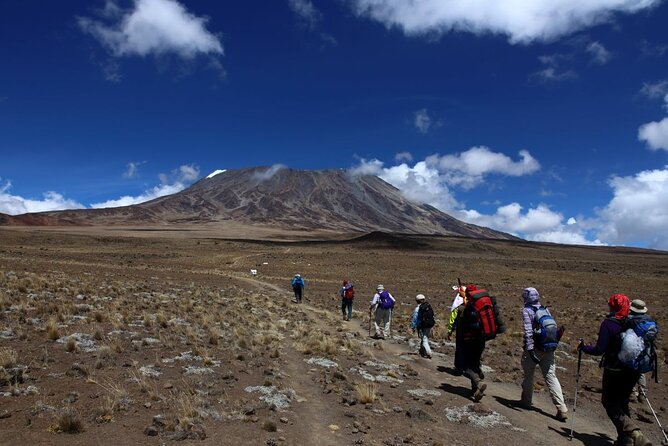
The third walking day leads gradually toward the Saddle, the high, open area between Mawenzi and Kibo. The vegetation fades, and the ground becomes volcanic scree. The mood changes too. You are now moving through a stark high-altitude zone where the mountain feels far more remote.
The walk from Horombo Hut to Kibo Hut takes about four to five hours. Kibo Hut sits at approximately 4,700 meters, at the foot of the crater wall. Reaching it around midday gives you an afternoon to rest, eat, and prepare for the summit attempt.
Do not treat this afternoon as spare sightseeing time. The best use of it is quiet rest. Your next alarm may come soon after sunset because the summit climb begins around 1 a.m. You will need warm clothing, a headlamp or torch, water, and whatever personal climbing gear you have arranged.
The hut system helps here. A bed is easier to settle into than a tent floor, though sleep at this altitude may still be difficult. The communal arrangement also means you should keep noise low and your equipment compact.
The provided food is served as part of the package, with breakfast, lunch, and dinner included during the mountain stay. The company receives strong praise for fresh, hot meals, and the quality mess tents include tables and chairs. Even with hut sleeping, that dining setup gives you a more orderly place to eat and recover.
A few more trips of this kind worth comparing:
- 5 Days Group Camping Safari
★ 5.0 · 730 reviews - 5-Day Highlights mid-Range Crater, Serengeti, Tarangire
★ 5.0 · 296 reviews - 5 Days Camping Tarangire, Serengeti & Ngorongoro crater & Visiting Maasai
★ 5.0 · 229 reviews - Tanzania Simba Safari – 5 Days
★ 5.0 · 217 reviews
Day 4: the 1 a.m. summit push
Summit day is the reason to take this trip seriously. You begin by torchlight at about 1 a.m., climbing over loose volcanic scree toward Gillman’s Point at 5,685 meters. The path uses graded zigzags in places, but the slope is steep and the pace is deliberately slow.
Reaching Gillman’s Point takes roughly five or six hours. If you arrive around sunrise, you can rest and watch the light spread across the upper mountain. This is already a major achievement, especially after beginning in the middle of the night.
If you still feel strong, you can continue along the crater rim toward Uhuru Peak. The round trip from Gillman’s Point takes about three hours, and the route passes close to glaciers that still occupy much of the summit area. Uhuru Peak reaches 5,896 meters, the highest point in Africa.
The itinerary describes the full summit day as 11 to 15 hours of walking from Kibo Hut to Gillman’s Point, followed by the descent to Horombo Hut. The wording focuses on Gillman’s Point, but in practical terms you should prepare for the longer day if you continue to Uhuru and return to Horombo.
The descent may feel surprisingly quick, but it is not effortless. Loose scree can make the downhill sections tiring, and your knees will notice the hours. You then return to Horombo Hut for the night. This is the day when a professional guide matters most. The company’s strongest praise centers on guide support, safety, encouragement, and the ability to keep spirits up when the climb becomes hard.
Gasto is repeatedly singled out for his experience, including a claim of more than 250 Kilimanjaro climbs. That figure is supplied as part of his reputation, not a guarantee of any particular outcome, but it does suggest why his name appears so often in connection with this company. The practical point is simple: ask about your guide team before departure and follow their advice about pace, rest, and summit decisions.
Day 5: returning through the forest
After the summit effort, you retrace the route through the moorland to Mandara Hut and then continue down through the forest to the park gate. The walk takes about five to six hours.
This final descent gives you one of the clearest visual contrasts on Kilimanjaro. The summit zone is dry, sparse, and cold, while the lower forest feels green and full of life. The change can make the mountain seem even taller because you pass through several distinct ecological zones in only a few days.
At the park gate, transport returns you to Moshi or Arusha. Airport transfers are included, which adds value if you are using this climb as part of a wider Tanzania trip. Pickup is offered, but confirm the exact pickup arrangement and location when booking.
What the $1,730 price really covers
At $1,730 per person, the package is not simply a guided walk. It includes overnight hut accommodation, professional mountain guides, park fees, rescue fees, all meals on the mountain, purified drinking water, a mess tent with tables and chairs, and airport transfers.
Those inclusions matter because Kilimanjaro costs can rise quickly when park and support charges are added separately. Meals and water are also practical essentials, not optional extras. The company’s food receives particularly strong praise, with fresh meals served hot during the climb.
You still need to budget for a Tanzania visa, tips, and personal climbing gear. The last item is important. The supplied information does not say that boots, warm layers, a sleeping bag, poles, or other equipment are provided, so ask Mountain Warriors for its current equipment list before you commit.
The private format adds another advantage. Only your own group participates, so you are not automatically combined with strangers. The data does not state the maximum group size, so ask how many people will be in your private party and how the guide team is assigned.
Huts, meals, and the daily routine
Marangu’s huts are its biggest comfort feature. Every campsite has sleeping huts with communal bunk rooms, sponge mattresses, pillows, beds, and solar lights. That arrangement reduces the need to carry a tent and gives you a more stable place to rest each night.
Do not expect hotel conditions. The huts are shared, and the word comfortable should be read in mountain terms. Your sleeping space is functional rather than private. The included mess tent, with tables and chairs, helps create a separate place for meals and downtime.
All breakfasts, lunches, and dinners are included for the five-day climb, along with purified drinking water. This simplifies your planning and reduces the amount of food and water you need to arrange yourself. The positive comments about the meals are specific enough to matter: the food is described as fresh and hot, rather than merely adequate.
The support team also carries heavy luggage and handles meal preparation, according to the experience described by one customer. Since the supplied details do not specify baggage limits or porter arrangements, get those terms in writing before you pack.
Fitness, altitude, and the five-day decision
You need a moderate level of physical fitness for this trip. That phrase should be taken seriously because the route includes several hours of walking on most days and one very long summit day.
The biggest issue is not only leg strength. You climb from 1,830 meters at the gate to 5,896 meters at Uhuru Peak in a short period. The five-day plan offers less time for your body to adjust. The six-day version is the better choice if you want a rest day at Horombo or an additional climb toward Mawenzi.
I would choose the five-day route only if your schedule requires it or if your guide confirms that the plan suits your condition. A shorter itinerary is not automatically better value if it leaves you too tired to attempt Uhuru Peak. The extra day costs more time, but it can make the overall climb more manageable.
Your guide’s judgment is essential on the summit morning. Reaching Gillman’s Point is a significant goal, while continuing to Uhuru requires more time and energy. The itinerary clearly allows for both, but you should expect the guide to make safety the priority.
Who should book this private climb?
This experience suits you if you want:
- The shortest Marangu Route schedule
- Hut accommodation instead of camping
- A private trip for your own group
- Meals, water, park fees, and rescue fees bundled into one price
- A guide-led climb with airport transfers included
- A route that begins in forest and reaches a high volcanic summit
It is less suitable if you want a quiet private room, a relaxed acclimatization schedule, or a short summit day. The communal huts may bother light sleepers, and the five-day plan leaves little spare time once you reach Horombo and Kibo.
The route is also a good fit if you value practical comfort over a more remote trail. Marangu uses the same path for ascent and descent, and it is widely known as the easiest and shortest route. That makes the experience straightforward, though not as varied in route direction as some longer options.
Booking, cancellation, and small practical details
The advertised meeting time is 7:30 a.m. Pickup is offered, and the experience is near public transportation, but airport transfers are also included. Confirm the exact pickup point, especially if you are staying in Arusha rather than Moshi.
Confirmation is provided when you book, and the ticket is mobile. You can cancel for a full refund if you do so at least 24 hours before the local start time. Cancellations or changes made within 24 hours are not refunded or accepted.
The experience has a top rating from five supplied customer reviews. The most praised elements are the guide team, food, organization, safety support, and the personal care associated with Gasto and Mountain Warriors. Five reviews are encouraging, but it is still a small sample, so I would ask direct questions about current guides, group size, gear, and the six-day upgrade before paying.
Should you book the five-day Marangu climb?
Book it if you want a well-supported, private Kilimanjaro climb with huts, included meals, and a relatively low price for a full park-based ascent. The strongest reasons are the sleeping setup, the bundled costs, and the repeated praise for Gasto and his team.
Choose the six-day version if you can spare the time. The extra acclimatization day is the most useful improvement available, especially for anyone concerned about the altitude. Either way, arrive ready for the summit morning: the route may be called the easy one, but Uhuru Peak still demands stamina, patience, and a long night on your feet.
FAQ
How long does the Marangu Route climb take?
The experience lasts approximately five days. A six-day option is also available for better acclimatization.
Where does the climb begin?
The climb begins at Kilimanjaro National Park’s Marangu Gate, which is about 1,830 meters above sea level. Transport is provided from Moshi or Arusha.
What time does the experience start?
The listed start time is 7:30 a.m.
Where do I sleep during the climb?
You sleep in communal mountain huts at each campsite. The huts have bunk beds, sponge mattresses, pillows, and solar lights.
Are meals included?
Yes. Breakfast, lunch, and dinner are included during the five-day mountain stay. Purified drinking water is also included.
Are park and rescue fees included?
Yes. Kilimanjaro National Park fees and rescue fees are included in the price.
Is personal climbing gear included?
No. Personal climbing gear is not included. You also need to pay separately for a Tanzania visa and tips.
Is this a private tour?
Yes. Only your own group participates in this private activity.
Can I cancel for a full refund?
Yes, if you cancel at least 24 hours before the experience start time. Cancellations or changes made less than 24 hours before the start are not refunded or accepted.
Just added around Arusha
- 5 Days Safari Tarangire, Serengeti, and Ngorongoro Crater★ 5.0 · 3 reviews
- Love lives in Africa★ 5.0 · 3 reviews
- 5 Days of Safari, Culture & Hot Springs – Tour from Arusha★ 5.0 · 3 reviews
- Arusha National Park Safari by Jeep★ 4.5 · 3 reviews
- 5Days Family _Group Tour Lodging Mid-Range in the Jungle★ 5.0 · 3 reviews
- Serengeti & Ngorongoro 3 Days Budget Safari★ 5.0 · 3 reviews
- 2 Days Tarangire and Ngorongoro Crater Tour★ 5.0 · 3 reviews
- 7 Days PRIVATE Best of Tanzania Safari *Departing everyday*★ 5.0 · 3 reviews
Kilimanjaro Treks, compared.



8-Day Small-group Lemosho Kilimanjaro Summit Trekking
Read our review →


Climbing Kilimanjaro through 7 days Machame Route
Read our review →

Browse the lists this tour appears in