
Reviewed · KILIMANJARO TREKS
7 Days Kilimanjaro Climb Machame Route
Africa’s highest summit rewards patience.
This 7-day Machame Route climb gives you a full Kilimanjaro experience, from rainforest to Arctic summit. I like the extra acclimatization day built into the schedule, and I like that park fees, camping gear, meals, guides, porters, airport transfers, and hotel nights are included. The main catch is simple: this is a demanding tent-based climb, not a gentle mountain holiday.
I also like the private format. Your group travels with its own guide and support crew, so the pace and daily routine can be adjusted more easily than on a large group departure. The route is beautiful, but you need reasonable fitness, patience at altitude, and a willingness to sleep in mountain camps for six nights.
In This Review
- Key reasons this climb earns attention
- Why the Machame Route is worth the effort
- Day 1: Machame Gate to Machame Camp
- Day 2: Machame Camp to Shira 2 Camp
- Day 3: Shira 2, Lava Tower, and Barranco Camp
- Day 4: Climbing the Barranco Wall to Karanga Camp
- Day 5: Karanga Camp to Barafu Camp
- Day 6: Barafu Camp to Uhuru Peak and Mweka Camp
- Day 7: Mweka Camp to the park gate
- Camping, meals, and the support crew
- What the $2,564.11 price covers
- Who should choose this climb?
- Booking details and cancellation
- Should you book the 7-day Machame climb?
- FAQ
- How long is the Kilimanjaro Machame Route climb?
- Where does the experience start?
- Is this a private tour?
- Does the climb use tents or mountain huts?
- Are meals included?
- Are park and rescue fees included?
- Is airport transportation included?
- Is a portable flush toilet included?
- Do I need previous trekking experience?
- Are flights and crew tips included?
Key reasons this climb earns attention
- Five climate zones in one climb: You move from lush rainforest through heath, moorland, alpine desert, and Arctic summit conditions.
- Seven days improves acclimatization: The longer version allows more time at altitude than the shorter six-day itinerary.
- Machame offers broad mountain views: The route crosses the Shira Plateau and follows Kilimanjaro’s southern circuit before the summit approach.
- A private guide and crew: Your own guide, cooks, and porters create a more personal experience.
- Most major costs are included: Park, camping, rescue fees, meals, water, equipment, hotels, and transfers are covered.
- Summit morning is the real test: You begin around midnight in darkness, cold, wind, and thin air before reaching Uhuru Peak.
Why the Machame Route is worth the effort
Machame is often called the Whiskey Route, a nickname that hints at its tougher character compared with the gentler Marangu Route. Marangu uses hut accommodation and a more gradual incline. Machame uses tents and steeper sections, but it gives you a wider range of scenery and a better sense of moving around the mountain.
The route is about 62 kilometers from gate to gate. That number looks manageable on paper, but distance is only part of the challenge. Altitude, cold, uneven ground, long summit hours, and the repeated climb and descent require steady energy.
I see the seven-day version as the sensible choice for most people considering Machame. The schedule gives your body more time to adjust before the summit push. You still need to be physically fit, but the extra day makes the climb less rushed than the six-day variation.
This is a private activity, so only your group participates. That matters on a mountain. You are not tied to the pace of a large mixed group, and you have more direct contact with the guide when the day becomes tiring or altitude begins to affect you.
More Kilimanjaro routes and climbs:
- 8-Day Small-group Lemosho Kilimanjaro Summit Trekking
★ 5.0 · 186 reviews - 7-Day Machame Kilimanjaro Summit Tour from Arusha
★ 5.0 · 125 reviews - Mountain Kilimanjaro Day Hike
★ 5.0 · 102 reviews
Day 1: Machame Gate to Machame Camp
The trip begins with a transfer toward Machame Gate in Kilimanjaro National Park. The provided schedule describes about an hour of driving from Moshi to Machame village, at roughly 1,490 meters. At the village, the guides and porters organize food and equipment, and you receive a packed lunch and mineral water.
After registration at the gate, the trail enters dense rainforest. This first day is a strong introduction to Kilimanjaro because the mountain does not begin as a barren wall of rock. You walk beneath tall trees, with birds and monkeys possible along the route. One memorable account describes seeing a troop of monkeys near the park entrance, along with old-growth trees and many birds.
The listed walking time is about seven hours, though exact timing depends on the group and trail conditions. You finish at Machame Camp, where accommodation is in a tent. The day is not technically difficult in the mountaineering sense, but the length can surprise you. Keep your daypack light and protect rain-sensitive items, since the rainforest can be wet.
Day 2: Machame Camp to Shira 2 Camp
The forest gives way to heath and open moorland as the trail climbs toward the Shira Plateau. The change is quick and dramatic. Instead of heavy tree cover, you get wider views, lower vegetation, and a more exposed feeling.
The route climbs from about 9,350 feet to 12,500 feet. The distance is approximately 5 kilometers, with four to six hours of hiking. You cross a large river gorge before reaching Shira 2 Camp.
This is a relatively short day by distance, but the altitude gain matters. Walk slowly from the beginning. The local phrase pole pole, meaning slowly slowly, is the right attitude for Kilimanjaro, even if it is not listed as a formal tour feature. Your guide’s job is not simply to point out the trail. It is also to help the group maintain a pace that gives the body time to adjust.
The open Shira area brings fine mountain views, but it also means less shelter from weather. At camp, keep warm layers and waterproof clothing close.
Day 3: Shira 2, Lava Tower, and Barranco Camp
Day 3 is one of the most useful parts of the seven-day plan. You climb to Lava Tower at approximately 15,190 feet, then descend to Barranco Camp at about 13,044 feet.
The route covers about 7 kilometers from Shira 2 to Lava Tower, followed by another 3 kilometers down to Barranco. Hiking time is listed as four to five hours to Lava Tower and two to three hours onward.
Lava Tower is a 300-foot volcanic rock formation in the alpine desert zone. The scenery becomes stark, rocky, and spare. You spend time at a high elevation, then sleep lower at Barranco. That climb-high, sleep-lower pattern is useful for acclimatization, even though the day may feel tiring.
The descent leads through the Senecio Forest, where giant plants create a strange transition between barren rock and the greener camp area. Barranco Camp also places you below the famous Barranco Wall, which you tackle the next morning.
This day may be the point where the trip shifts from scenic hiking to serious high-altitude trekking. The schedule specifically calls for moderate physical fitness here. If you are feeling headache, nausea, unusual tiredness, or other altitude symptoms, tell your guide rather than trying to hide it.
A few more trips of this kind worth comparing:
- Tanzania Classic – 7 Days
★ 5.0 · 1,151 reviews - 7-Day Premium Luxury Tanzania Safari All-Inclusive
★ 5.0 · 426 reviews - Group Safari 7 Days in Tanzania’s Main Parks
★ 5.0 · 240 reviews - 7 Days Tanganyika Wilderness Safari
★ 5.0 · 159 reviews
Day 4: Climbing the Barranco Wall to Karanga Camp
The Barranco Wall looks intimidating, but the route over it is non-technical. That means you do not need climbing equipment for a technical rock ascent, though you do need balance, confidence, and careful footwork.
You begin with a steep climb of roughly 900 feet. The trail then passes through hills and valleys before dropping into the Karanga Valley. Another steep section takes you to Karanga Camp.
The exact distance and hiking time are not provided, but the day is described as short and useful for acclimatization. That shorter schedule is welcome after the previous day’s high elevation and before the push toward Barafu Camp.
This is a good morning to keep your hands free and your pack organized. The route can require attention to each step, especially when the group is moving close together. A private guide can help set a comfortable rhythm and prevent the stronger members of the group from racing ahead.
Day 5: Karanga Camp to Barafu Camp
From Karanga, you reach the junction with the Mweka Trail and continue over rocky ground to Barafu Camp. The elevation rises from about 13,106 feet to 15,331 feet, with approximately 4 kilometers of walking.
Barafu marks the end of the southern circuit. By this point, the route has shown you Kilimanjaro from several angles, rather than taking you directly up and down one side. The views toward Mawenzi and Kibo add a sense of scale to the final preparation.
Barafu is not a sightseeing stop. It is a staging camp for the summit. You eat dinner, organize summit clothing and equipment, and try to rest before leaving just after midnight.
This is where good packing matters. Put your warmest layers, headlamp, gloves, water, snacks, and trekking poles where you can reach them quickly. You will not want to unpack your entire bag in the cold and dark.
Day 6: Barafu Camp to Uhuru Peak and Mweka Camp
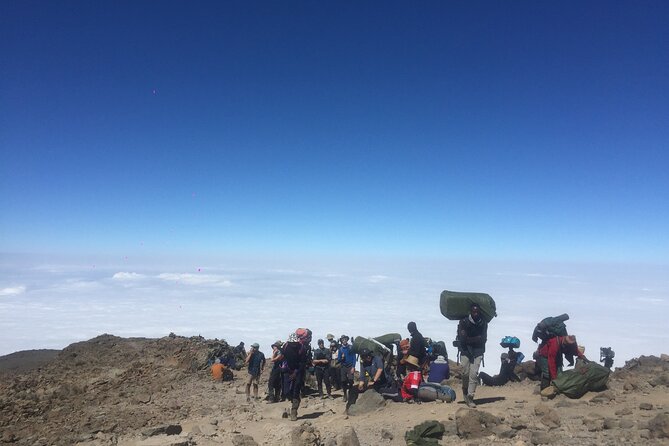
Summit day is the hardest part of the climb. You start just after midnight, ascending in darkness toward Stella Point at about 18,900 feet. The cold and wind can be severe, and the trail is steep and rocky.
The listed hiking time from Barafu to Uhuru Peak is seven to eight hours. Reaching Stella Point brings sunrise views over Mawenzi Peak, one of the great rewards of the route. From there, you continue along the crater rim toward Uhuru Peak at 19,341 feet, the highest point in Africa.
The final stretch is not easy simply because you have reached Stella Point. You are still at extreme altitude, and the effort can feel slow. Take frequent short breaks, follow the guide’s pace, and focus on the next manageable section rather than the whole distance.
After the summit, you descend to Mweka Camp. The route from Uhuru Peak to camp is about 12 kilometers, dropping to roughly 10,065 feet. You stop at Barafu for lunch before continuing down.
The descent is hard on tired knees, especially on loose or rocky sections. Trekking poles are particularly useful here. Mweka Camp sits in the upper forest, where late-afternoon mist and rain are common. You have your final dinner on the mountain and a chance to rest after a very long day.
Day 7: Mweka Camp to the park gate
The final walking day descends from Mweka Camp to Mweka Gate. The distance is listed as about 10 kilometers, with three to four hours of hiking. You drop from approximately 10,065 feet to 5,380 feet.
The lower trail can be muddy and wet, depending on rain. That means your boots and clothing may take a final beating, even though the summit is behind you. At the gate, you collect your summit certificate before continuing about an hour to Mweka Village.
The operator’s vehicle meets the group at Mweka Gate and returns you to the hotel in Moshi. The included pre-trek and post-trek hotel accommodation gives you a proper place to prepare before the climb and recover afterward.
Camping, meals, and the support crew
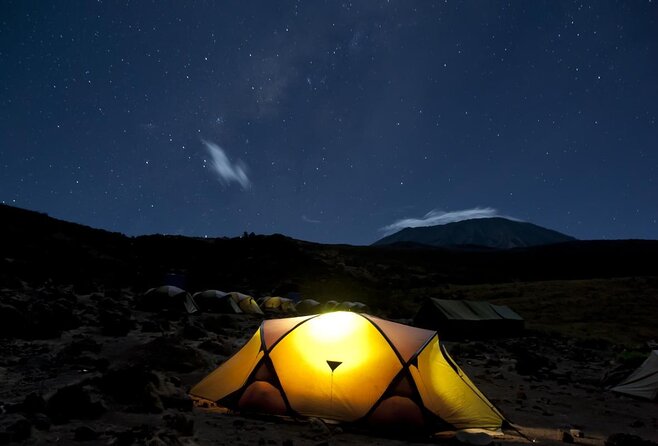
Machame is tent-only, so do not book this expecting mountain huts. The package includes three-season mountain tents and double-layer sleeping mats. Park fees, camping fees, rescue fees, and 18 percent VAT are also included.
Meals are provided three times daily on the mountain, along with snacks, filtered water, bottled water, coffee, and tea. The exact menus are not supplied, but having a cook and regular meals is important during a long high-altitude climb. You should still bring any personal snacks you know you will eat.
The mountain team includes professional guides, cooks, and porters. The strongest praise for this company focuses on communication and personal care. Daniel is repeatedly singled out for staying in touch before the trip and helping organize arrangements. John is praised as a lead guide, while Godfrey is described as a managing director who helped coordinate an earlier climb.
The practical lesson is to ask who your lead guide will be before departure and how the porter team is organized. Tips for the mountain crew are not included, so budget for them separately. Personal items, laundry, and any service not listed also cost extra.
A portable flush toilet with a toilet tent is available for an additional 65 US dollars per toilet and tent. Otherwise, you should expect the standard campsite toilet arrangements, since a private flush toilet is not part of the listed package.
What the $2,564.11 price covers
At $2,564.11 per person, this is a substantial purchase, but the price includes many costs that can quickly add up on Kilimanjaro. Park, camping, and rescue fees are covered, as are VAT, transport to and from the mountain gate, airport transfers, hotel stays before and after the trek, equipment, crew, meals, and water.
That bundled price is valuable if you want one company to handle the main logistics. You are not separately arranging a hotel, mountain transfers, cooks, porters, and park entry. The private format also gives you a more personal trip than a large shared departure.
Still, compare the details before paying. Confirm the hotel name, room arrangements, airport transfer plan, group size, tipping guidance, and what camping equipment you must bring yourself. The package lists tents and sleeping mats, but it does not say that personal clothing, boots, trekking poles, or sleeping bags are supplied.
Flights are excluded. Laundry and personal items are excluded too. If you want the portable flush toilet, add 65 dollars per toilet and tent to your budget.
Who should choose this climb?
I would recommend this route to a fit hiker who wants dramatic scenery and accepts basic camping. Previous trekking experience is helpful, and the itinerary specifically describes Machame as suitable for people with some trekking experience and good physical fitness.
The seven-day schedule also suits someone who prefers a more measured approach to altitude. It is not a guarantee of reaching the summit, but the extra acclimatization time is a sensible advantage.
This climb may not suit you if you want hut accommodation, short walking days, or a soft adventure with easy access to showers and private toilets. The summit morning is long and cold, and the total effort is serious even with a strong support team.
The experience also suits solo climbers and small groups who want personal attention. One solo climber described the service as highly personalized, while other successful climbs included couples, friends, and a parent traveling with a son.
Booking details and cancellation
The meeting point is listed as Arusha in Tanzania, while the detailed schedule refers to Moshi for the hotel, airport transfers, and the drive to Machame Gate. Confirm the exact arrival city and hotel arrangements before booking, especially if your flight lands in Arusha.
Confirmation is provided at booking. Free cancellation is available if you cancel at least 24 hours before the local start time. Cancellations or changes made less than 24 hours before the start are not accepted for a refund.
Should you book the 7-day Machame climb?
Book it if you want the classic Kilimanjaro route with varied scenery, a private crew, and a package that covers most major costs. I especially like the seven-day pacing, the southern circuit views, the included pre and post-trek hotel nights, and the strong emphasis on direct communication from the local team.
Think twice if you dislike tents or have little experience with long mountain days. The Whiskey Route nickname is fair: Machame is scenic, but it asks more of you than the hut-based alternative.
For a fit, prepared climber who wants to reach Uhuru Peak with a private guide and a full support crew, this is a strong-value Kilimanjaro plan. Pack for rain, cold, mud, and a very early summit start. Most of all, choose the slower pace and listen closely to your guide.
FAQ
How long is the Kilimanjaro Machame Route climb?
The experience lasts approximately six to seven days, with this itinerary using seven days and six nights for better acclimatization.
Where does the experience start?
The listed meeting point is Arusha, in Tanzania’s Arusha Region. The detailed schedule also refers to hotel accommodation and transfers in Moshi, so confirm the exact meeting and hotel details before departure.
Is this a private tour?
Yes. Only your group participates in the activity, with a private guide and support crew.
Does the climb use tents or mountain huts?
The Machame Route uses tents only. Three-season mountain tents and double-layer sleeping mats are included.
Are meals included?
Yes. Three meals per day are included while you are on the mountain. Breakfast, lunch, dinner, snacks, bottled water, coffee, and tea are also listed as included.
Are park and rescue fees included?
Yes. Park fees, camping fees, rescue fees, and 18 percent VAT on tour fees and services are included.
Is airport transportation included?
Yes. Two-way private airport transfers are included, along with transportation to and from the mountain gate.
Is a portable flush toilet included?
No. A portable flush toilet with a toilet tent costs an additional 65 US dollars per toilet and tent.
Do I need previous trekking experience?
The route is recommended for people with some trekking experience and good physical fitness. The itinerary also specifies a moderate physical fitness level for the high-altitude section near Lava Tower.
Are flights and crew tips included?
No. Flights, tips for the mountain crew, personal items, laundry, and services not specifically listed are excluded.
Just added around Arusha
- 5 Days Safari Tarangire, Serengeti, and Ngorongoro Crater★ 5.0 · 3 reviews
- 5 Days of Safari, Culture & Hot Springs – Tour from Arusha★ 5.0 · 3 reviews
- Love lives in Africa★ 5.0 · 3 reviews
- Arusha National Park Safari by Jeep★ 4.5 · 3 reviews
- 5Days Family _Group Tour Lodging Mid-Range in the Jungle★ 5.0 · 3 reviews
- 2 Days Tarangire and Ngorongoro Crater Tour★ 5.0 · 3 reviews
- Serengeti & Ngorongoro 3 Days Budget Safari★ 5.0 · 3 reviews
- 7 Days PRIVATE Best of Tanzania Safari *Departing everyday*★ 5.0 · 3 reviews
Kilimanjaro Treks, compared.



8-Day Small-group Lemosho Kilimanjaro Summit Trekking
Read our review →


Climbing Kilimanjaro through 7 days Machame Route
Read our review →

Browse the lists this tour appears in