
Reviewed · KILIMANJARO TREKS
Climb Mount Kilimanjaro: 7 Days Machame Route
The mountain makes you earn every view. This seven-day Machame Route climb gives you a supported path up Kilimanjaro, with a guide, cook, porters, tents, meals, airport transfers, and park fees bundled into one package. I especially like the high-camp acclimatization plan and the practical comforts, including thick sleeping pads, modern tents, oxygen systems, and pulse oximeters. The main catch is simple: this is a serious physical challenge, not a scenic stroll.
I also like that the route crosses several distinct zones, from thick rainforest to open moorland, high rock, and the snowy summit. The small private-group format should make the pace and daily support feel more personal. Still, the price is significant, and you should clarify the extra guide, cook, and porter payments listed outside the package before you commit.
In This Review
- Key points to know before you book
- What the $3,034 package really gives you
- Starting at Machame Gate in the rainforest
- Shira Camp 2 brings the first wide views
- The 4,600-meter acclimatization day
- Barranco Wall and Karanga Camp
- Barafu Camp prepares you for the summit
- The 13-hour push to Uhuru Peak
- The rainforest return to Mweka Gate
- The crew is a major part of the value
- Who should choose this seven-day climb
- Should you book the Machame Route?
- FAQ
- How long is the Kilimanjaro climb?
- Where does the trek begin?
- Is airport pickup included?
- How many people share a tent?
- Are meals included?
- Is a vegetarian option available?
- What is the cancellation policy?
Key points to know before you book
- The Machame Route uses seven days for acclimatization, including a high point around 4,600 meters before sleeping lower.
- Summit day lasts about 13 hours, beginning between midnight and 2 a.m. and ending with a descent toward Mweka.
- A full mountain crew supports you, including a professional guide, cook, and porters carrying up to 15 kilograms per climber.
- The package includes airport transfers, hotels before and after the climb, meals, park permits, rescue fees, tents, and sleeping pads.
- You sleep in shared tents, normally with one or two other climbers, rather than in mountain huts.
- A moderate fitness level is required, but the summit attempt remains demanding even with a strong support team.
What the $3,034 package really gives you
At $3,034, this is not a budget walk. It is a full-service mountain expedition with several large costs already handled. Kilimanjaro National Park permits, rescue fees, camping fees, airport pickup, trailhead transfers, two hotel stays with breakfast, mountain meals, tents, group dining equipment, and the crew are included.
That matters because Kilimanjaro costs can become confusing when permits, food, transport, and porters are priced separately. Here, much of the basic structure is in one package. You also receive bottled water, coffee or tea, breakfast, lunch, and dinner during the climb, plus an international certificate after a successful ascent.
The equipment list is useful rather than flashy. You share a tent with one or two other climbers, sleep on warm two-inch pads, and eat in a dining tent with tables, chairs, and crockery. A portable flush toilet can be provided free if you request one, which is worth asking about before departure.
There are still extra costs to check. Personal gear rental, hotel meals and drinks in Moshi, laundry, and toiletries are not included. The pricing information also lists daily amounts for the guide, cook, and porter under exclusions: $15 to $20 for the guide, $10 to $15 for the cook, and $8 to $10 for the porter. Ask the operator exactly how these figures apply, since the crew itself is included in the advertised package.
US nationals are also listed as paying $100, with other nationalities paying $50, though the description does not clearly label this charge. Confirm what it covers. Good questions before booking are often worth more than a new pair of socks.
More Kilimanjaro routes and climbs:
- Kilimanjaro climb by Lemosho Route (7-day)
★ 5.0 · 651 reviews - Kilimanjaro climb, Machame Route (7-day)
★ 5.0 · 262 reviews - Kilimanjaro Climbing Lemosho Route 8 Days.
★ 5.0 · 186 reviews
Starting at Machame Gate in the rainforest
Your climb begins at Machame Gate, normally about an hour from Moshi. The stated start time is 8 a.m., and this first transfer gets the mountain day moving without requiring you to arrange a separate local taxi.
At the gate, you meet the guide, porters, and cook while park formalities are completed. There is a practical bit of organized confusion as equipment is sorted and loads are assembled. That is part of the experience, not wasted time. The crew has to make sure food, tents, cooking gear, and personal bags are distributed before the trail begins.
The first six-hour walk climbs through dense rainforest. This is one of the most pleasant openings on Kilimanjaro because the air and scenery change gradually. You begin under thick trees, with a steadily rising path rather than an immediate high-altitude test.
You should not treat this first day as easy simply because the altitude is lower. Six hours on an uphill trail can tire your legs, and the best approach is to keep a slow, even pace from the start. The crew support helps here. Porters carry up to 15 kilograms per climber, leaving you to focus on walking, drinking, eating, and staying warm.
Shira Camp 2 brings the first wide views
Day two takes about five hours and moves into the low alpine zone, where moorland and grassland replace the rainforest. The route remains relatively steep, so your body begins to notice both the climb and the thinner air.
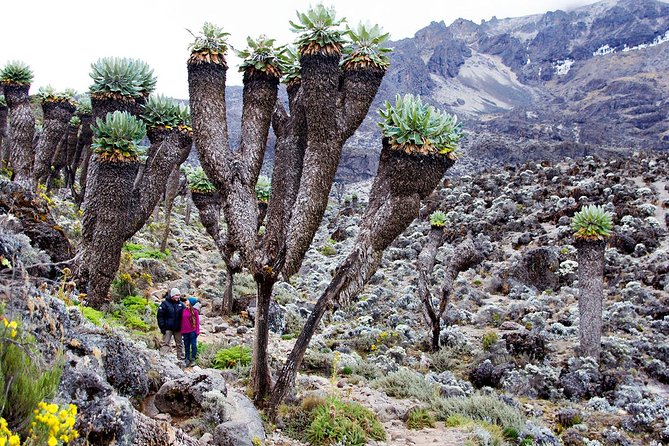
Shira Camp 2 sits on a plateau. This is an important visual change: instead of looking mostly into trees, you begin to see across open ground toward Kibo to the northwest and Mount Meru to the east. The views give you a clear sense that the summit is still ahead, but the mountain has already changed character.
The shorter walking time helps you settle into the daily rhythm. You walk, arrive at camp, eat, rest, and prepare for another cold night. Since breakfast, lunch, and dinner are included during the climb, you do not need to carry a week of food. You should still expect to manage your own personal essentials, including toiletries and any rented or private equipment.
The 4,600-meter acclimatization day
Day three is one of the most useful parts of this itinerary. The route reaches roughly 4,600 meters, yet you finish at a similar elevation to where you began at Shira Camp. The walk takes about six hours across high moorland.
The value is in the climb-high, sleep-low pattern. You spend time at a greater altitude, then return to a lower sleeping elevation. That gives your body a chance to adjust before the harder upper mountain days. It also lets you learn how you respond to altitude while the route is still giving you time to adapt.
This is not a sightseeing day disguised as a rest day. At 4,600 meters, the air can feel thin, and even a moderate slope may require patience. Walk slowly. Tell the guide if you feel unwell, and use the pulse oximeter and oxygen system as part of the safety setup when the crew considers them necessary.
The modern equipment does not remove altitude risk. It simply gives the crew more tools to monitor and support you. Your own judgment still matters.
A few more trips of this kind worth comparing:
- Climbing Kilimanjaro through 7 days Machame Route
★ 5.0 · 151 reviews - 7 Days Kilimanjaro via Machame route affordable price
★ 5.0 · 110 reviews - Private Kilimanjaro Hike 7 Day Lemosho Route
★ 5.0 · 60 reviews - 7-Day Magical Tanzania Safari -Premium High End Package
★ 5.0 · 53 reviews
Barranco Wall and Karanga Camp
Day four covers about four hours, but the shorter time does not mean an effortless morning. You first descend toward the beginning of the Great Barranco, a large ravine, then climb the Barranco Wall.
The wall is a rock climb, but it is described as non-technical. You do not need mountaineering skills in the technical sense, yet the ascent can be long and tiring. You will use your hands at points, take your time, and follow the guide’s route carefully. This is where a calm crew and steady pacing matter more than speed.
After the wall, the trail climbs from Karanga Valley to Karanga Camp at about 3,963 meters. The day offers a useful combination of effort and altitude management. You gain height, but the route also keeps you moving through varied terrain rather than sending you straight toward the summit.
The schedule may look gentle on paper. Do not let the four-hour estimate fool you. Stops, terrain, fatigue, and the condition of the group can affect the actual day.
Barafu Camp prepares you for the summit
Day five takes about four hours and continues upward to Barafu Camp. By now, you have completed the South Circuit, which offers views of Kibo from several angles.
Barafu is the staging point for the summit attempt. You arrive, eat dinner, rest, and organize your clothing and equipment before the midnight-to-2 a.m. start. This pause is valuable because summit day will be much longer than any earlier day.
Use this afternoon wisely. Keep your gear close, drink as directed by the crew, and avoid treating the camp as a place for a long nap that leaves you awake when you need to move. The package provides warm sleeping pads and modern tents, but no tent turns high-altitude sleep into a normal night.
Your guide should also be able to help you decide what personal gear to carry. Personal gear rental is not included, so establish before arrival whether you need to rent clothing, poles, or other items.
The 13-hour push to Uhuru Peak
Summit day is the hardest part of the route by a wide margin. You leave between midnight and 2 a.m., heading toward the summit between the Rebmann and Ratzel glaciers. The climb leads through heavy scree toward Stella Point on the crater rim.
Scree is loose rock that shifts underfoot. Progress can feel slow, especially in darkness and cold. This is the section that demands the most mental focus. You are tired before the day has properly begun, and each step may require patience.
At Stella Point, you stop for a short rest and may see sunrise over the mountain. Faster climbers might reach Uhuru Peak for sunrise, but you should not chase the clock. The stated schedule recognizes that summit day is a long effort, and a controlled pace is more important than an early arrival.
From Stella Point, the final hour to Uhuru Peak may include snow. At 5,895 meters, Uhuru Peak is the highest point on Kilimanjaro and the highest point in Africa. The summit moment is likely to feel less like a photo stop and more like the payoff for six days of careful effort.
After the summit, you descend toward Mweka. The descent is not a soft landing. It is long, and tired knees can make downhill walking surprisingly hard. The full day is listed at about 13 hours, so you should prepare mentally for a very early start followed by a lengthy descent.
Oxygen systems and pulse oximeters are included as safety equipment, but they are not a guarantee of success. The guide’s decisions, your response to altitude, and the group’s pace all matter. A certificate is provided for a successful ascent, not simply for reaching the mountain.
The rainforest return to Mweka Gate
Day seven is the final trekking day. The route drops through rainforest to Mweka Gate and takes about four hours.
After the exposed upper mountain, the return to trees can feel like a major change in atmosphere. The air becomes easier, the trail descends steadily, and the end of the climb comes into view. At Mweka Gate, you complete park formalities and receive your certificate if you reached the summit.
You then spend the night at your arranged hotel, with breakfast included. The package also provides the return transfer to Kilimanjaro Airport, which is helpful if you have a fixed departure plan. Confirm the transfer timing with the operator, especially if your flight is early.
The crew is a major part of the value
The guide, cook, and porters are not background services. They make the route possible. The porters carry the heavy group and personal loads, the cook prepares the included mountain meals, and the guide manages the route, pace, and altitude concerns.
The crew is described as having more than six years of climbing experience. That is useful, but you should still ask how many climbers will be in your private group and how the daily pace is handled. The booking is for a private activity, so only your group participates. That can make it easier to communicate, but a private group does not make the mountain less strenuous.
The strongest praise attached to this experience focuses on the crew being helpful, friendly, and supportive throughout a physically exhausting climb. That is exactly the quality I would value most on Kilimanjaro. Good equipment matters, but patient support matters more when you are cold, tired, and still far from camp.
Tipping appears to be a separate consideration. Since daily amounts for the guide, cook, and porter are listed outside the main price, ask for the full expected total and the preferred method before you start. Clear expectations protect both you and the crew.
Who should choose this seven-day climb
This route suits you if you want a serious Kilimanjaro attempt with a full support system and a structured seven-day plan. It is a good match for someone who values included transfers, organized camps, prepared meals, and a private group rather than arranging each part independently.
It may also suit you if you prefer gradual altitude exposure. The 4,600-meter day followed by a lower sleeping elevation gives the schedule a sensible acclimatization feature.
You should think twice if you are looking for a relaxed outdoor holiday. The final day to the summit lasts about 13 hours, and the published requirement is moderate physical fitness. Even with porters and an experienced crew, you must be ready for long uphill walks, cold nights, loose rock, and a very early summit start.
Vegetarian meals are available if you request them when booking. Airport pickup is offered, and the experience provides a mobile ticket, which keeps the arrival process simple. Free cancellation is available up to 24 hours before the start time. Inside that window, the amount is not refunded and changes are not accepted.
Should you book the Machame Route?
I would book this climb if you want Kilimanjaro with strong logistical support and you accept that the summit day will be genuinely hard. The included permits, rescue fees, crew, meals, transfers, tents, hotel nights, and safety equipment make the $3,034 price easier to understand, though you must confirm the additional crew payments and national charge before paying.
The best reason to choose it is the combination of route variety and acclimatization. You begin in rainforest, cross moorland, reach high ground before sleeping lower, tackle the Barranco Wall, and approach the summit from Barafu. The main warning is just as clear: you need steady fitness, realistic expectations, and the discipline to walk slowly.
If a supportive crew, private group, and organized seven-day plan matter more to you than finding the lowest possible price, this is a sensible Kilimanjaro option. If your schedule or fitness leaves little room for a 13-hour summit day, choose a different trip rather than hoping enthusiasm will carry you to the top.
FAQ
How long is the Kilimanjaro climb?
The experience lasts approximately seven days, including the climb, hotel accommodation before and after the trek, and the return to the arranged hotel after reaching Mweka Gate.
Where does the trek begin?
The trekking begins at Machame Gate, which is normally about one hour from Moshi. The stated start time is 8 a.m.
Is airport pickup included?
Yes. Pickup from Kilimanjaro International Airport is included, along with the transfer to the hotel, transport to the trailhead, and the return transfer to Kilimanjaro Airport.
How many people share a tent?
You share a tent with one or two other climbers during the mountain portion of the experience.
Are meals included?
Breakfast, lunch, and dinner are included during the six meal days listed for the climb. Coffee or tea and bottled water are also included. Meals and drinks at the Moshi hotel before and after climbing are not included.
Is a vegetarian option available?
Yes. You need to advise the operator at the time of booking if you require vegetarian meals.
What is the cancellation policy?
You can cancel at least 24 hours before the experience start time for a full refund. Cancellations or changes made within 24 hours are not accepted, and the amount paid is not refunded.
Just added around Moshi
- 8 Day Tanzania Family Safari★ 5.0 · 3 reviews
- Experience A Taste of Local Life in Luxury Safari★ 5.0 · 3 reviews
- 7 Day Tour Machame Route★ 5.0 · 3 reviews
- Chemka (Kikuletwa) Hot Springs, Tanzania★ 5.0 · 3 reviews
- The World’s Best 1 Day Tarangire Budget Group Safari From Arusha★ 5.0 · 3 reviews
- 8 Days Mt Kilimanjaro Climb – Lemosho Route★ 5.0 · 3 reviews
- Moshi: Lake Chala Tour: Hiking &/or Kayaking★ 4.5 · 3 reviews
- 3 Days Tanga Exclusive Beach Holiday★ 5.0 · 3 reviews
Kilimanjaro Treks, compared.



8-Day Small-group Lemosho Kilimanjaro Summit Trekking
Read our review →


Climbing Kilimanjaro through 7 days Machame Route
Read our review →

Browse the lists this tour appears in