
Reviewed · KILIMANJARO TREKS
Climb Kilimanjaro in 8 Days via Lemosho Route
The mountain changes with every camp. This 8-day Lemosho Route climb gives you a gradual path toward Uhuru Peak, with rainforest, heath, high plateau, alpine desert, and wide views of Kilimanjaro along the way. The small group size, capped at 10 people, should also make the pace and support more personal than a large departure.
I especially like the extra acclimatization time built into the route, and I like that the price includes airport transfers, park permits, meals, camping equipment, guides, porters, and safety equipment. The main consideration is the summit day: about 13 hours on foot, followed by a descent to Mweka Camp. You need a moderate fitness level and a real tolerance for long, tiring days.
In This Review
- Key things to know before booking
- Why eight days is a smart length for Kilimanjaro
- Day 1: From Moshi to Big Tree Camp
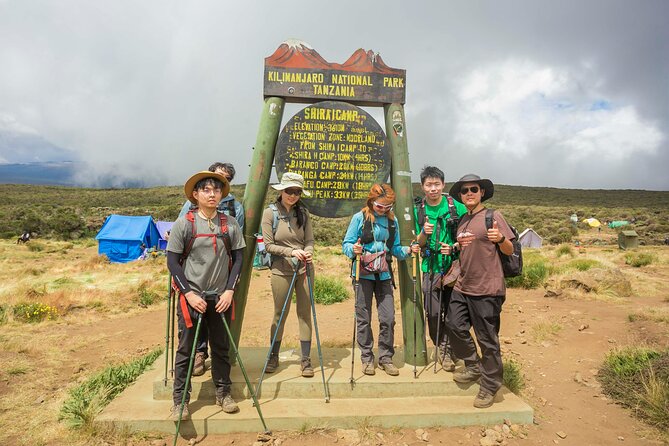
- Day 2: Leaving the rainforest for Shira Camp 1
- Day 3: A short acclimatization day on the Shira Plateau
- Day 4: Lava Tower, Barranco Wall, and a seven-hour crossing
- Day 5: Climbing Barranco Wall to Karanga Camp
- Day 6: Alpine desert and Barafu Camp
- Day 7: Stella Point, Uhuru Peak, and the long descent
- Day 8: Descending through rainforest to Mweka Gate
- What the $2,500 price really covers
- The people behind the climb
- Who should choose this Lemosho climb?
- Should you book the 8-day Lemosho Route?
- FAQ
- How long is the Kilimanjaro Lemosho Route experience?
- How difficult is the climb?
- What is included in the $2,500 price?
- Are flights and travel insurance included?
- Where does the trek begin and end?
- What is the maximum group size?
Key things to know before booking
- The Lemosho Route approaches Kilimanjaro gradually: You begin in rainforest and gain height in stages, which gives your body more time to adjust.
- Summit day is the major test: The climb to Stella Point and Uhuru Peak begins in the early hours and lasts about 13 hours in total.
- The scenery changes dramatically: Expect rainforest, heath, the Shira Plateau, alpine desert, Barranco Wall, glacier views, and the summit ridge.
- The group is limited to 10 people: That is small enough for closer contact with the guides while still offering company on the trail.
- The $2,500 price covers many major costs: Park fees, permits, tents, meals, transfers, guides, porters, water, and safety equipment are included.
- The human support is a major part of the experience: Guides and porters are repeatedly praised for their care, encouragement, and friendly spirit, with Efatha, Sebastian, Elissafi, and Kenny named in particular.
Why eight days is a smart length for Kilimanjaro
Kilimanjaro is not a technical climb in the mountaineering sense, but it is a serious high-altitude trek. The difficulty comes from the height, the cold, the uneven trail, and the final push after several days of walking. An eight-day schedule gives you more time to handle that gradual change than a shorter itinerary.
The Lemosho Route is appealing because the first days are not rushed. Day 3 is deliberately short, with the stated purpose of helping you acclimatize before the route becomes more demanding. Day 4 also includes a stop near Lava Tower before descending to Barranco Camp, another useful high-and-low pattern.
That pacing does not guarantee a successful summit. Altitude affects people differently, and the final ascent remains hard. Still, a gradual schedule is one of the strongest features of this trip, especially if you are choosing between a quicker route and a longer one.
The route also gives you a varied visual experience. You do not spend eight days looking at the same type of trail. Kilimanjaro changes from thick forest to open high ground, then to rocky, dry country near the summit.
More Kilimanjaro routes and climbs:
- Kilimanjaro climb by Lemosho Route (7-day)
★ 5.0 · 651 reviews - Kilimanjaro climb, Machame Route (7-day)
★ 5.0 · 262 reviews - Kilimanjaro Climbing Lemosho Route 8 Days.
★ 5.0 · 186 reviews
Day 1: From Moshi to Big Tree Camp
The day starts after breakfast in Moshi, with transport to Londorossi Gate. Here, you complete the park registration formalities before a shorter drive to the Lemosho trailhead. The trek then begins in the rainforest and continues to Big Tree Camp, with about four hours of walking.
This is a gentle introduction in terms of distance, but do not mistake it for a sightseeing stroll. You are beginning a multi-day high-altitude trek, and the best approach is to walk slowly from the start. The rainforest provides shade and a softer first setting, while the first camp gives you your initial taste of tent life.
The practical advantage of having transport to the gate and trailhead included is clear. You do not have to arrange separate park access or find your own way to the starting point. Airport transfers to and from Kilimanjaro International Airport are also included, though you will need to arrange and pay for international flights yourself.
Day 2: Leaving the rainforest for Shira Camp 1
Day 2 continues through the rainforest before the trail steepens and enters the heath zone. The walk is listed at about five hours, ending at Shira Camp 1.
This is one of the route’s first important changes. The enclosed feel of the forest begins to give way to more open ground, and you start to see how quickly Kilimanjaro’s plant life changes with altitude. The hike is longer than Day 1, but the schedule still allows you to gain height at a measured pace.
Your accommodation is in tents throughout the trek. Camping is part of the appeal for many people, since it keeps you close to the mountain and avoids returning to a hotel each night. It also means you should be ready for basic conditions, shared routines, and less personal space than you would have in Moshi.
Day 3: A short acclimatization day on the Shira Plateau
The third day is relatively short, at about five hours, and heads toward the Shira Plateau. The route offers views of Kilimanjaro and the surrounding scenery while giving your body more time to adjust.
This day has an important job. It breaks up the physical effort before the longer crossing toward Lava Tower and Barranco. You may be tempted to treat a shorter day as an easy day, but it is better used for resting, eating well, drinking the supplied clean water, and paying attention to how you feel.
The Shira Plateau is also where the route begins to feel more expansive. You have moved beyond the forest and into open high country, with the mountain taking a stronger visual role. The combination of time and scenery makes this one of the more rewarding parts of the schedule.
A few more trips of this kind worth comparing:
- Safari Serengeti And Ngorongoro
★ 5.0 · 288 reviews - Climbing Kilimanjaro – Machame Route
★ 5.0 · 170 reviews - Climbing Kilimanjaro through 7 days Machame Route
★ 5.0 · 151 reviews - Kilimanjaro climb, Lemosho Route (8-day)
★ 5.0 · 148 reviews
Day 4: Lava Tower, Barranco Wall, and a seven-hour crossing
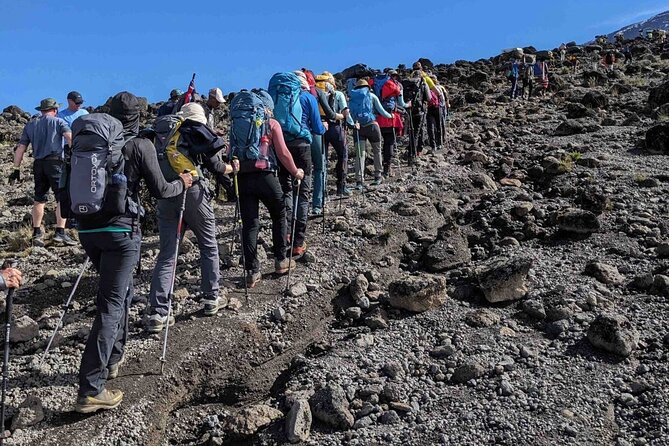
Day 4 is a major transition. You cross the Shira Plateau toward the junction leading to Lava Tower, stop for acclimatization, and then descend to Barranco Camp by way of the scenic Barranco Wall. The stated walking time is about seven hours.
The high point of the day is not simply reaching a camp. The route takes you higher, then drops you down to sleep at Barranco. That pattern helps your body experience greater altitude without keeping you at the highest point for the night.
The Barranco Wall can look intimidating from a distance. The itinerary describes the climb as easier than it appears, but you should still expect hands-on sections and a slower pace. This is not a flat trail, and the day may feel long after the earlier climb toward Lava Tower.
At Barranco Camp, the reward is a dramatic setting and the satisfaction of having crossed a substantial section of the route. This is also a good point to appreciate the value of experienced guides. Their role is not only to lead the way, but to manage pace and help the group move safely over changing ground.
Day 5: Climbing Barranco Wall to Karanga Camp
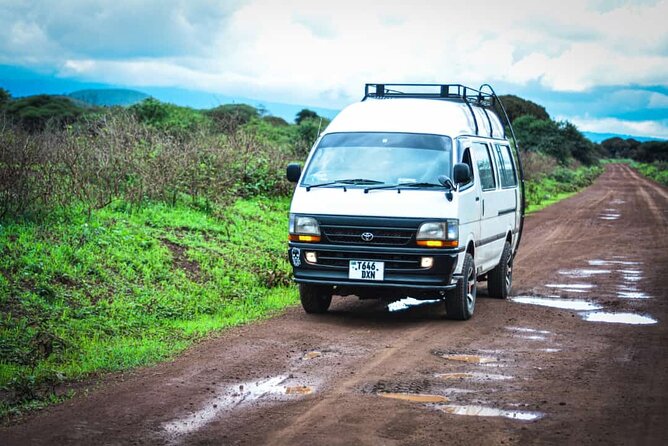
The day begins with the climb up Barranco Wall, then continues through valleys and ridges to Karanga Camp. The walk is listed at about five hours, with views toward Kibo’s southern glacier.
The wall is the headline feature, but the route afterward is just as important. The trail winds through uneven terrain rather than following a simple uphill line. Valleys and ridges make the day feel active even though the total walking time is shorter than Day 4.
The views toward the southern glacier give you a clearer sense of the high mountain ahead. At this stage, Kilimanjaro is no longer an abstract goal visible in the distance. You are moving through its upper zones, and the summit attempt is beginning to feel close.
The support team matters here. Several accounts praise the porters for being cheerful, helpful, and attentive, while the guides are praised for encouragement and safety. You should remember that tips are not included in the $2,500 price, so plan for that separate expense.
Day 6: Alpine desert and Barafu Camp
Day 6 crosses alpine desert terrain toward Barafu Camp, with about four hours of walking. From camp, you get views of Mawenzi and the summit ridge, then rest and prepare for the final ascent.
This shorter day is useful because the next one is the hardest by far. Barafu Camp is a staging point for the summit, not a place to fill with extra activity. Your priorities are eating, drinking, organizing your personal gear, and resting as much as possible.
The alpine desert is a striking contrast to the forest where you began. Plant life becomes sparse, the ground feels more exposed, and the summit ridge looks much closer. The setting can be beautiful, but it also underlines how little shelter there is at this height.
Camping equipment, sleeping bags, sleeping mats, tents, and other listed equipment are included. Your own personal gear is not. You will need to bring items such as hiking boots, clothing, and a backpack, and you should make sure your equipment suits cold, wet, and changing conditions.
Day 7: Stella Point, Uhuru Peak, and the long descent
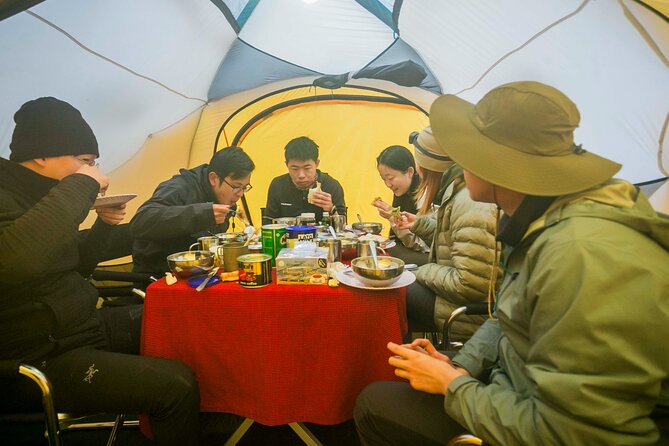
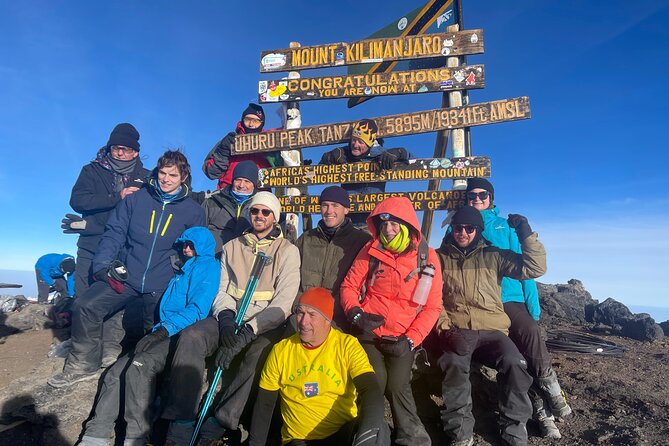
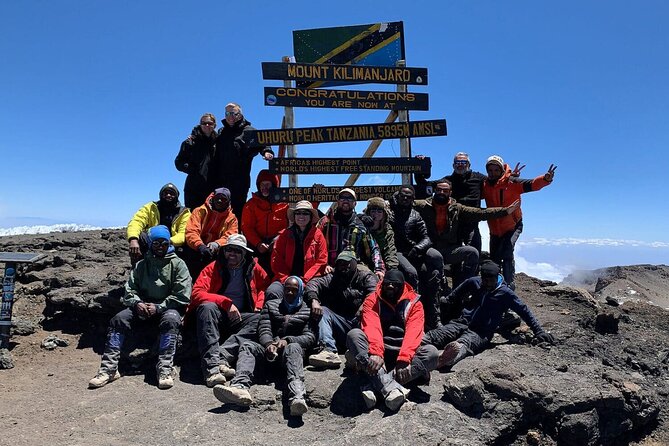
Summit day begins in the early hours. You climb toward Stella Point and aim to arrive around sunrise, then continue to Uhuru Peak, the highest point in Africa. Afterward, you descend to Barafu Camp for a short rest before continuing to Mweka Camp, for a total of about 13 hours.
This is the day to respect. The distance and altitude make it demanding, and the return to Mweka means you do not finish the summit and immediately settle into a full night of rest. Your body has to climb, descend, recover briefly, and keep moving.
Stella Point is a major milestone, but it is not the final summit. You still continue along the rim toward Uhuru Peak. Reaching the summit certificate point is the goal, but the descent is part of the challenge and should not be treated as an afterthought.
The guides’ encouragement can be especially valuable on this day. Past groups have specifically praised Efatha, Sebastian, Elissafi, and Kenny, along with assistant guides and porters, for keeping people supported and motivated. Your assigned team may differ, but the company’s guide and porter support is central to the experience.
Safety equipment listed for the climb includes oxygen tanks and first aid kits. That is reassuring, but it does not remove the need for proper preparation, honest communication with your guides, or travel insurance that includes medical and evacuation coverage. Insurance is not included.
Day 8: Descending through rainforest to Mweka Gate
The final day takes you through rainforest to Mweka Gate, with about five hours of walking. At the gate, you say goodbye to the mountain crew and transfer back to your hotel in Moshi for a well-earned celebration.
The descent is often easier mentally because the summit is behind you, but tired legs can make downhill walking uncomfortable. Take your time, especially on uneven ground. The return to the rainforest also brings a strong sense of completion: in eight days, you have passed through several distinct climate zones and reached Africa’s highest point.
The included transfer to Moshi simplifies the end of the trip. Additional hotel nights and meals before or after the climb are not included, so you will need to budget for those if your flight schedule requires extra time.
What the $2,500 price really covers
At $2,500 per person, this is not a low-cost day excursion. It is a full supported mountain expedition lasting eight days, and the price includes many expenses that can add up quickly when arranged separately.
Included costs cover:
- Airport transfers to and from Kilimanjaro International Airport
- Transport to and from the trailhead
- Park fees and permits
- Experienced guides and porters
- Tents, sleeping bags, sleeping mats, and other camping equipment
- Clean drinking water during the trek
- Breakfast, lunch, and dinner during the eight-day program
- First aid kits and oxygen tanks
- A pre-climb briefing and orientation
- A Kilimanjaro summit certificate
That package gives the price solid value, particularly because park access and camping logistics are already handled. The cost does not cover flights, insurance, personal hiking gear, tips, extra accommodation, alcohol, personal purchases, or optional excursions.
Food appears to be one of the stronger parts of the operation. Specific praise goes to the cook for serving varied, balanced meals, and to the team for providing hot drinks in the tent. On a mountain, a warm drink and a meal you can look forward to are not minor comforts.
The people behind the climb
A Kilimanjaro trek is shaped as much by the support crew as by the route. The strongest praise for this experience focuses on friendly, professional guides, helpful porters, enjoyable food, and a sense of safety throughout the climb.
The group limit of 10 is useful. You get the social energy of a shared climb without being placed in a very large crowd. It can also make it easier for guides to notice differences in pace and offer encouragement when someone is struggling.
The company has been associated with guides including Jackson, Efatha, Sebastian, Elissafi, Kenny, Innocent, and Martin in different trips. Do not assume every named guide will be assigned to your departure, but you can ask who will lead your group before booking.
A practical point deserves attention: porters are essential to the camping setup, yet tips are excluded from the price. Ask the operator for current tipping guidance so you can budget fairly and avoid confusion at the end.
Who should choose this Lemosho climb?
I would recommend this route to you if you want a scenic, gradual approach and are willing to spend eight days camping. It suits people who prefer a measured schedule over a rushed summit attempt, and it is a strong fit for small groups, couples, and families with the required fitness level.
You should be comfortable walking for several hours on successive days. The 13-hour summit day is the key warning sign. If that sounds far beyond your normal activity level, you should not rely on enthusiasm alone.
This trip is less suitable if you want hotel comfort, a short adventure, or a flexible itinerary with plenty of free time. The route is carefully structured around altitude and camp locations, and the mountain decides much of the schedule.
The start time is listed as 8:00 am, with confirmation provided when you book. Free cancellation is available if you cancel at least 24 hours before the local start time. Poor weather may lead to a new date or a full refund, according to the stated policy.
Should you book the 8-day Lemosho Route?
Book it if you want a serious but carefully paced Kilimanjaro climb with varied scenery, strong logistical support, and a small group capped at 10 people. The extra day compared with shorter routes is valuable, especially because the schedule includes acclimatization time before the summit push.
Think twice if you are unprepared for cold camping, long walking days, or a 13-hour summit attempt. Before paying, confirm the assigned guides, the current tipping expectations, the camping equipment provided, and the exact insurance requirements.
For a first Kilimanjaro climb, the mix of gradual ascent, dramatic scenery, full meal support, and experienced guides makes this a sensible choice. The mountain will still be hard, but the route gives you a fair and well-supported chance to meet it properly.
FAQ
How long is the Kilimanjaro Lemosho Route experience?
The climb lasts approximately eight days, from transport out of Moshi on Day 1 to the return to Moshi after reaching Mweka Gate on Day 8.
How difficult is the climb?
Participants should have a moderate physical fitness level. The most demanding section is summit day, which takes about 13 hours and includes the climb to Stella Point, Uhuru Peak, and the descent to Mweka Camp.
What is included in the $2,500 price?
The price includes airport transfers, trailhead transport, park fees, permits, guides, porters, meals, drinking water, tents, sleeping bags, sleeping mats, safety equipment, a pre-climb briefing, and a summit certificate.
Are flights and travel insurance included?
No. International flights and travel insurance are not included. Insurance costs may include medical care, evacuation, and trip cancellation protection, depending on the policy you choose.
Where does the trek begin and end?
The trip begins with transport from Moshi to Londorossi Gate and the Lemosho trailhead. It ends at Mweka Gate, followed by transfer back to a hotel in Moshi.
What is the maximum group size?
The maximum group size is 10 people. The listed meeting time is 8:00 am, and booking confirmation is provided at the time of reservation.
Just added around Moshi
- Moshi: Lake Chala Tour: Hiking &/or Kayaking★ 4.5 · 3 reviews
- 3 Days Tanga Exclusive Beach Holiday★ 5.0 · 3 reviews
- Serengeti Wildebeest Migration.★ 5.0 · 3 reviews
- Chemka Hotpsrings E-Bike Day Trip★ 5.0 · 3 reviews
- Explore 1 day Ngorongoro Crater Budget Group Safari from Arusha★ 5.0 · 3 reviews
- Explore the 360° of Kilimanjaro★ 5.0 · 3 reviews
- Affordable Short Tanzania Safari (2 Days Camping Safari)★ 5.0 · 3 reviews
- Rongai Route 7 Days★ 5.0 · 3 reviews
Kilimanjaro Treks, compared.



8-Day Small-group Lemosho Kilimanjaro Summit Trekking
Read our review →


Climbing Kilimanjaro through 7 days Machame Route
Read our review →

Browse the lists this tour appears in