
Reviewed · KILIMANJARO TREKS
5 Days Kilimanjaro Trekking – Marangu Route
Africa’s highest peak rewards steady effort. This five-day Marangu Route trek gives you a direct path toward Uhuru Peak, with forest, moorland, volcanic terrain, and a long summit night all packed into one demanding trip. I like the route’s comfortable hut accommodation and the chance to see several distinct climate zones without camping each night. I also like the private format, since your guide can adjust the walking pace to suit your group.
The main caution is the schedule. Five days is a short time for a mountain that rises to 5,895 meters, and the summit day is physically tough. The extra acclimatization day at Horombo is described as optional, but I would treat it as highly useful rather than an easy day to skip.
In This Review
- Key points to know before you book
- Why the Marangu Route appeals to first-time climbers
- Pickup from Moshi and the drive to Marangu Gate
- Mandara Hut and the first forest section
- Horombo Huts at 3,700 meters
- The Horombo acclimatization day
- The midnight climb to Gilman’s Point
- The long descent to Horombo
- Returning through the rainforest to Moshi
- Guides, porters, food, and the private format
- What $1,460 includes and what it means
- Who should book this Kilimanjaro climb?
- Should you book Afrishare’s five-day Marangu Route?
- FAQ
- How long is the Kilimanjaro Marangu Route tour?
- Where does the tour begin?
- Is this a private tour?
- What is the highest point reached?
- Is the Horombo acclimatization day required?
- What accommodation is included?
- Is food included?
- Can I cancel for a refund?
Key points to know before you book
- A hut-based climb: You sleep in mountain huts rather than tents, with four nights of accommodation included.
- The summit starts around midnight: Expect a steep, cold climb to Gilman’s Point, followed by another push to Uhuru Peak.
- Horombo is your acclimatization base: The optional walk to Zebra Rocks or Mawenzi Tarn can improve your summit chances.
- The scenery changes quickly: You move from rainforest to open moorland, semi-desert terrain, volcanic scree, and the upper slopes of Kibo.
- A private tour for your group: Hotel pickup and drop-off are included, and the pace can be managed more easily than on a large group departure.
- The price is $1,460 per person: That includes park fees, a professional guide, lunch, four nights of accommodation, and transport connected with the climb.
Why the Marangu Route appeals to first-time climbers
Marangu is often called the Coca Cola route because it is considered one of the easier routes up Kilimanjaro. That nickname can mislead you. The trail may be more straightforward than some alternatives, but the altitude and summit night remain serious challenges.
The biggest practical advantage is the hut system. You are not carrying or sleeping in a tent, and you have a more sheltered base at the end of each walking day. For many people, that makes the climb feel more manageable. The huts do not remove the hard work, but they do reduce some of the camping burden.
You also get strong changes in scenery. Lower on the mountain, the trail passes through rainforest. Higher up, the trees thin out and the route opens into moorland with giant senecio and lobelias. Near the summit, the ground becomes harsher, with scree, snow, and volcanic rock.
I would choose this route if you value a simpler trail and hut accommodation. I would not choose it simply because it sounds easy. A moderate fitness level is required, and your body still has to cope with a rapid rise from Moshi to nearly 5,900 meters.
More Kilimanjaro routes and climbs:
- Kilimanjaro climb by Lemosho Route (7-day)
★ 5.0 · 651 reviews - Kilimanjaro climb, Machame Route (7-day)
★ 5.0 · 262 reviews - Kilimanjaro Climbing Lemosho Route 8 Days.
★ 5.0 · 186 reviews
Pickup from Moshi and the drive to Marangu Gate
The day begins early. You can be collected from the airport or from your accommodation, then driven to the Marangu starting gate. Hotel pickup and drop-off are included, which makes the arrival day simpler, especially if you are carrying trekking luggage and have just landed in Tanzania.
At the gate, the climb begins after the entry formalities. The package includes all fees and taxes, so you do not need to handle the park charges separately. It is worth confirming your pickup time and location before the start, particularly if you are arriving by air on the same morning.
The mountain itself has three major volcanic centers: Shira, Mawenzi, and Kibo. Kibo is the snow-capped summit cone and reaches 5,895 meters. Mawenzi becomes a striking companion as you climb, particularly around Horombo.
The first day is less about dramatic altitude and more about settling into the rhythm. Walk slowly from the start. A relaxed pace helps you conserve energy for the much harder days ahead.
Mandara Hut and the first forest section
The early section of the Marangu Route leads through rainforest toward Mandara Hut. This is one of the most appealing parts of the climb because the vegetation feels very different from the dry, open upper mountain.
The forest can be wet, particularly in poor weather. Pack rain gear where you can reach it quickly, rather than burying it at the bottom of your bag. The route is operated in all weather, so you should expect conditions to change.
The first overnight stop is Mandara Hut, at about 2,700 meters. From here, the route soon leaves the forest and moves into open moorland. That change is easy to notice: the air feels thinner, the trees give way to broad views, and giant plants begin to appear.
The supplied schedule is not perfectly clear about how the first two days are divided, but the important point is that Mandara is the first mountain hut and Horombo is the next major base. Ask Afrishare for the exact daily walking distances and overnight sequence before departure.
Horombo Huts at 3,700 meters
From Mandara Hut, the walk to Horombo takes about three to four hours according to the planned schedule. After roughly 15 minutes, you leave the rainforest behind and follow an ascending path across open moorland.
Horombo sits at approximately 3,700 meters. This is where the climb begins to feel more serious. You may notice a headache, tiredness, shortness of breath, or a slower pace. The best response is to tell your guide early. Staying quiet about altitude symptoms does not help you reach the summit.
The setting is excellent. You get views toward Mawenzi and Kibo, with giant senecio and lobelias adding a distinctly Kilimanjaro feel. These plants are not just background decoration. They mark the unusual high-altitude environment and make this section memorable even before the summit appears close.
Accommodation at the huts is one of the route’s strongest features. Feedback about the trip praised the comfort of the accommodation, food, guides, chef, and porters. The exact hut conditions are not described in detail, so you should still expect basic mountain accommodation rather than hotel service.
A few more trips of this kind worth comparing:
- Private Kilimanjaro Hike 7 Day Lemosho Route
★ 5.0 · 60 reviews - Best Kilimanjaro hiking day trip tour with Kilinge Adventures
★ 4.5 · 54 reviews - #1. Best Kilimanjaro Day hike Tour-Machame Route-ISMANI
★ 4.2 · 47 reviews - Best Kilimanjaro Adventure 7 days Machame route Trekking
★ 5.0 · 42 reviews
The Horombo acclimatization day
The extra day at Horombo starts and ends at the same hut. You can rest at camp or take a day walk toward Zebra Rocks at 4,200 meters and Mawenzi Tarn Hut at about 4,300 meters.
I strongly favor taking the acclimatization walk if your guide considers it suitable. The route gives you the useful pattern of going higher and returning to sleep lower. That can help your body adjust before the summit attempt. It also gives you another chance to see Mawenzi and the upper mountain without carrying your full summit-day load.
The word optional deserves care here. It may be optional in the schedule, but skipping it makes an already compressed five-day climb even tighter. The third day is also your chance to check clothing, water, snacks, and headlamp batteries before the midnight start.
Do not treat Horombo as a spare holiday day. Use it to rest, drink, eat, and watch for altitude problems. The summit success stories associated with this company repeatedly point to a slow, controlled pace and attentive guides. That is exactly what you want at this stage.
The midnight climb to Gilman’s Point
Summit day starts very early, usually between midnight and 2 a.m. You climb steep terrain covered in heavy scree or snow toward Gilman’s Point on the crater rim.
The planned climb to Gilman’s Point takes about four to five hours. The supplied elevation is given as 5,861 meters, or 18,640 feet. The effort is slow and deliberate. At this altitude, rushing only wastes energy.
This is the toughest part of the trip for most people. It is dark, cold, and steep, and you are walking after several days of exertion. Your guide’s pacing matters a great deal. The company’s feedback repeatedly praises guides for being patient, checking how the group was doing, and slowing down when needed.
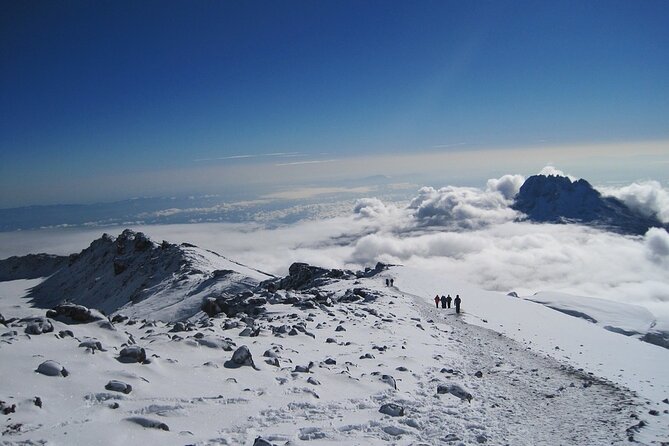
From Gilman’s Point, you continue toward Uhuru Peak. The final section takes another one to two hours in the schedule. Uhuru is listed at 5,895 meters, or 19,340 feet, and is the highest point in Africa.
The route description promises striking views along the way, though visibility depends on weather. At the summit, you have time for photographs before beginning the long descent. Bring a camera or phone only if you can keep it protected from cold and moisture. A summit photograph is a fine reward, but reaching the top safely matters more.
The long descent to Horombo
After Uhuru Peak, you descend toward Kibo for lunch and a rest, then continue down to Horombo for dinner and overnight. The descent from the summit area to Horombo is expected to take another three to four hours.
This is a very long day. Reaching the summit is only half the job. Your knees, feet, and concentration still have to carry you down scree and uneven ground. Trekking poles can help, especially on the descent.
The value of having dinner and a bed at Horombo is clear here. You do not have to continue all the way to the park gate after the summit. That break gives you time to recover before the final descent.
Returning through the rainforest to Moshi
After breakfast, you descend through moorland toward Mandara Hut, then continue through the forest to Marangu Gate. The lower section uses a good path, but rain can make it wet and muddy.
Pack gaiters and trekking poles if you have them. At lower elevations, shorts and a T-shirt may be comfortable, but keep rainwear and warmer clothing within reach. Mountain weather does not always respect your clothing plan.
A car waits at the gate, with hot lunch provided before the drive back to Moshi or Arusha. The company can also arrange an airport drop-off if you are flying out the same day after the trek. I would be cautious about booking a tight onward flight, since the descent and drive can take longer in poor weather or heavy traffic.
Guides, porters, food, and the private format
The package includes a professional guide and is run as a private activity for your group. That is useful on a mountain where different people often need different walking speeds.
Feedback about the crew is especially positive. Specific praise focuses on patient guides, a skilled chef, helpful porters, good food, and a steady pace. One reported trip named guides Alex and Godfrey. Another described the director, Ibra, helping coordinate a wider Tanzania program that included Kilimanjaro, Arusha National Park, and a month-long landscape restoration course.
Those names do not guarantee that the same people will lead your climb, but they show the company has received strong personal praise for its team. Ask who your guide will be and how many porters and support staff are assigned to your group before departure.
Lunch is included, along with four nights of accommodation. Vegetarian meals are available if requested at booking, and you should provide any other dietary requirements in advance. Alcoholic drinks and souvenir photographs cost extra.
What $1,460 includes and what it means
The price is $1,460 per person. That is not a budget walk, but the value depends on what you would otherwise have to arrange separately.
The listed package includes:
- Four nights of accommodation
- All fees and taxes
- Lunch
- A professional guide
- Hotel pickup and drop-off
- A private tour
The price also packages the mountain logistics into one arrangement. You are not separately arranging the transport from Moshi to Marangu, the return vehicle, park fees, guide, or hut stays.
The key question is not simply if $1,460 is cheap. It is whether the private support, guide, food arrangements, hut accommodation, and transport match what you need. If you want the simplest possible way to organize a five-day climb, the price may be reasonable. If you already have local transport, park access, and a trekking team arranged, it may not be the right comparison.
The trip is booked an average of 42 days ahead, so do not leave planning until the last week. The price is per person, and a child rate applies only when sharing with two paying adults.
Who should book this Kilimanjaro climb?
This trek suits you if you want:
- A five-day route with hut accommodation
- A private climb rather than a shared group
- Hotel pickup and return transport
- A route with rainforest, moorland, volcanic terrain, and summit views
- Support from guides, a chef, and porters
- A company with strong feedback about pace, food, and care
It may not suit you if you need a slow, extended acclimatization schedule. Five days is compact, and the summit attempt comes after a short period on the mountain. You should also think twice if you have low fitness, limited cold-weather gear, or little tolerance for a midnight start and a very long summit day.
The best preparation is simple: train for long uphill walks, practice using trekking poles, bring layers and reliable rain gear, and tell the guide promptly about any altitude symptoms. Do not judge the climb by the Coca Cola nickname. Kilimanjaro is still a high-altitude mountain.
Should you book Afrishare’s five-day Marangu Route?
I would book this trek if you want the practical comfort of huts, a private group, and a tightly organized route from Moshi to the summit and back. The strongest points are the crew’s reported patience, the good food, the manageable pace, and the useful Horombo acclimatization option.
I would not book it without first confirming the exact day-by-day schedule, the guide assignment, what meals beyond lunch are included, and the pickup plan. Most important, understand that five days leaves less room for acclimatization than a longer climb.
For a fit walker who accepts the altitude challenge and wants a straightforward Kilimanjaro plan, this is a strong option. Take the Horombo day, walk slowly, keep your rain gear handy, and save plenty of energy for the descent.
FAQ
How long is the Kilimanjaro Marangu Route tour?
The tour lasts approximately five days and includes four nights of accommodation.
Where does the tour begin?
Pickup is available from the airport or your accommodation, followed by a drive to the Marangu starting gate.
Is this a private tour?
Yes. Only your group participates in the private activity.
What is the highest point reached?
The route aims for Uhuru Peak, listed at 5,895 meters, or 19,340 feet, the highest point in Africa.
Is the Horombo acclimatization day required?
The day is described as optional, with the choice to rest at Horombo or walk to Zebra Rocks and Mawenzi Tarn Hut. It is an important acclimatization opportunity.
What accommodation is included?
Four nights of accommodation are included. The route uses mountain huts at stops such as Mandara and Horombo.
Is food included?
Lunch is included. Vegetarian meals are available, and you should provide dietary requirements when booking. Alcoholic drinks are not included.
Can I cancel for a refund?
You can cancel at least 24 hours before the experience start time for a full refund. Cancellations or changes made less than 24 hours before the start are not accepted for a refund.
More 5-Day Experiences
- 5 Days Camping Tarangire, Serengeti & Ngorongoro crater & Visiting Maasai
★ 5.0 · 58 reviews - 5-Day Majestic Tanzania Safari – High End All Inclusive
★ 5.0 · 44 reviews - 5 Day Mid range Tanzania Safari
★ 5.0 · 34 reviews - 5 days Tanzania Camping Safari
★ 5.0 · 29 reviews
Just added around Moshi
- Moshi: Lake Chala Tour: Hiking &/or Kayaking★ 4.5 · 3 reviews
- 3 Days Tanga Exclusive Beach Holiday★ 5.0 · 3 reviews
- Serengeti Wildebeest Migration.★ 5.0 · 3 reviews
- Chemka Hotpsrings E-Bike Day Trip★ 5.0 · 3 reviews
- Explore 1 day Ngorongoro Crater Budget Group Safari from Arusha★ 5.0 · 3 reviews
- Explore the 360° of Kilimanjaro★ 5.0 · 3 reviews
- Affordable Short Tanzania Safari (2 Days Camping Safari)★ 5.0 · 3 reviews
- Rongai Route 7 Days★ 5.0 · 3 reviews
Kilimanjaro Treks, compared.



8-Day Small-group Lemosho Kilimanjaro Summit Trekking
Read our review →


Climbing Kilimanjaro through 7 days Machame Route
Read our review →

Browse the lists this tour appears in