
Reviewed · KILIMANJARO TREKS
Climb Kilimanjaro Machame Route 7 Days
Kilimanjaro rewards patience more than bravado. This seven-day Machame climb gives you a well-paced route up Africa’s highest mountain, with forest, moorland, high volcanic slopes, glacier views, and a sunrise summit attempt. I especially like the extra acclimatization day between Barranco and Barafu, and the fact that the package includes guides, porters, a cook, camping equipment, meals, airport transfers, and two hotel nights. The main consideration is simple: this is a serious physical challenge, not a casual holiday hike.
I also like the practical setup. Foot On Kili Tanzania Adventures provides airport pickup, a company representative to meet you on arrival, and transport back to Moshi after the descent. Past praise centers on the care given by guides such as Mussa and Frankie, the food on the mountain, and steady support during the summit push. At $2,200 per person, the price is reasonable for a private, fully supported seven-day climb, but you still need to budget for tips, a visa, flights, drinks, and personal gear.
In This Review
- Key points before you book
- Why seven days is the sensible Machame schedule
- Arrival in Tanzania and the Moshi start
- Day 1: Machame Gate to Machame Camp
- Day 2: Machame Camp to Shira Camp
- Day 3: Shira Camp to Lava Tower to Barranco Camp
- Day 4: Barranco Camp to Karanga Camp
- Day 5: Karanga Camp to Barafu Camp
- Day 6: Barafu Camp to Uhuru Peak and Mweka Camp
- Day 7: Mweka Camp to Moshi
- What the $2,200 price really covers
- Food, equipment, and support on the mountain
- Who should choose this climb
- Cancellation and planning notes
- Should you book the Machame Route in seven days?
- FAQ
- Where does the climb start?
- How long is the Machame Route climb?
- Is this a private tour?
- What level of fitness do I need?
- What is included in the $2,200 price?
- What is not included?
- What equipment is recommended for the route?
- Can I cancel for a full refund?
Key points before you book
- Seven days on the Machame Route: The schedule breaks Barranco to Barafu into two days, giving you more time to adjust to altitude.
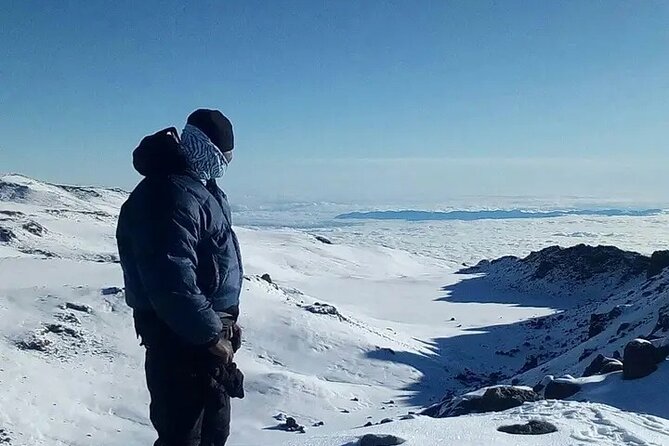
- A midnight summit start: You climb through the night toward Stella Point and Uhuru Peak, usually reaching the top around sunrise.
- A full support team: The package includes a guide, cook, porters, camping equipment, park fees, food, and an oxygen tank.
- Two hotel nights included: You begin and finish with time in Moshi or Arusha, rather than rushing straight from the airport to the trail.
- Private group format: Only your group participates, which allows the pace and support to be handled around your party.
- A demanding but scenic route: Expect muddy forest paths, rocky ridges, loose gravel, cold high camps, and a long summit day.
Why seven days is the sensible Machame schedule
The Machame Route is often chosen for its changing scenery and gradual rise toward the summit. The seven-day version is especially appealing because it does not rush the section between Barranco Camp and Barafu Camp.
That extra day matters. The summit attempt begins around midnight, so you want to reach Barafu, eat, organize your clothing and gear, and sleep as much as possible before climbing through the dark. A shorter itinerary can leave you facing the hardest day while tired from a long approach.
This is still no easy walk. The route gains altitude quickly during the first few days, and the summit day combines a five-kilometer ascent with a 12-kilometer descent. You need strong physical fitness, patience, and the willingness to walk slowly when the guide sets the pace.
The private format is useful here. You are not tied to a large mixed group, and your guide can pay attention to how your party is handling the altitude. The trip description emphasizes safety, professional guides, good equipment, and a trained mountain team. Those are not minor details on Kilimanjaro. They shape your chances of enjoying the climb and completing it safely.
More Kilimanjaro routes and climbs:
- Kilimanjaro climb by Lemosho Route (7-day)
★ 5.0 · 651 reviews - Kilimanjaro climb, Machame Route (7-day)
★ 5.0 · 262 reviews - Kilimanjaro Climbing Lemosho Route 8 Days.
★ 5.0 · 186 reviews
Arrival in Tanzania and the Moshi start
Your arrival begins with an airport pickup. A company representative meets you at the arrival point with a signboard, introduces himself, gives you a short briefing, and drives you to your hotel in Moshi.
The stated meeting point is Honey Badger Lodge in Moshi, at M92P+CP, Kiboriloni 1258. The package includes two hotel nights in Moshi or Arusha, although the supplied information does not specify the exact hotel arrangement for every booking. Confirm that detail before you travel.
This first hotel time is useful. You can settle after your flight, organize your personal climbing items, and meet the team before walking into the mountain environment. It also gives you a buffer if your flight schedule changes.
The drive from Moshi to Machame Gate takes about 50 minutes. The road passes through Machame village on the lower slopes of Kilimanjaro, then reaches the national park gate, where the trek begins.
Day 1: Machame Gate to Machame Camp
The first walking day covers about 11 kilometers and takes roughly five to seven hours. You climb from around 5,400 feet to 9,400 feet through rain forest.
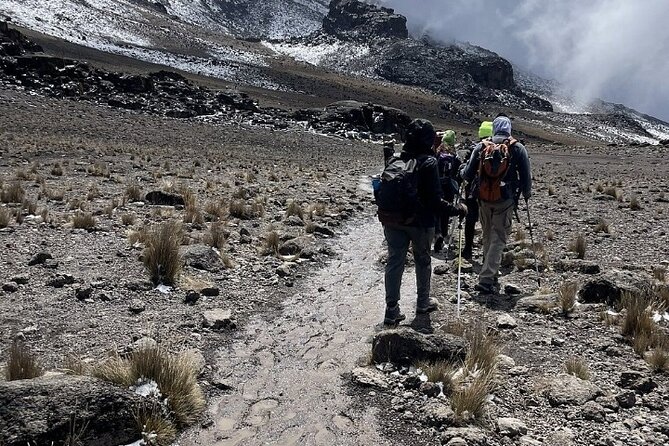
This is a classic first day on Kilimanjaro. The trail winds up a ridge beneath thick forest, with a noticeable change from road travel to mountain walking. Lower sections can be muddy and slippery, especially in wet conditions. Gaiters and trekking poles are practical choices, not fancy extras.
The challenge here is less about altitude and more about settling into a steady rhythm. You may feel eager at the start, but the best approach is to walk slowly and keep energy in reserve. Machame Camp marks your first mountain night, and the forest setting makes it feel like a real departure from ordinary life.
Day 2: Machame Camp to Shira Camp
Day two is shorter, covering about five kilometers in four to six hours. You climb from 9,400 feet to approximately 12,500 feet, leaving the forest for moorland.
The trail becomes more open as you cross a small valley and follow a steep, rocky ridge covered with heather. The route then turns west toward a river gorge and Shira Camp.
The shorter distance does not mean an effortless day. Your body is now adjusting to higher altitude, and the gain of more than 3,000 feet can be felt. I would treat this as an acclimatization day with views rather than a day to chase speed.
At camp, the routine is straightforward: rest, eat dinner, and sleep. Since food is included on the mountain and a cook is part of the team, you are not responsible for planning meals after a tiring day. That support has received strong praise, particularly for the quality of the cooking and attentive care.
A few more trips of this kind worth comparing:
- Climbing Kilimanjaro through 7 days Machame Route
★ 5.0 · 151 reviews - 7 Days Kilimanjaro via Machame route affordable price
★ 5.0 · 110 reviews - Private Kilimanjaro Hike 7 Day Lemosho Route
★ 5.0 · 60 reviews - 7-Day Magical Tanzania Safari -Premium High End Package
★ 5.0 · 53 reviews
Day 3: Shira Camp to Lava Tower to Barranco Camp
This is one of the most important days of the climb. The route covers about 10 kilometers in six to eight hours, rising from 12,500 feet to roughly 13,000 feet, but passing near Lava Tower at about 13,000 feet and toward a junction at around 16,000 feet.
The habitat changes to semi-desert. From the Shira Plateau, you head east along a ridge, pass the junction toward Kibo Peak, and then turn southeast toward Lava Tower, also called the Shark’s Tooth.
After Lava Tower, the route begins to descend toward Barranco Camp. That up-and-down pattern is deliberate. You spend time at a higher altitude, then sleep lower, which helps your body adjust before the summit attempt.
This day can be uncomfortable. You may feel the thin air, and the long hours require steady effort. Yet it is valuable preparation. Barranco Camp, at around 13,000 feet, gives you a dramatic high-mountain setting and places you well for the next day’s shorter walk.
Day 4: Barranco Camp to Karanga Camp
Day four covers about five kilometers in four to five hours. You leave Barranco Camp, climb the steep ridge beside the Barranco Wall, and continue to Karanga Camp at approximately 13,100 feet.
The Barranco Wall is the most visually striking feature of this section. The route is steep, but the itinerary treats this as a short acclimatization day rather than a long march. That is a wise design choice.
You should not expect a relaxed stroll. The combination of rock, altitude, and exposure can require concentration. Still, the limited distance leaves time to rest, eat, and prepare mentally for the higher camp ahead.
Day 5: Karanga Camp to Barafu Camp
The walk to Barafu Camp is only about four kilometers, taking four to five hours, but you climb from 13,100 feet to around 15,300 feet. The surroundings shift into alpine desert, with sparse vegetation and a much more severe mountain feel.
You join the junction with the Mweka Trail and continue uphill to Barafu. Reaching this camp means you have completed the South Circuit, with views of the summit from several angles. Mawenzi and Kibo are visible from the area.
This is a short day on paper, but Barafu is not the place to spend your energy unnecessarily. You need to rest, eat dinner, check your warm layers, and prepare for a midnight or early morning departure. Your guide should explain the summit routine and help ensure you are ready.
The inclusion of camping equipment, food, porters, and a cook makes a real difference at this point. You can focus on resting instead of carrying the full camp or preparing your own meals. An oxygen tank is also included, though its presence should not make you treat altitude lightly.
Day 6: Barafu Camp to Uhuru Peak and Mweka Camp
Summit day is the hardest part of the climb. You usually start between midnight and 2 a.m., ascending through heavy scree toward Stella Point on the crater rim.
The ascent covers about five kilometers and takes roughly seven to eight hours. You climb from 15,300 feet to Uhuru Peak at 19,345 feet. The route heads northwest between the Rebmann and Ratzel glaciers, though conditions can change and snow may appear near the summit.
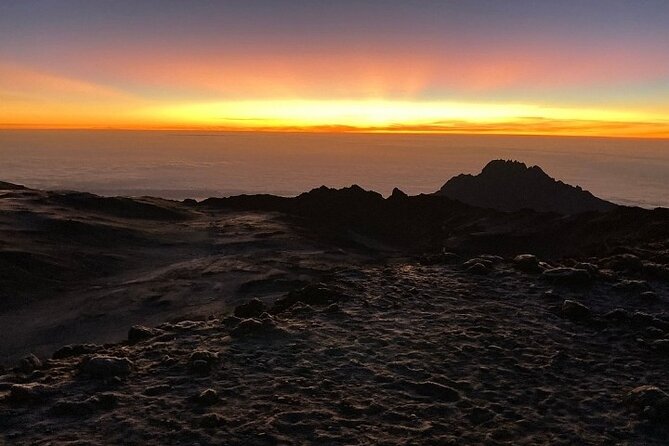
At Stella Point, around 18,600 feet, you can pause for a short rest. If the weather cooperates, sunrise from this position is a major reward. Faster climbers may see sunrise from Uhuru Peak itself, but the important goal is to climb safely and steadily rather than race the clock.
Uhuru Peak is the highest point on Kilimanjaro and the highest point in Africa. Reaching it is a major physical achievement, but the summit is only half of the day. You then descend 12 kilometers toward Mweka Camp, stopping at Barafu for lunch.
The descent over loose gravel can be hard on tired legs. Gaiters and trekking poles are especially useful here. Mweka Camp sits in the upper forest, where mist or rain may arrive later in the afternoon. Dinner and sleep at camp should feel well earned.
This is where the personal care from the mountain team matters most. Feedback about Mussa, Frankie, and the wider crew repeatedly points to support, kindness, and careful attention during the climb. The best guide is not the one who pushes everyone at the same speed. It is the one who helps you manage your own effort and make sound decisions.
Day 7: Mweka Camp to Moshi
The final walking day covers about 10 kilometers and takes three to four hours. You descend from around 10,000 feet to 5,400 feet through rain forest and continue to Mweka Park Gate.
Lower sections can be wet and muddy. Gaiters remain useful, while shorts and a T-shirt may be comfortable once the temperature rises. Keep rain gear and warmer clothing close, since mountain weather can shift before you reach the gate.
At the park gate, you receive your summit certificates. From there, you continue for about another hour to Mweka village, where a vehicle meets you and drives you back to your hotel in Moshi.
The return transfer is a welcome detail. After the summit day and descent, you do not want to arrange a complicated ride on your own. An air-conditioned vehicle is included, and the company also describes its transport as a 4×4 safari vehicle.
What the $2,200 price really covers
At $2,200 per person, this is not a budget walk, but it includes many of the expenses that make a Kilimanjaro climb possible.
The package includes:
- National park entry fees
- Camping equipment
- Mountain food
- A guide, cook, and porters
- Team salaries
- An oxygen tank
- Two hotel nights in Moshi or Arusha
- Airport transfers
- An air-conditioned vehicle
The strongest value comes from the seven-day schedule and the full mountain support. You are paying for permits, logistics, staff, food, transport, and a route that gives you more acclimatization time than a rushed climb.
The price does not include tips and beverages, a Tanzanian visa, flights, or personal climbing items. Personal equipment can be a major extra cost if you do not already own suitable cold-weather clothing, footwear, rain protection, gaiters, and trekking poles.
Ask for a clear breakdown of the team arrangement and equipment before paying. The supplied information promises quality equipment, but it does not list every item available for hire or the condition of individual pieces.
Food, equipment, and support on the mountain
A cook is included, and food on the mountain is part of the package. Strong praise has focused on the meals and the attentive service around camp. That matters because appetite and energy can become difficult at altitude.
Camping equipment is also included, but personal climbing items are not. You should ask exactly what the operator provides before arrival. The information specifically recommends gaiters and trekking poles for muddy forest sections and loose gravel on the descent.
The team includes guides and porters, and salaries are included in the price. Tips are not. Tipping is an important cost to plan for, so ask the company for current guidance on how much and how to distribute it.
Safety is presented as the top priority, with an oxygen tank included. That is reassuring, but no equipment replaces careful pacing, honest communication about symptoms, and respect for the altitude. You should tell your guide promptly if you feel unwell.
Who should choose this climb
I would recommend this trip to someone who wants a private, fully supported Kilimanjaro climb and has enough time for the seven-day schedule. It suits people who value a slower approach, mountain scenery, and a team that handles transport, food, camping, and park arrangements.
It may also suit first-time high-altitude climbers who want a structured route rather than an independent trek. The schedule is demanding, but the extra day before Barafu gives you a better chance to rest before the summit attempt.
I would not choose it if you want a short, easy outdoor experience. You need strong physical fitness, and the summit day involves walking at night, climbing to 19,345 feet, then descending for many hours. The listing gives an approximate duration of one to seven days, but the detailed plan is clearly a seven-day climb with hotel arrangements before or after the mountain. Confirm the exact number of nights and dates with Foot On Kili before booking.
The tour is private, and service animals are allowed. It is also listed near public transportation, though the company provides airport transfers and dedicated vehicle support.
Cancellation and planning notes
You can cancel up to 24 hours before the experience start time for a full refund. Cancellations or changes made less than 24 hours before the start are not accepted for a refund, and cut-off times use local Tanzanian time.
Confirmation is provided at booking. I would still confirm the airport meeting point, hotel location, available personal gear, exact pickup arrangements, and current tipping guidance before you fly.
Should you book the Machame Route in seven days?
Yes, if you want a carefully paced Kilimanjaro climb with a private group, full mountain support, airport transfers, and two hotel nights included. The best reason to choose this version is the extra acclimatization day before Barafu, not simply the scenic route.
Book it if you are prepared for a demanding summit night and understand the extra costs for flights, visa, drinks, tips, and personal climbing equipment. The praise for Mussa, Frankie, the food, and the caring mountain team adds confidence, but you should still ask direct questions about equipment and logistics.
For a serious first Kilimanjaro attempt, this seven-day Machame plan offers a sensible balance of scenery, support, and time. It is tough, but it does not needlessly hurry you.
FAQ
Where does the climb start?
The listed meeting point is Honey Badger Lodge in Moshi, Kilimanjaro, Tanzania. Airport pickup is offered, and a company representative meets you at the arrival point with a signboard.
How long is the Machame Route climb?
The detailed itinerary lasts seven days. The overall trip also includes two hotel nights in Moshi or Arusha, according to the package information.
Is this a private tour?
Yes. Only your group participates in the activity.
What level of fitness do I need?
You should have a strong physical fitness level. The route includes long walking days, steep sections, high altitude, a midnight summit departure, and a long descent after reaching Uhuru Peak.
What is included in the $2,200 price?
The price includes camping equipment, park entry fees, team salaries, two hotel nights in Moshi or Arusha, airport transfers, an oxygen tank, food on the mountain, a guide, cook, porters, and an air-conditioned vehicle.
What is not included?
Flights, a Tanzanian visa, beverages, tips, and personal climbing items are not included.
What equipment is recommended for the route?
Gaiters and trekking poles are recommended for muddy forest trails and loose gravel during the descent. Personal climbing items are not included, so confirm the exact equipment arrangement before departure.
Can I cancel for a full refund?
Yes. You can cancel at least 24 hours before the experience start time for a full refund. Cancellations or changes made less than 24 hours before the start time are not accepted for a refund.
Just added around Moshi
- Moshi: Lake Chala Tour: Hiking &/or Kayaking★ 4.5 · 3 reviews
- 3 Days Tanga Exclusive Beach Holiday★ 5.0 · 3 reviews
- Serengeti Wildebeest Migration.★ 5.0 · 3 reviews
- Chemka Hotpsrings E-Bike Day Trip★ 5.0 · 3 reviews
- Explore 1 day Ngorongoro Crater Budget Group Safari from Arusha★ 5.0 · 3 reviews
- Explore the 360° of Kilimanjaro★ 5.0 · 3 reviews
- Affordable Short Tanzania Safari (2 Days Camping Safari)★ 5.0 · 3 reviews
- Rongai Route 7 Days★ 5.0 · 3 reviews
Kilimanjaro Treks, compared.



8-Day Small-group Lemosho Kilimanjaro Summit Trekking
Read our review →


Climbing Kilimanjaro through 7 days Machame Route
Read our review →

Browse the lists this tour appears in