
Reviewed · KILIMANJARO TREKS
Discover Our Latest 6 Days Climbing Kilimanjaro – Marangu Route
Kilimanjaro rewards steady steps. This six-day Marangu Route climb takes you from Moshi to Uhuru Peak with hut accommodation, meals, a guide, porters, and private transfers included. I like the planned acclimatization day at Horombo Huts, and I like the chance to climb with your own party rather than being placed with strangers. The main caution is cost: the advertised $1,150 price does not include park fees, insurance, tips, gear, flights, or hotels before and after the climb.
I also like the clear rhythm of the route: rainforest on day one, high moorland on day two, a rest and acclimatization walk on day three, then the summit attempt on day five. The drawback is that six days is still a demanding schedule, and the summit day can last about 12 hours. You need good fitness, suitable equipment, and a sensible attitude toward altitude.
In This Review
- Key points to know before booking
- Why the Marangu Route appeals to first-time climbers
- Day one: Moshi to Marangu Gate and Mandara Hut
- Day two: Mandara Hut to Horombo at 3,720 meters
- Day three: the Horombo acclimatization walk to Mawenzi
- Day four: crossing the Saddle to Kibo Hut
- Day five: the 12-hour push to Uhuru Peak
- Day six: descending through Mandara to Moshi
- What the $1,150 price really covers
- Guides, porters, meals, and the human side
- Who should book this climb?
- Useful planning details before departure
- FAQ
- How long is the Kilimanjaro climb?
- Which route does the climb use?
- Is accommodation included?
- Is the climb private?
- Are meals included?
- Are Mount Kilimanjaro park fees included?
- What happens if bad weather cancels the climb?
- Should you book the six-day Marangu climb?
Key points to know before booking
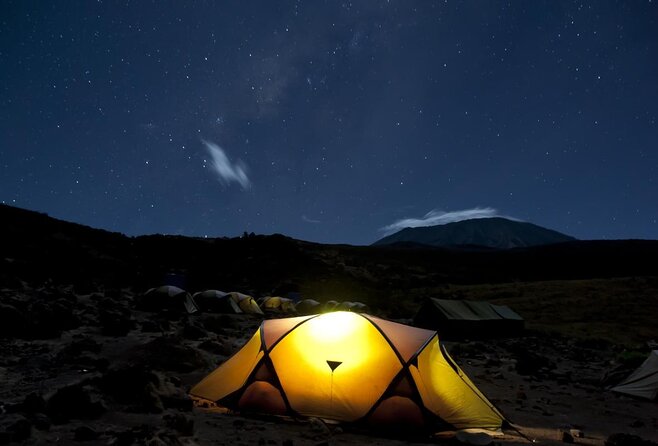
- Marangu uses huts instead of tents: You sleep in dormitory-style mountain huts, which means less camping equipment but limited privacy and basic facilities.
- The Horombo acclimatization day matters: A four to five-hour walk toward Mawenzi Peak takes you up to about 4,600 meters before returning to sleep at Horombo.
- Summit day begins after midnight: You climb toward Gillman’s Point for sunrise, then continue toward Uhuru Peak if you have enough strength and time.
- The $1,150 price is not all-inclusive: Park fees, medical insurance, tips, personal hiking gear, flights, and Moshi hotels are separate.
- The service receives strong praise: The experience has a 4.7 rating from 11 reviews, with 100 percent recommending it. The guide, porters, chef, and support during the summit push receive the warmest praise.
- Private does not automatically mean tiny: The experience is described as private, but the stated maximum is 90 participants. Confirm your actual party size before paying.
Why the Marangu Route appeals to first-time climbers
Marangu is often chosen because it is considered the easiest route on Kilimanjaro in terms of trail shape and hut accommodation. That does not make it easy in the everyday sense. You still climb to 5,895 meters, and altitude remains the serious challenge.
I like the route’s gradual change in scenery. You begin in thick forest, continue through heather and open moorland, cross the dry Saddle between Mawenzi and Kibo, and finally climb over loose scree toward the crater rim. Each day feels different, which helps keep the long walk interesting.
The route also has a practical advantage. You are not carrying camping equipment, and you sleep in huts rather than tents. The tradeoff is that the dormitory rooms are basic, and the route can feel less quiet than a camping route. If you value a bed under a roof and a simpler packing list, Marangu makes sense. If solitude is your main goal, ask detailed questions about your group and hut arrangements.
The operator describes this as a private climb, allowing you to stay with friends or family instead of joining an unfamiliar party. That is a real benefit for pacing and morale. Still, the published maximum of 90 people creates some uncertainty. I would ask the company to confirm the size of your actual climbing group, how many guides will be assigned, and whether the private arrangement applies from the Moshi pickup through the summit.
More Kilimanjaro routes and climbs:
- Kilimanjaro climb by Lemosho Route (7-day)
★ 5.0 · 651 reviews - Kilimanjaro climb, Machame Route (7-day)
★ 5.0 · 262 reviews - Kilimanjaro Climbing Lemosho Route 8 Days.
★ 5.0 · 186 reviews
Day one: Moshi to Marangu Gate and Mandara Hut
Your morning begins with pickup from your hotel in Moshi. The drive takes you to Marangu Gate, where registration and park formalities take place before you begin walking.
The first day leads through Kilimanjaro’s rainforest zone. Expect a four to five-hour hike toward Mandara Hut. This is a pleasant introduction to the mountain, with mosses, lichens, flowers, and orchids along the trail. You might also see colorful birds, colobus monkeys, and other monkey species.
Clear weather may give you views down toward Moshi and the plains. Those views are a useful reminder that you are gaining height quickly, even though the forest can make the climb feel sheltered and mild.
Mandara Hut is your first overnight stop. The accommodation is dormitory-style, so pack with shared sleeping space in mind. The listed package includes breakfast, lunch, and dinner during the trek, along with hut or camping fees as specified by the operator.
I like this opening day because it is not an all-out test. You have time to settle into the walking pace, check your clothing and daypack, and pay attention to how your body feels. Your guide will be important here, especially in keeping the group moving slowly rather than treating the first day like a race.
Day two: Mandara Hut to Horombo at 3,720 meters
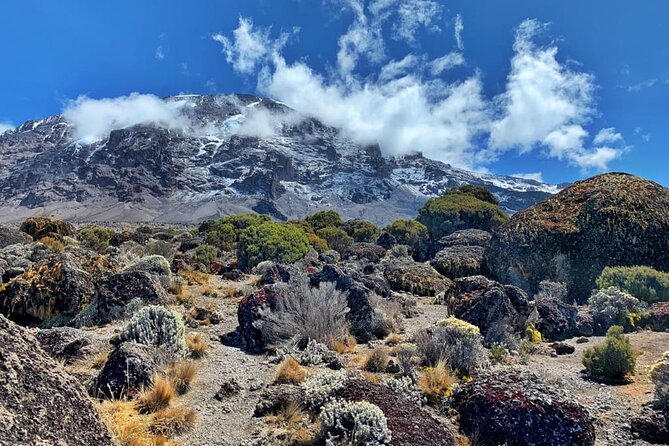
After breakfast, the route leaves the final stretch of rainforest and reaches open alpine meadows. The vegetation becomes lower and more exposed, with large heather and wide views of Kilimanjaro’s two major summits.
Kibo is the snow-capped cone that forms the main summit area. Mawenzi is more rugged and rocky. Seeing both ahead gives this day a strong sense of direction, even though the walk can take five to seven hours.
You gain about 1,000 meters, reaching Horombo Huts at approximately 3,720 meters. That is a meaningful rise in one day, so the advice to walk pole pole, meaning slowly, is not a slogan. It is one of the most useful rules on the mountain.
Horombo is an important stop because you spend two nights here. The extra night gives your body more time to adjust before you move higher. It also breaks up the climb and makes the six-day plan more reasonable than a rushed itinerary.
This day can feel long because the vegetation thins and the trail becomes more open. The reward is the view. You can look back toward the forest and plains while also seeing the higher slopes ahead. Keep your water, rain protection, and warm layer easy to reach. Weather can change as you gain altitude, and the schedule leaves little room for misplaced gear.
Day three: the Horombo acclimatization walk to Mawenzi
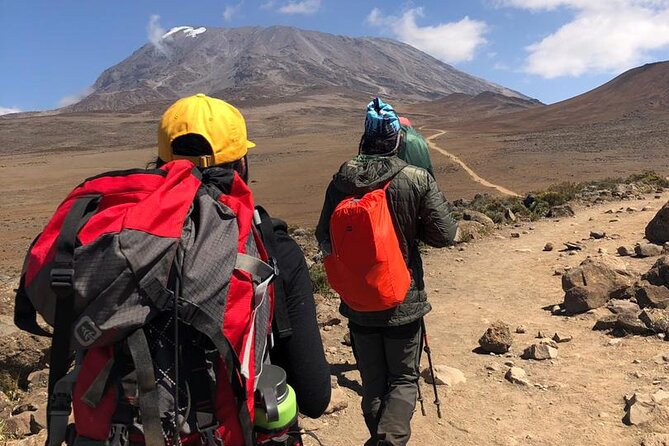
Day three is not a lazy rest day. It is an acclimatization day, and it may be the most important feature of the entire schedule.
The planned walk takes four to five hours round trip toward the base of Mawenzi Peak. You climb to about 4,600 meters, then return to Horombo for dinner and another night. This follows the useful high-walk, low-sleep principle: you visit a higher elevation during the day but sleep at the lower Horombo altitude.
I like this design because it gives you a chance to test your response to altitude before summit day. The extra walk also lets you see Mawenzi up close, with its dramatic rock formations and very different character from Kibo.
Do not treat this outing as a chance to prove how strong you are. Walk slowly, drink as directed by your guide, and report symptoms such as headache, nausea, dizziness, or unusual fatigue. A planned acclimatization day improves your chances, but it cannot guarantee a successful summit.
Horombo is also where you can take stock of your equipment. Your hands, feet, and shoulders will tell you if socks, boots, gloves, or pack adjustments need attention. Ask the porters to carry anything unnecessary before the next morning’s move toward Kibo.
A few more trips of this kind worth comparing:
- Kilimanjaro climb, Lemosho Route (6-day)
★ 5.0 · 129 reviews - Kilimanjaro climb, Marangu route (6-day)
★ 5.0 · 72 reviews - 6 Days 5 Night Safari
★ 5.0 · 57 reviews - 6 Days Tanzania Classic Safari
★ 5.0 · 52 reviews
Day four: crossing the Saddle to Kibo Hut
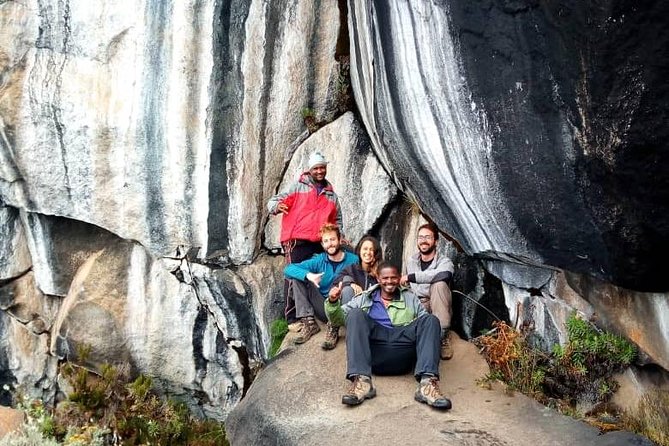
The walk from Horombo to Kibo Hut takes about five to seven hours. The route passes the last water point and crosses the Saddle, a broad, dry area between Mawenzi and Kibo.
The change in scenery is stark. The forest and heather are gone, replaced by a stony, arid setting with sparse alpine plants. The route can feel almost lunar, and the upper slopes of Kibo begin to dominate the view.
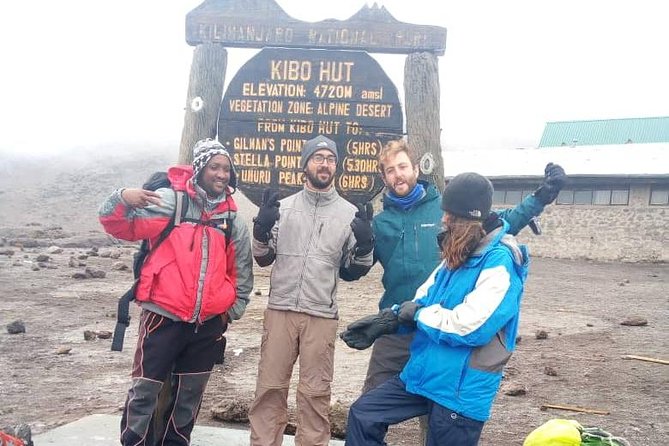
Kibo Hut sits at roughly 4,705 meters. It offers dormitory accommodation and limited amenities. This is not the place to expect comfort or entertainment. You arrive, eat, organize your summit clothing, and try to sleep before the midnight wake-up.
The practical advice here is simple: repack before dinner. Give the porters anything you will not need for the summit attempt. Keep your headlamp or torch, warm layers, water, snacks, gloves, and essential personal items close by.
This night is often mentally difficult. You are high, the facilities are basic, and the summit effort is waiting only a few hours away. I would not judge the experience by your comfort at Kibo. The hut is a staging point, not a retreat.
Day five: the 12-hour push to Uhuru Peak
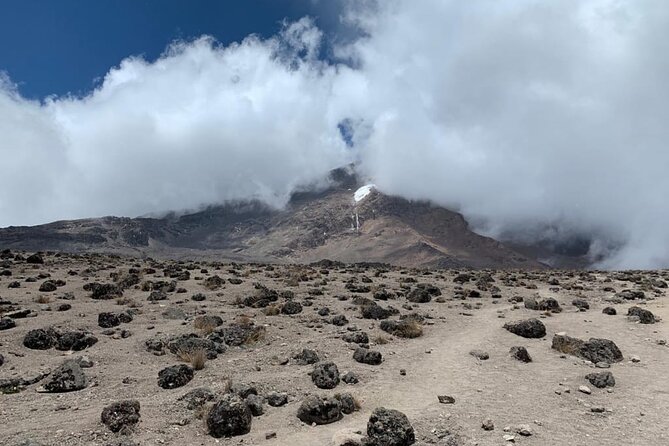
Summit day begins shortly after midnight. You climb by torchlight over a long slope of scree. At that hour, the scree is often frozen, which can make the surface easier to handle than it might be later in the day.
The route passes Hans Meyer’s Cave after about two hours, then reaches Johanne’s Notch after roughly three hours. From there, the climb toward the crater rim becomes steeper. The first major target is Gillman’s Point at 5,685 meters.
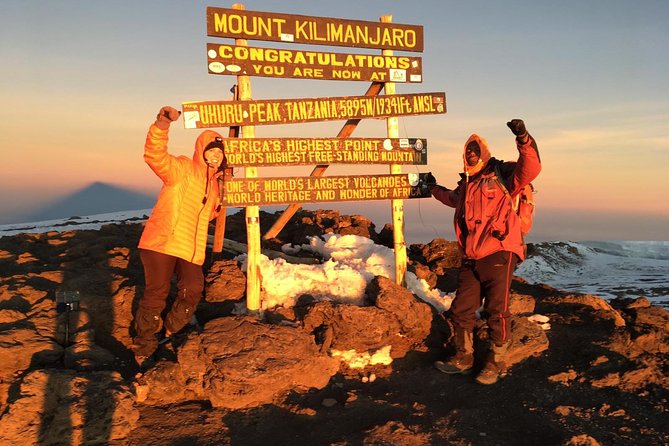
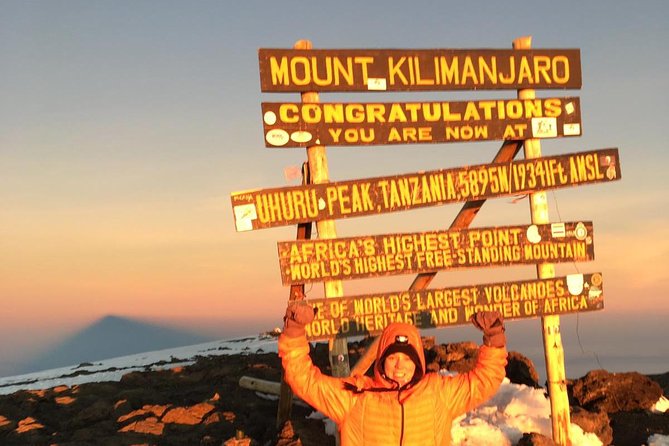
Reaching Gillman’s Point around sunrise is a powerful moment. The rising sun lights the ice fields and the jagged form of Mawenzi. It is also the point where fatigue becomes very real. From Gillman’s Point, you continue around the crater rim toward Uhuru Peak, the highest point on Kilimanjaro, if your strength and timing allow.
The complete summit day is listed at about 12 hours. That includes the ascent, time near the summit, and descent toward Horombo Huts. You need to understand this before booking. The summit attempt is not just a final short walk. It is a long, cold, physically demanding day after several days of climbing.
Strong guide support matters here. One especially positive account praised the guide for encouraging the climber through the final stretch, while also crediting the porters and chef. That tells you where the value of a guided climb lies: not only navigation, but also pacing, morale, meals, and practical support when your energy drops.
You should also accept that Uhuru Peak is not guaranteed. Altitude, weather, illness, and exhaustion can force a retreat. A responsible guide should treat a safe descent as a success, not a failure.
Day six: descending through Mandara to Moshi
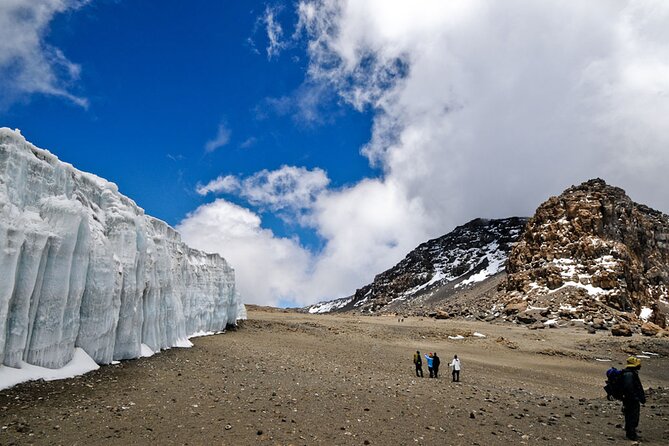
After the summit effort, the final day takes you back through the alpine meadows and rainforest. You pass Mandara Hut and continue to Marangu Gate, covering about 20.8 kilometers in approximately eight hours.
The descent usually feels faster than the climb, but tired legs can make it awkward. Take care on the downhill sections, especially over uneven ground. Your knees and feet may be more uncomfortable than they were on the way up.
At Marangu Gate, the vehicle takes you back to your hotel in Moshi. Breakfast and lunch are included on this final day, and the return transfer is included if you are going back to the hotel booked in Moshi town.
The certificate mentioned in the package is a small but meaningful finish. More important, you have completed a full mountain circuit from rainforest to summit zone and back down again.
What the $1,150 price really covers
At $1,150 per person, the trip can offer good value for a six-day guided climb, but only if you budget for the extra costs. The price includes:
- Pickup from your Moshi hotel to Marangu Gate
- Return transfer from Marangu Gate to your Moshi hotel
- Briefing before the climb
- Professional Kilimanjaro guide
- Porters and a chef, as reflected in the service description
- Breakfast, lunch, and dinner during the trek
- Hut or camping fees listed by the operator
- A trekking certificate
The large omission is park fees. The information says all Mount Kilimanjaro park fees are not included and can be paid directly to the park or through the tour operator. Ask for the exact amount before booking. This is not a minor add-on, and it can change your real total substantially.
You also need to pay for travel and medical insurance, tips for the mountain crew, airport transfers, flights, hotels before and after the climb, and personal hiking equipment. If you are flying into Tanzania without gear, the equipment cost can be significant.
I like that Moshi hotel transfers are included. That removes one annoying piece of planning and gives you a direct start and finish. I would still request a written price breakdown showing park fees, crew arrangements, and any expected transport charges.
Guides, porters, meals, and the human side
The strongest praise goes to the mountain crew. The guide receives credit for helping a climber reach the summit, while the porters and chef are also singled out for their support.
That matters because a Kilimanjaro climb is a team effort. Your guide sets the pace, watches how you are coping, and makes decisions in changing conditions. Porters carry shared equipment and supplies. The chef keeps the group fed through long days when appetite and energy may not be at their best.
Tips are not included, so plan for them separately. The exact amount is not provided here, and you should ask the operator for its current tipping guidance before departure. Good practice is to carry suitable small bills in the local currency or another accepted currency, but confirm what the company recommends.
Meals are included throughout the trek, with breakfast and lunch specifically listed on the final descent day. Since no menus are provided, ask about dietary requirements before you arrive. Do not assume every special diet can be handled without advance notice.
Who should book this climb?
I would recommend this experience to a reasonably fit person who wants a structured Kilimanjaro climb with hut accommodation and a planned acclimatization day. It suits friends, couples, families with suitable fitness, and private groups that want to stay together.
It is also a good match if you prefer having transport arranged from Moshi and do not want to organize a separate guide, porters, cook, and mountain permits on your own.
I would be more cautious if you dislike shared dormitories, need hotel-level comfort, or have no experience with long uphill days. The six-day schedule is helpful, but it remains compact. Anyone with medical concerns should arrange proper medical advice and insurance before booking.
The stated maximum of 90 participants deserves a direct question. The experience is presented as a private party, yet 90 is a large maximum. Confirm your party size, sleeping arrangements, guide-to-climber ratio, and how the private service works before you commit.
Useful planning details before departure
Confirmation is provided at booking, and pickup is available from your hotel in Moshi town. Airport pickup and drop-off are not included, so arrange those separately if needed.
The experience is near public transportation, though the actual climb begins with the included transfer to Marangu Gate. Mobile tickets are offered, which makes it easier to keep the booking details on your phone.
Most people can participate according to the supplied information, but that should not be confused with an easy physical rating. You will face long walking days, high altitude, cold summit conditions, and a descent of several hours after reaching the top.
Cancellation is free if you cancel at least 24 hours before the start time. Cancellations or changes made later are not refunded or accepted. Poor weather can lead to a different date or a full refund, based on the operator’s policy.
FAQ
How long is the Kilimanjaro climb?
The experience lasts approximately six days, from pickup in Moshi through the return to town.
Which route does the climb use?
It uses the Marangu Route, beginning at Marangu Gate and passing Mandara Hut, Horombo Huts, and Kibo Hut before the summit attempt.
Is accommodation included?
Yes. The climb includes dormitory-style hut accommodation, with hut or camping fees listed among the inclusions. Facilities at Kibo Hut are described as limited.
Is the climb private?
It is described as a private guided climb for your own party. However, the stated maximum is 90 participants, so confirm your actual party size with Africa Natural Tours before booking.
Are meals included?
Yes. Breakfast, lunch, and dinner are included during the trek. Breakfast and lunch are specifically included on the final day.
Are Mount Kilimanjaro park fees included?
No. All Mount Kilimanjaro park fees are listed as separate. They can be paid directly to the park or through the tour operator.
What happens if bad weather cancels the climb?
If poor weather causes the experience to be canceled, you will be offered another date or a full refund. For your own cancellation, you must cancel at least 24 hours before the start time for a full refund.
Should you book the six-day Marangu climb?
I would book this trip if you want the practical side of Kilimanjaro handled for you: Moshi transfers, a guide, porters, meals, huts, and a built-in acclimatization day. The route offers a clear progression from forest to summit, and the support crew appears to be the experience’s strongest asset.
I would not book it without first confirming the park-fee total, actual party size, tipping expectations, gear needs, and medical insurance requirements. The $1,150 headline price is only the starting point.
For a fit hiker who accepts basic huts and a very long summit day, this is a sensible and well-supported way to attempt Kilimanjaro. Go slowly, prepare for cold and altitude, and judge success by making good decisions all the way down the mountain.
Just added around Moshi
- Moshi: Lake Chala Tour: Hiking &/or Kayaking★ 4.5 · 3 reviews
- 3 Days Tanga Exclusive Beach Holiday★ 5.0 · 3 reviews
- Serengeti Wildebeest Migration.★ 5.0 · 3 reviews
- Chemka Hotpsrings E-Bike Day Trip★ 5.0 · 3 reviews
- Explore 1 day Ngorongoro Crater Budget Group Safari from Arusha★ 5.0 · 3 reviews
- Explore the 360° of Kilimanjaro★ 5.0 · 3 reviews
- Affordable Short Tanzania Safari (2 Days Camping Safari)★ 5.0 · 3 reviews
- Rongai Route 7 Days★ 5.0 · 3 reviews
Kilimanjaro Treks, compared.



8-Day Small-group Lemosho Kilimanjaro Summit Trekking
Read our review →


Climbing Kilimanjaro through 7 days Machame Route
Read our review →

Browse the lists this tour appears in