
Reviewed · KILIMANJARO TREKS
Kilimanjaro-marangu Route 6 Days Itinerary
A high summit begins with a slow start. This Marangu Route climb gives you a clear eight-day plan, starting and ending at Kilimanjaro Mountain Resort in Marangu, with airport transfers included. I like the extra acclimatization day at Horombo Hut and the practical hotel start, which lets you check equipment and meet the crew before walking uphill. The main caution is the demanding summit day, listed at 13 to 15 hours, and the route’s schedule should be clarified because the product is called a six-day climb but runs across eight calendar days.
I also like that the route uses huts rather than tents and includes a private transfer from Kilimanjaro International Airport. At $1,950 per person, the price can make sense if the quoted package covers the stated accommodation, meals, park entry, and both airport transfers. Still, ask exactly what is included before paying, especially since one published complaint describes a late pickup and concerns about communication.
In This Review
- Key points before you book
- What the $1,950 package is really buying
- Day 1 at Marangu Mountain Resort
- Day 2: rainforest to Mandara Hut at 2,700 meters
- Day 3: moorland views on the way to Horombo
- Day 4: the extra Horombo night
- Day 5: across the Saddle to Kibo Hut
- Day 6: the midnight summit attempt
- Day 7: returning to Marangu Gate
- Day 8: airport transfer or extra plans
- Weather, timing, and the best months
- Who will like this Marangu climb?
- Communication deserves a careful check
- Cancellation and booking details
- Should you book this route?
- FAQ
- How long does the full experience last?
- Where does the climb begin and end?
- Are airport transfers included?
- Where do you sleep during the climb?
- How long is the summit day?
- Can you cancel for a full refund?
Key points before you book
- Eight calendar days, six mountain days: The first day is for arrival, briefing, and equipment checks, while the final day is for departure.
- Horombo acclimatization night: An extra day near 3,720 meters gives you a more sensible adjustment period than rushing straight upward.
- Hut-based Marangu Route: You sleep at Mandara, Horombo, and Kibo huts, with no tent camping listed.
- Summit attempt starts before midnight: The climb to Gillman’s Point and possibly Uhuru Peak is the toughest part of the trip.
- Airport transfers are included: Pickup from JRO and the return transfer are stated as part of the package.
- Best timing matters: January, February, August, and September are presented as the strongest months, while the long rains of March through May should be avoided.
What the $1,950 package is really buying
This is not a casual mountain walk. It is a guided Kilimanjaro ascent with a private arrival transfer, a hotel night before the climb, hut accommodation on the mountain, meals identified throughout the itinerary, park access, and a return transfer to the airport. Those included services are important because Kilimanjaro logistics can become expensive and awkward when arranged piece by piece.
The starting point is Kilimanjaro Mountain Resort in Marangu, on the lower slopes of the mountain. You can arrive at Kilimanjaro International Airport at any time, then take the included private transfer to the resort. That first night is more than a bed. It gives you a place to prepare, sort your bag, and deal with missing or unsuitable equipment before the trail begins.
At 5:30 pm, you attend a pre-climb briefing and equipment check. The operator also says it will confirm mandatory medical coverage and travel insurance. Take this seriously. The mountain is not the place to discover that your footwear, warm layers, rain protection, or insurance documents are inadequate.
The price is harder to judge because the supplied details do not spell out every inclusion in one simple list. Park admission is marked as included on each mountain day, and airport transfers are included. Meals and overnight stays are identified in the schedule, but you should confirm whether every meal, guide service, hut fee, tips, and any emergency arrangements are covered.
More Kilimanjaro routes and climbs:
- Kilimanjaro climb by Lemosho Route (7-day)
★ 5.0 · 651 reviews - Kilimanjaro climb, Machame Route (7-day)
★ 5.0 · 262 reviews - Kilimanjaro Climbing Lemosho Route 8 Days.
★ 5.0 · 186 reviews
Day 1 at Marangu Mountain Resort
Your first day is deliberately easy. After reaching the resort, you have time to rest before the evening briefing. This is useful if your flight arrives tired or late, though the promise of arrival at any time should not be confused with an entirely flexible first day. The briefing is fixed for 5:30 pm.
The equipment check is one of the most valuable parts of this opening evening. Use it to ask direct questions about what you will carry, what the guides carry, and what happens if an item is judged unsuitable. The itinerary also lists bed, dinner, and breakfast at the resort.
The stated meeting time is 8:30 am, which does not fully match the flexible airport arrival information or the 5:30 pm briefing. Ask the operator to confirm the exact pickup and briefing times for your booking. Clear timing is especially important after a long international flight.
Day 2: rainforest to Mandara Hut at 2,700 meters
After breakfast, you make a short transfer from the resort to Marangu Gate. Park formalities come first, then the walking begins in tropical rainforest. This opening section should feel shaded and relatively sheltered compared with the high mountain days, but it is still a steady uphill walk lasting about five to six hours.
Mandara Hut sits at 2,700 meters. The itinerary gives dinner and an overnight stay there, with the option to rest around the forest camp. This is a good first mountain night because you gain altitude without yet facing the exposed upper slopes.
Your job is to start slowly. Many people make the mistake of treating the first day as an easy victory and walking too fast. You want energy in reserve for the next five days, not a heroic first afternoon followed by a headache and poor sleep.
The route description gives a five-hour estimate in one place and five to six hours in another. That is not a major problem, but it shows why you should think in broad time windows rather than exact arrival times.
Day 3: moorland views on the way to Horombo
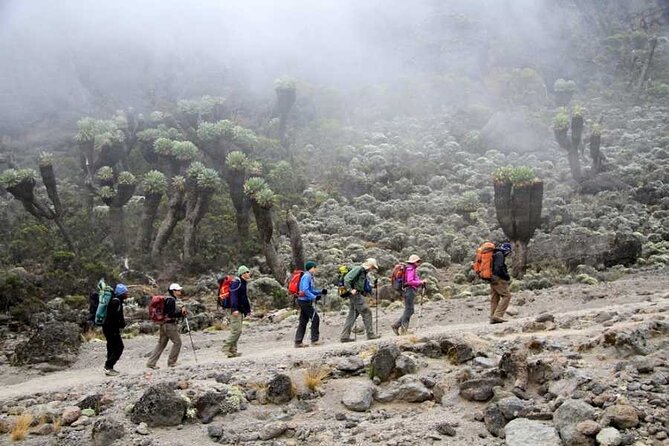
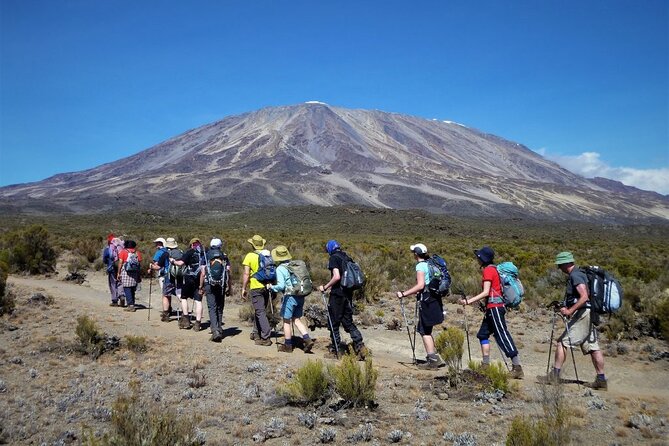
The morning begins with a steep section through forest. Soon the trees thin and the trail opens into moorland. In clear weather, you may see Kibo and Mawenzi, the two major peaks that give this climb much of its visual drama.
The walk from Mandara to Horombo Hut is listed at four to six hours, ending at about 3,720 meters. You arrive around mid-afternoon, giving you time to rest and take in the views around camp.
Horombo is an important point in the route. It is high enough for altitude to become a real concern, but not yet as severe as Kibo. Pay attention to headache, nausea, unusual tiredness, or difficulty sleeping. The itinerary repeatedly stresses drinking enough water and walking slowly. That advice is simple, but it matters.
The word pole pole, meaning slowly slowly, is the right spirit for this route. Do not judge your progress by the strongest person in the group. The goal is to reach the summit safely, not to win the walk to the next hut.
A few more trips of this kind worth comparing:
- Kilimanjaro climb, Lemosho Route (6-day)
★ 5.0 · 129 reviews - Kilimanjaro climb, Marangu route (6-day)
★ 5.0 · 72 reviews - 6 Days 5 Night Safari
★ 5.0 · 57 reviews - 6 Days Tanzania Classic Safari
★ 5.0 · 52 reviews
Day 4: the extra Horombo night
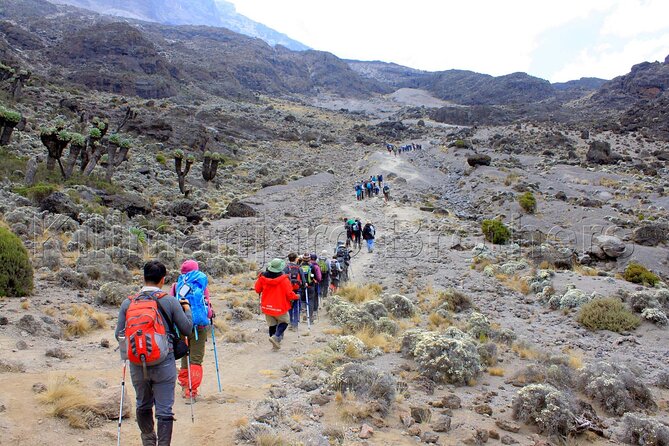
Day 4 is the route’s strongest feature. Instead of moving higher immediately, you spend another night at Horombo for acclimatization. The planned walk heads toward Mawenzi Hut and passes the Zebra Rocks, then returns to Horombo.
The schedule allows about three hours for this outing. It gives your body more time at altitude while keeping the day manageable. You also get a break from packing and moving your main gear to a new hut.
All meals for the day are provided at Horombo Hut. Drink steadily, keep your pace relaxed, and use the day to ask the guide how you are progressing. An extra acclimatization day cannot guarantee a summit, but it is a much more sensible plan than treating altitude as something you can simply ignore.
This day may feel uneventful if you are eager to climb higher. That is exactly why some people undervalue it. On Kilimanjaro, a quiet day can be more useful than another hard ascent.
Day 5: across the Saddle to Kibo Hut
The route now leaves the greener lower sections and moves toward the lunar desert of the Saddle, the high area between Mawenzi and Kibo. The scenery becomes more open and stark. The walk to Kibo Hut is given as four to six hours, although the description also refers to a six to seven-hour day. Plan for a long, slow crossing rather than relying on the shorter estimate.
Kibo Hut is at approximately 4,700 meters. There is no running water there, an important practical detail. Carry enough water according to your guide’s instructions, and expect the facilities to be basic.
The remainder of the day is for resting before the summit push. You are expected to have an early night, though sleeping at this altitude can be difficult. Organize your summit clothing and headlamp before lying down. The less you need to think about after midnight, the better.
This is also the point where the route becomes physically and mentally serious. The distance may not look extreme on paper, but altitude changes the effort. Walk slowly, eat what you can, and tell your guide promptly if you feel unwell.
Day 6: the midnight summit attempt
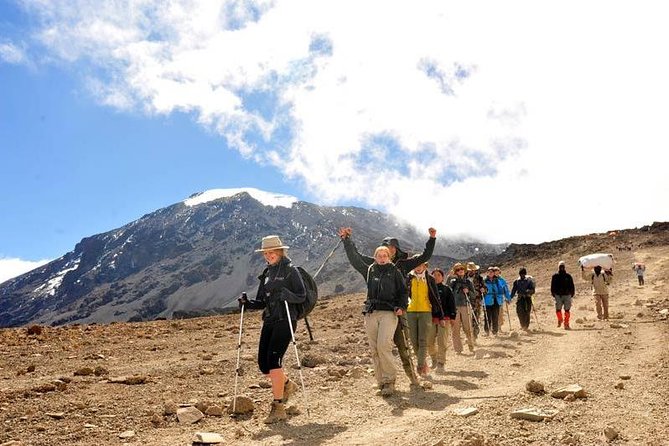
The summit day begins before midnight. You climb in darkness over loose volcanic scree, using a slow, steady pace and a series of graded zigzags. The first major goal is Gillman’s Point on the crater rim at about 5,685 meters.
At Gillman’s Point, you rest briefly and may watch sunrise over Mawenzi. This can be one of the most memorable moments of the climb, but do not let the excitement push you beyond your limits. The itinerary says those still feeling strong can continue along the crater rim toward Uhuru Peak.
Uhuru Peak reaches 5,895 meters, the highest point in Africa. The route describes the walk from Gillman’s Point to Uhuru as a three-hour round trip. That section is optional in the sense that it depends on how you are feeling, but you should discuss the decision with your guide rather than treating it as a simple add-on.
After the summit, the descent to Kibo Hut is described as remarkably fast, followed by refreshments and a continued descent to Horombo Hut. The full day is listed at 13 to 15 hours. This is the most demanding part of the trip by far.
The schedule contains a small inconsistency, giving the duration as 13 minutes in one place. That is clearly not compatible with a summit day of 13 to 15 hours, so treat the longer figure as the useful planning number and confirm the final route plan with the operator.
Day 7: returning to Marangu Gate
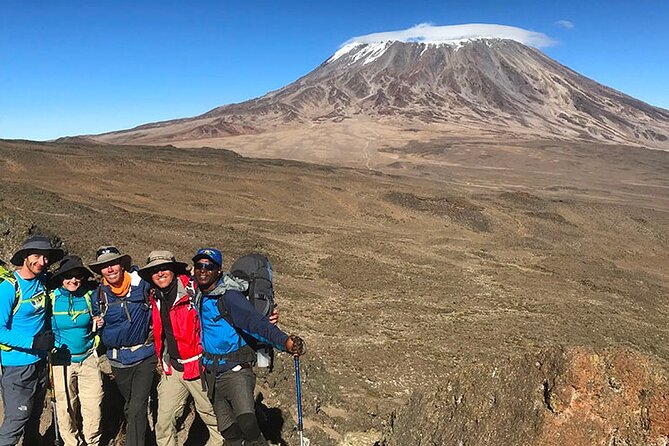
From Horombo, you descend past Mandara Hut and continue to Marangu National Park Gate. The walk is listed at six to seven hours. After the long summit day, downhill walking can still punish tired legs, so do not assume this will feel effortless.
Successful climbers receive summit certificates at the gate. You then transfer back to Kilimanjaro Mountain Resort for dinner and an overnight stay. That return to a proper hotel bed can feel like a small luxury after several nights in mountain huts.
This final mountain day also gives the operator a chance to close the trip in an organized way. Make sure you know when the transfer leaves, where your luggage is stored, and what time dinner is served. Those details are not fully spelled out, so ask before the descent.
Day 8: airport transfer or extra plans
The final day is for saying goodbye to the guide team and taking the included private transfer from Moshi to Kilimanjaro International Airport. The operator also says you can discuss a short safari or another option if your schedule allows.
Do not book a tightly timed flight without confirming the transfer plan. Mountain schedules can shift because of weather, health, or trail conditions, and the itinerary does not give a fixed airport departure time.
The included airport transfer is a real advantage. You do not need to arrange transport after a physically exhausting week, and the same package is designed to begin and end at the resort.
Weather, timing, and the best months
The strongest climbing months listed are January, February, August, and September. January and February are described as the warmest, with evenings and mornings often clear of clouds.
July can be colder. November usually brings short rains, but climbing can still be possible because rain does not necessarily fall every day. The long rains in March, April, and May are specifically discouraged.
August and September may suit you if you prefer the stated dry-season window, while January and February offer warmer conditions. No month removes the risk of poor weather, so keep some flexibility in your schedule if possible. The operator says a poor-weather cancellation can lead to a different date or a full refund.
Who will like this Marangu climb?
This trip suits you if you want a structured, guided ascent with hut accommodation, a proper pre-climb hotel night, and an extra acclimatization day. It is also a good match if you value private transfers and do not want to solve every Kilimanjaro connection yourself.
You need a moderate level of physical fitness. The summit day requires much more than a normal sightseeing walk, and the itinerary’s 13 to 15-hour estimate should be taken seriously. You should be comfortable with long uphill and downhill days, cold conditions, basic hut facilities, and a pre-midnight start.
The experience may not suit you if you want a short, relaxed mountain holiday or a schedule with plenty of free time. It also may not suit you if you prefer private rooms and hotel comforts every night. Kibo has no running water, and the mountain huts are clearly more basic than the resort.
The activity is private, so only your own group participates. That can make communication easier and give the guide more room to respond to your pace, though the quality of that experience depends heavily on the crew assigned to your departure.
Communication deserves a careful check
The overall rating provided is 4.3 from nine reviews, but one detailed one-star account raises concerns about a pickup arriving 30 minutes late without advance notice and questions about the professionalism of the crew. The operator apologized and said the criticism would help improve its service.
That does not prove your trip will have the same problem, but it is useful warning. Confirm the airport driver’s name, phone number, hotel pickup time, briefing time, and emergency contact before arrival. Keep those details saved offline.
The absence of named guides in the supplied information also means you should not assume a particular guide will lead your climb. Ask who will meet you, how many people are in your group, and how the operator handles guide changes.
Cancellation and booking details
You can cancel for a full refund if you do so at least 24 hours before the experience starts. Changes made less than 24 hours before the start are not accepted, and cancellations inside that window are not refunded.
The activity requires good weather. If the operator cancels because conditions are poor, you are offered another date or a full refund. Confirmation is provided at booking, and the activity is marked as suitable for people with moderate physical fitness.
Should you book this route?
I would consider booking it if you want the classic Marangu hut route with a sensible acclimatization day and airport transfers included. The strongest value comes from the way the package links the resort, park entry, mountain huts, meals listed in the plan, summit attempt, and return transport into one arrangement.
Before paying $1,950, get the inclusions in writing. Confirm all meals, hut nights, guide support, tips, equipment, transfer times, and the handling of medical or weather problems. If the operator answers clearly and on time, this can be a practical route for a fit first-time climber. If communication remains vague, choose a company that gives you firmer details before you fly.
FAQ
How long does the full experience last?
The full schedule lasts about eight days. The first day covers arrival, the resort stay, briefing, and equipment checks. Days 2 through 7 cover the mountain route, and Day 8 is for departure.
Where does the climb begin and end?
The mountain program begins and ends at Kilimanjaro Mountain Resort in Marangu. You are transferred from the resort to Marangu Gate at the start and returned to the resort after descending.
Are airport transfers included?
Yes. A private transfer from Kilimanjaro International Airport to the resort is included, as is the departure transfer from Moshi to Kilimanjaro International Airport.
Where do you sleep during the climb?
The itinerary lists overnight stays at Mandara Hut, Horombo Hut, and Kibo Hut. You also stay at Kilimanjaro Mountain Resort before and after the mountain section.
How long is the summit day?
The summit day from Kibo Hut to the summit area and back to Horombo Hut is listed at 13 to 15 hours. The climb begins before midnight.
Can you cancel for a full refund?
Yes, if you cancel at least 24 hours before the experience start time. Cancellations made less than 24 hours before the start are not refunded.
Just added around Moshi
- Moshi: Lake Chala Tour: Hiking &/or Kayaking★ 4.5 · 3 reviews
- 3 Days Tanga Exclusive Beach Holiday★ 5.0 · 3 reviews
- Serengeti Wildebeest Migration.★ 5.0 · 3 reviews
- Chemka Hotpsrings E-Bike Day Trip★ 5.0 · 3 reviews
- Explore 1 day Ngorongoro Crater Budget Group Safari from Arusha★ 5.0 · 3 reviews
- Explore the 360° of Kilimanjaro★ 5.0 · 3 reviews
- Affordable Short Tanzania Safari (2 Days Camping Safari)★ 5.0 · 3 reviews
- Rongai Route 7 Days★ 5.0 · 3 reviews
Kilimanjaro Treks, compared.



8-Day Small-group Lemosho Kilimanjaro Summit Trekking
Read our review →


Climbing Kilimanjaro through 7 days Machame Route
Read our review →

Browse the lists this tour appears in