
Reviewed · KILIMANJARO TREKS
Mountain Kilimanjaro Climbing 7 Days Rongai Route
The quiet side of Kilimanjaro rewards steady walkers. I like the low-traffic Rongai Route and its northern approach, especially for anyone who wants more wilderness and less foot traffic than Marangu. I also like the seven-day schedule, which gives you a better chance to adjust to altitude than the six-day minimum. The tradeoff is clear: the scenery is less varied than on Kilimanjaro’s western routes, and summit day is a punishing 15-hour effort.
This Moshi-based climb costs $2,628.72 per person, with pickup offered and a maximum group size of 15. Oscar, the main contact praised in the available feedback, helped past clients shape combined climbing and safari trips and answered questions through WhatsApp. That kind of communication matters before a serious mountain trip, though you should still confirm exactly what the price includes, what gear is supplied, and the pickup time.
In This Review
- Key points to know before choosing Rongai
- Why the Rongai Route feels different
- Day 1: NaleMuru to Simba Camp at 2,625 meters
- Day 2: Second Cave and the first real altitude gain
- Day 3: Moorland and Kikelewa Cave at 3,630 meters
- Day 4: Mawenzi Tarn at 4,330 meters
- Day 5: Crossing the saddle to Kibo Camp
- Day 6: Gillman’s Point, Uhuru Peak, and the long descent
- Day 7: Horombo to the national park gate
- What the $2,628.72 price means
- Who should choose this climb
- Practical preparation that will improve the climb
- FAQ
- How long is the Kilimanjaro Rongai Route climb?
- Where does the Rongai Route begin?
- What is the highest point reached?
- How difficult is the climb?
- How large can the group be?
- What is the cancellation policy?
- Should you book the seven-day Rongai climb?
Key points to know before choosing Rongai
- The only northern approach: Rongai begins near the Kenyan border, giving you a quieter route up Kilimanjaro.
- Seven days is the sensible choice: The extra day supports a steadier ascent and acclimatization, while the six-day version is the route minimum.
- A two-route journey: You climb via Rongai and descend through the Marangu side, seeing different parts of the mountain.
- The summit day is extreme: Expect a midnight start, Gillman’s Point at 5,681 meters, Uhuru Peak at 5,895 meters, and up to 15 hours on your feet.
- The route suits moderate fitness, not casual sightseeing: The ordinary hiking days are manageable, but the final ascent demands stamina, patience, and a tolerance for cold and altitude.
- The north side can help in wet weather: Rongai receives less precipitation than the southern and western approaches, making it a useful option during the rainy season.
Why the Rongai Route feels different
Rongai is Kilimanjaro’s northern route. You begin at NaleMuru, close to the Kenyan border, rather than starting from the busier southern side. That geographic difference shapes the whole trip: the opening days pass through farmland, pine forest, moorland, and broad wilderness before you meet the Marangu route near Kibo Camp.
I like that change of pace. You get a sense of moving through a remote mountain rather than simply joining a procession toward the summit. Rongai has gained popularity, but it remains quieter than Marangu, which is its main selling point.
The scenery is not constantly changing in dramatic fashion. The western routes are known for more varied views, while Rongai gives you a slower sequence of forest, moorland, open high country, and volcanic desert. In return, you get clear views toward the Kenyan plains and long stretches where the mountain feels spacious.
The route is rated moderately difficult. That description is fair for most of the trek, but it can sound too gentle if you focus only on the first five days. The summit push is strenuous for almost everyone. Your success will depend less on speed than on walking slowly, drinking regularly, resting when needed, and following your guides’ instructions.
More Kilimanjaro routes and climbs:
- Kilimanjaro climb by Lemosho Route (7-day)
★ 5.0 · 651 reviews - Kilimanjaro climb, Machame Route (7-day)
★ 5.0 · 262 reviews - Kilimanjaro Climbing Lemosho Route 8 Days.
★ 5.0 · 186 reviews
Day 1: NaleMuru to Simba Camp at 2,625 meters
The first morning begins with a drive from Moshi to NaleMuru, the trailhead for Rongai. Pickup is offered, but the published start time is 12:00 am, while the day’s description says the drive takes place in the morning. Confirm the exact meeting time before departure so you are not guessing in the dark.
The trail starts through farmland and pine forest. This is a pleasant introduction to Kilimanjaro because the mountain does not demand everything from you at once. You have about four hours of walking before reaching Simba Camp at 2,625 meters, near the edge of the moorland zone.
The first camp comes with wide views over the Kenyan plains. On this lower section, you might see colobus monkeys, and there is also a chance of elephants or buffalo along the route. Wildlife sightings are never guaranteed, so treat them as a bonus rather than part of the core promise.
This is an important first day for getting your rhythm right. Keep your pace easy, even if you feel strong. A common mistake on a mountain is spending energy early because the trail feels comfortable. Rongai rewards restraint from the beginning.
Day 2: Second Cave and the first real altitude gain
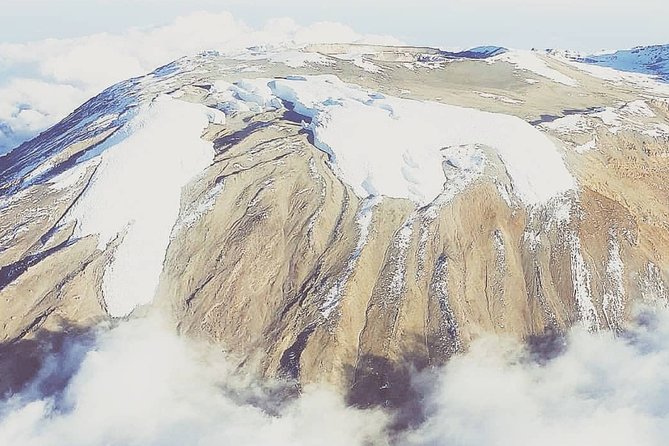
Day two takes about four hours and climbs steadily to Second Cave at 3,450 meters. The trail leaves more of the lower forest behind, and the views open toward Kibo, the main volcanic cone, and the eastern ice fields around its crater rim.
The route includes a hot lunch, followed by time to rest at camp. You may also take an acclimatization walk toward Third Cave in the afternoon. That extra movement is useful because it lets your body experience a little more height without forcing you to sleep at the higher point.
I like the structure of this day. You gain altitude gradually, pause for food, and have time to adjust rather than rushing to the next camp. The drawback is that the views are still fairly broad and open, without the dramatic plant changes found on some other Kilimanjaro routes.
At 3,450 meters, you may notice that ordinary walking feels different. Do not use speed as a measure of fitness here. The best pace is one that allows you to continue without repeatedly stopping.
Day 3: Moorland and Kikelewa Cave at 3,630 meters
The pine forest gives way to moorland on day three. You continue upward for around four hours, with more views of Kibo’s eastern ice fields and the wide slopes of Kilimanjaro’s highest volcanic cone.
This is where Rongai begins to feel remote. You leave the main trail and follow a smaller path toward Mawenzi, the second of Kilimanjaro’s three volcanoes. The destination is a sheltered valley near Kikelewa Caves, at 3,630 meters.
Mawenzi adds character to this part of the walk. Its jagged peaks and steep rock faces are a strong contrast to Kibo’s broad, rounded mass. The camp’s sheltered position is also welcome, particularly if the weather turns cold or windy.
The shorter walking time does not mean the day is effortless. Altitude can affect you even when the trail is not steep. Use the afternoon to eat, drink, and rest. If you feel headache, nausea, unusual fatigue, or other altitude symptoms, tell the guides early rather than trying to hide it.
A few more trips of this kind worth comparing:
- Climbing Kilimanjaro through 7 days Machame Route
★ 5.0 · 151 reviews - 7 Days Kilimanjaro via Machame route affordable price
★ 5.0 · 110 reviews - Private Kilimanjaro Hike 7 Day Lemosho Route
★ 5.0 · 60 reviews - 7-Day Magical Tanzania Safari -Premium High End Package
★ 5.0 · 53 reviews
Day 4: Mawenzi Tarn at 4,330 meters
Day four begins with a short but steep climb over grassy slopes. The effort earns you a fine view toward the Kenyan plains, a reminder that the mountain rises from a much larger and more varied region than the summit photographs suggest.
Vegetation fades as you climb toward Mawenzi Tarn Hut at approximately 4,330 meters. The camp sits beneath the towering cliffs of Mawenzi, one of the most striking settings on the route.
You have time to rest or explore nearby for acclimatization. That pause is valuable. The itinerary does not treat every day as a race, and the spare time gives you a chance to adapt before the high camp and summit night.
This is also a good point to take stock. You are now high enough for altitude to become a serious concern, even if you still feel fine. Eat what you can, keep warm, and organize your clothing and headlamp before bedtime. You do not want to sort through a pack at midnight with stiff fingers.
Day 5: Crossing the saddle to Kibo Camp
The fifth day crosses the lunar desert known as the saddle between Mawenzi and Kibo. The walk takes about six hours, and the scenery changes sharply. Grass and moorland give way to a broad, bare expanse with little shelter.
This is one of the route’s most memorable sections. You can see the summit ahead, with the trail to high camp stretching across the open ground. The view gives you a useful sense of scale, but it can also make the final climb look intimidating. Kilimanjaro does not hide the work still ahead.
The day ends at Kibo Camp, where the rest of the afternoon is set aside for resting. You will have an early night before the midnight ascent. That schedule is not glamorous, but it is necessary. The summit attempt begins while most people are asleep, and your body needs every bit of energy it can store.
Pack only what you need for the summit push. Keep warm layers, water, snacks, and headlamp access simple. The exact equipment arrangements are not provided here, so ask the operator in advance what you carry and what porters handle.
Day 6: Gillman’s Point, Uhuru Peak, and the long descent
Summit day is the heart of the trip and the part you should take most seriously. You begin around midnight and climb slowly toward Hans Meyer Cave at 5,220 meters. From there, the trail continues upward toward Gillman’s Point at 5,681 meters on the crater rim.
The climb is long and strenuous. At this altitude, even a gentle slope can feel demanding. The goal is not to reach the top quickly. A slow, steady rhythm gives you the best chance of conserving energy.
You should reach Gillman’s Point around sunrise, when the first light begins to warm the crater rim. This timing creates one of the great visual moments of the climb, but do not let the view distract you from the remaining effort. Uhuru Peak is still another one to two hours away.
At 5,895 meters, Uhuru Peak is the highest point on Kilimanjaro. Reaching it is a major physical achievement, but the summit is only halfway through the day’s work. You return to Kibo Hut for a warm meal and a one to two-hour rest before continuing down to Horombo Hut.
The total day lasts about 15 hours. That figure includes the summit climb, the return to Kibo, the break, and the descent. You need to be ready for a difficult second half, when tired legs and altitude combine. For many people, going down after the summit feels nearly as demanding as going up.
This schedule is the main reason I would choose seven days instead of six. The extra acclimatization time does not make the summit easy, but it gives you a more measured approach to the highest part of the mountain.
Day 7: Horombo to the national park gate
The final day takes about seven hours and descends through the heath and moor zones to Mandara Hut at 2,700 meters. A warm lunch is provided there before the trail enters the tropical rainforest again.
After roughly six hours of trekking, you reach the Kilimanjaro National Park Gate at 1,860 meters. The return through forest feels like a dramatic change after the cold, open summit zone. You finish the walk by saying goodbye to the guides, then take a short transfer back to your Moshi hotel.
A hot shower and a proper celebration will feel well earned. The itinerary also reminds you to tip guides, cooks, and porters before leaving the mountain. Tips are not a minor detail on a guided climb. Set aside cash before you start so the final farewell is simple and respectful.
What the $2,628.72 price means
At $2,628.72 per person, this is a serious purchase, but not an ordinary sightseeing excursion. The price covers a seven-day guided Kilimanjaro program with national park access reflected through included admission tickets, mountain support, meals at specified points, and transport back to Moshi. Still, the supplied details do not spell out every inclusion, so ask for a written breakdown before paying.
The maximum group size is 15. That is small enough to feel manageable, but not necessarily intimate. If you prefer a private climb, say so clearly. One available account describes a private seven-day Rongai climb followed by a five-day safari, while another group combined the climb with a three-day budget safari. Those examples show that Oscar and Exceed Expectations Tours can handle linked mountain and safari plans, but your own arrangement should be confirmed in writing.
The value is strongest if you want a quieter route and a full seven-day schedule. You are paying for time on the mountain, not just a summit certificate. If you only care about reaching the top as cheaply and quickly as possible, this may not be the best fit.
Communication is another positive point. Oscar was praised for answering questions in a WhatsApp group and customizing arrangements around a group’s needs. That is useful when you are sorting out arrival plans, safari add-ons, fitness concerns, or equipment questions. Ask direct questions and save the answers.
Who should choose this climb
I would point this trip toward a reasonably active person who wants a quieter route and can commit to a full week on the mountain. You do not need advanced backpacking experience, and the route is specifically considered suitable for people with less backpacking background.
You do need moderate physical fitness. The shorter four-hour days are not a complete picture of the effort. The summit day lasts about 15 hours, includes extreme altitude, and requires a midnight start.
Rongai is also a sensible option for people considering a climb during the rainy season because the northern side receives less precipitation. That does not mean dry weather is guaranteed. It simply gives this route a practical weather advantage.
I would hesitate to recommend it to anyone expecting constant dramatic scenery, a leisurely walk, or a quick weekend-style challenge. The route is remote, the high camps are basic by their nature, and the final ascent can be cold, exhausting, and uncomfortable.
Practical preparation that will improve the climb
Before booking, ask for details that are not stated in the published information:
- What airport or hotel pickup is included?
- What time will the vehicle collect you, given the listed midnight start?
- Which meals are included on each day?
- What equipment can you rent?
- How are guide, cook, and porter tips handled?
- Is the climb private or shared within the 15-person maximum?
Bring clothing that can handle warm forest conditions and freezing summit conditions. Keep your summit layers organized, and make sure your headlamp is easy to reach. The route description confirms a midnight start, but it does not provide a full packing list.
Build extra rest into your plans before and after the climb if possible. The Moshi transfer on day seven follows a long descent, and you may not feel ready for another demanding activity immediately.
Free cancellation is available if you cancel at least 24 hours before the local start time. Changes or cancellations inside that window are not accepted for a refund, so check the local cutoff carefully.
FAQ
How long is the Kilimanjaro Rongai Route climb?
The climb lasts approximately seven days. Six days is the minimum stated duration, but seven days is recommended for a steadier ascent and acclimatization.
Where does the Rongai Route begin?
The route begins at NaleMuru village, on the northern side of Mount Kilimanjaro near the Kenyan border. The experience is based in Moshi, Tanzania, and pickup is offered.
What is the highest point reached?
The summit is Uhuru Peak at 5,895 meters. On the way, you reach Gillman’s Point at 5,681 meters on the crater rim.
How difficult is the climb?
The route is described as moderately difficult and suitable for people with a moderate fitness level. The final ascent is much harder than the earlier days and lasts around 15 hours, including the descent to Horombo Hut.
How large can the group be?
The maximum group size is 15 people. The available information also includes examples of private climbs, but you should confirm whether your booking is private or shared.
What is the cancellation policy?
You can receive a full refund if you cancel at least 24 hours before the experience begins. Cancellations or changes made less than 24 hours before the local start time are not accepted for a refund.
Should you book the seven-day Rongai climb?
Book it if you want Kilimanjaro with fewer people, a northern approach, a wilderness feel, and a seven-day schedule that gives acclimatization room. The chance to climb one route and descend another adds variety, while the Kenyan views and Mawenzi camps provide memorable scenery.
Think twice if you want a softer adventure. The route may be moderate overall, but summit night is not. At $2,628.72, the best value comes from using the extra time well, preparing seriously, and asking Exceed Expectations Tours for clear details about equipment, meals, transport, and group format before you commit.
Just added around Moshi
- Moshi: Lake Chala Tour: Hiking &/or Kayaking★ 4.5 · 3 reviews
- 3 Days Tanga Exclusive Beach Holiday★ 5.0 · 3 reviews
- Serengeti Wildebeest Migration.★ 5.0 · 3 reviews
- Chemka Hotpsrings E-Bike Day Trip★ 5.0 · 3 reviews
- Explore 1 day Ngorongoro Crater Budget Group Safari from Arusha★ 5.0 · 3 reviews
- Explore the 360° of Kilimanjaro★ 5.0 · 3 reviews
- Affordable Short Tanzania Safari (2 Days Camping Safari)★ 5.0 · 3 reviews
- Rongai Route 7 Days★ 5.0 · 3 reviews
Kilimanjaro Treks, compared.



8-Day Small-group Lemosho Kilimanjaro Summit Trekking
Read our review →


Climbing Kilimanjaro through 7 days Machame Route
Read our review →

Browse the lists this tour appears in