
Reviewed · KILIMANJARO TREKS
Best 7 Days Machame Route group hiking on Kilimanjaro
Africa’s highest summit demands respect. This 6 to 7 day Machame Route climb takes you from Moshi through rainforest, moorland, high volcanic desert, and finally to Uhuru Peak at 5,895 meters. The route is famous for its scenery and its demanding pace.
I like the changing scenery, from wet forest to the open Shira Plateau and icy summit slopes. I also like the careful acclimatization day at Lava Tower before dropping to Barranco Camp. The main drawback is the short six day version, which combines Barranco, Karanga, and Barafu into one long day and gives your body less time to adjust.
This climb is arranged by Rede Tours and Safaris, also listed as Amore African Safari LTD. The price is $2,080 per person, and the package includes transport, park fees, meals, airport pickup, and a support crew. The tour has received a 5 out of 5 rating from 13 published responses, with repeated praise for the guides, porters, chef, tents, and friendly care.
In This Review
- Key points before you book
- Why the Machame Route remains so popular
- Day 1: Machame Gate and the wet rainforest
- Day 2: Shira Plateau and the first cold night
- Day 3: Lava Tower, the Shark’s Tooth, and Barranco
- Day 4: Barranco Wall, Karanga, and Barafu
- Day 5: Stella Point, Uhuru Peak, and the long descent
- Day 6: Mweka descent and the return to Moshi
- What the $2,080 price includes
- The crew, camp support, and group atmosphere
- Who should choose this Machame climb?
- Booking details and cancellation
- Should you book the 7 day Machame Route?
- FAQ
- How long is the Machame Route experience?
- What time does the climb start?
- Where does the route begin?
- What is the highest point reached?
- Is food included?
- Is transport included?
- What costs are not included?
- Can I cancel for a full refund?
Key points before you book
- The route crosses five distinct climate zones: Expect rainforest, moorland, alpine desert, high-altitude scree, and snow near the summit.
- The third day is built for acclimatization: You climb to Lava Tower, then descend to Barranco Camp, a useful climb high and sleep low pattern.
- The summit attempt begins around midnight to 2 a.m.: You reach Stella Point near sunrise if the weather cooperates, then continue to Uhuru Peak.
- The six day schedule is the tougher option: It skips an overnight at Karanga Camp and combines that section with the climb to Barafu.
- The crew is central to the experience: Names connected with the operation include Nalisis and Omary, with strong praise for the guide and porter teams.
- The $2,080 price covers the main expedition costs: You still need to budget for a visa, flights, personal hiking equipment, and crew tips.
Why the Machame Route remains so popular
Machame approaches Kilimanjaro from the south. You begin with a drive from Moshi toward Machame Village and enter the forest almost as soon as you pass the gate. From there, the trail climbs toward the Shira Plateau, crosses the Southern Circuit, reaches Barafu Camp, and descends by the Mweka Route.
The route is often called the Whiskey route. That nickname hints at its rougher character compared with the gentler-sounding Marangu Route. Machame has steep sections, loose ground, wet forest, and a demanding summit night. You should not choose it simply because it is popular.
You should choose it because the views keep changing. One day you are under tall forest canopy. The next, you are walking across open moorland with broad views toward Kibo and Mawenzi. Later, you cross bare volcanic ground beneath the Southern Ice Field.
The route also uses the Southern Circuit, where several Kilimanjaro paths come together. That gives you different views of the summit before summit night, rather than approaching the mountain from one angle throughout.
More Kilimanjaro routes and climbs:
- Kilimanjaro climb by Lemosho Route (7-day)
★ 5.0 · 651 reviews - Kilimanjaro climb, Machame Route (7-day)
★ 5.0 · 262 reviews - Kilimanjaro Climbing Lemosho Route 8 Days.
★ 5.0 · 186 reviews
Day 1: Machame Gate and the wet rainforest
Your day begins with an early breakfast and pickup from the Shanty Town area or your hotel in Moshi. The published start time is 8 a.m., and the drive goes toward Machame Village. If road conditions allow, the vehicle continues closer to Machame Gate. If not, you may walk the final 3 kilometers from the village, which can take about an hour on a muddy road.
This road condition warning matters. A short vehicle transfer can become a wet approach walk, so your daypack should hold rain gear, water, and shoes suitable for mud. You can buy mineral water in the village and receive a packed lunch there.
At Machame Gate, you register with the park authorities. Then the trail enters the rainforest, often on a soggy, slippery path. The day takes about seven hours, including a welcome lunch stop around the halfway point, before you reach camp.
The forest is a fine opening to the climb, but it is not an easy stroll. Rain can turn the trail into mud, and wet conditions may slow the group. Trekking poles, gaiters, and waterproof layers are especially useful here.
Day 2: Shira Plateau and the first cold night
You leave Machame Camp after breakfast. The first section climbs for about an hour through the upper forest. The trail then becomes gentler for roughly two hours as you enter the moorland zone.
After lunch and a short rest, you continue along a rocky ridge toward the Shira Plateau. The vegetation becomes lower and more open, and the forest feels far behind. You may see the Western Breach and its glaciers looking east, an early reminder that the summit is not just a distant cone but a high volcanic massif with ice and rock.
Shira Camp sits at about 3,840 meters. The day lasts around six hours, but the cold becomes a bigger concern than the walking time. The camp is exposed, and nighttime temperatures can drop well below freezing.
The crew boils water for drinking and washing, then serves dinner. That practical support is important at altitude, where a warm drink and a chance to wash can make the evening much easier.
Pack warm layers where you can reach them without emptying your bag. The transition from humid forest to a freezing camp happens quickly over two days.
Day 3: Lava Tower, the Shark’s Tooth, and Barranco
Day three is one of the most useful parts of the itinerary. From Shira, you climb east along a ridge, pass the junction toward Kibo, and turn southeast toward Lava Tower, also called the Shark’s Tooth.
The route reaches around 16,000 feet at the junction toward Arrow Glacier. You do not sleep at that height. Instead, you descend to Barranco Camp at about 13,000 feet.
This is a classic acclimatization pattern: climb high, then sleep lower. You may feel tired during the ascent, especially as the air thins, but the descent gives your body a better chance to adjust before the summit attempt.
The walking time is around six hours. The day can feel strange because you finish at roughly the same elevation where you began, but the height gained and lost still matters. It is not wasted effort.
Barranco Camp is known for its position beneath the Barranco Wall. Dinner and an overnight stop here prepare you for one of the route’s most memorable sections the following morning.
A few more trips of this kind worth comparing:
- Private Kilimanjaro Hike 7 Day Lemosho Route
★ 5.0 · 60 reviews - Best Kilimanjaro hiking day trip tour with Kilinge Adventures
★ 4.5 · 54 reviews - #1. Best Kilimanjaro Day hike Tour-Machame Route-ISMANI
★ 4.2 · 47 reviews - Best Kilimanjaro Adventure 7 days Machame route Trekking
★ 5.0 · 42 reviews
Day 4: Barranco Wall, Karanga, and Barafu
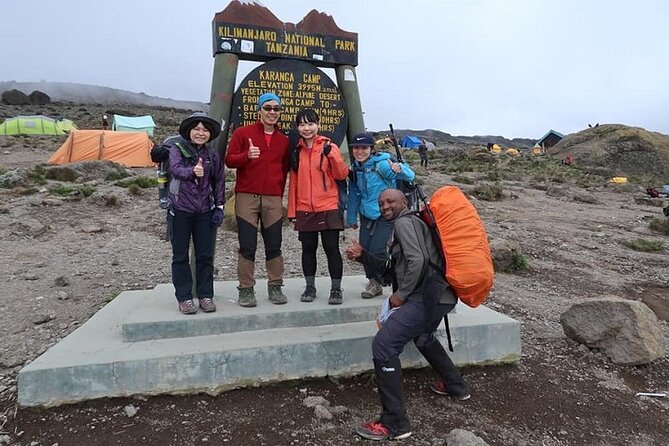
After breakfast, you tackle the steep ridge beside the Barranco Wall. The trail then reaches Karanga Valley Camp. On a seven day schedule, this is where you would normally spend the night, but the six day version continues onward.
You pass the junction with the Mweka Trail and climb to Barafu Hut. This combined day takes about six hours according to the schedule, though the distance and steep ground can make it feel long. You have completed the Southern Circuit, with views of Kibo and Mawenzi from different angles.
Barafu means ice, and the name suits the exposed high camp. It is your staging point for the summit, not a place for a relaxed evening. You eat dinner, rest, organize summit layers, and prepare for a midnight to 2 a.m. departure.
This is where the itinerary choice matters most. The seven day option gives you an extra night at Karanga and splits the climb to Barafu. That creates a slower rhythm. The six day option saves a day and may suit hikers with strong mountain experience, but it adds strain before the hardest night.
Day 5: Stella Point, Uhuru Peak, and the long descent
The summit day begins in darkness. You climb northwest between the Rebmann and Ratzel glaciers, moving over heavy scree toward Stella Point on the crater rim.
This is described as the most mentally and physically difficult part of the climb, and that is easy to understand from the schedule alone. You have already spent several days at altitude, you are walking overnight, and loose scree can make each step feel short.
At Stella Point, around 18,600 feet, you stop for a brief rest. If weather conditions cooperate, sunrise becomes the reward. From there, the trail continues for about an hour toward Uhuru Peak, with possible snow along the way.
Uhuru Peak is the highest point on Kilimanjaro and the highest point in Africa. The summit moment may be brief because of cold, fatigue, and thin air, but it is the clear goal of the entire route.
The day does not finish at the summit. You descend after reaching the top, making this a long and tiring day even if the listed walking time is about six hours. The schedule also notes that faster hikers may see other members of the group on the descent, so you should expect different walking speeds within the party.
A guide’s encouragement matters here. The published experiences repeatedly praise the support of the guide and porter teams, including a successful climb led with Omary and strong organizational praise directed to Nalisis. Still, no guide can remove the effects of altitude. Your pace, health, and willingness to turn around must remain more important than the summit photograph.
Day 6: Mweka descent and the return to Moshi
After breakfast, you descend through lower terrain toward Mweka Park Gate. The trail can become wet and muddy again as you lose altitude.
Gaiters and trekking poles are useful on this section. At lower elevations, shorts and a T-shirt may be enough for walking, but keep rain gear and warmer clothing within reach because conditions can change before you reach the gate.
At Mweka Gate, you receive summit certificates. A vehicle then takes you back to your hotel in Moshi.
The final day is less dramatic than summit night, but it brings welcome closure. You move from high mountain conditions back toward ordinary road travel, a hot shower, and a bed. The listed walking time is about six hours.
What the $2,080 price includes
At $2,080 per person, this is not a budget day hike. It is a full mountain expedition with national park fees, transport, food, camp support, and porters. The price includes:
- All fees and taxes
- Private transportation
- Airport pickup
- Six lunches
- Six breakfasts
- Five dinners
Those meals cover the scheduled climbing period, and the crew boils drinking and washing water at camp. That makes the package more useful than a simple guide-only service.
You still need to pay for your visa, flights, personal hiking equipment, and tips for the crew. Tipping is a normal part of planning for a supported Kilimanjaro climb, so do not treat the published price as your complete trip budget.
There is also a wording issue worth clearing up before payment. The experience is described in different places as group joining, shared, private, or a private activity for only your group. Published accounts describe groups ranging from couples to larger mixed parties, including one group of ten. Ask Rede Tours whether your departure is private or combined with other climbers, and ask how many people will be in the group.
The crew, camp support, and group atmosphere
The strongest praise goes to the human side of the climb. The guide, porters, and chef are repeatedly described as caring, welcoming, skilled, and well organized. One account names Nalisis in the organization, while another credits Omary during the summit effort.
The operation is also praised for good tents and strong hiking support. That matters because camp comfort becomes increasingly valuable after cold nights, long climbs, and the summit attempt.
A group climb can add energy to the route. You may share the effort with people from different countries, and several published accounts describe groups joining together successfully. The tradeoff is that different fitness levels can affect pace, rest stops, and summit timing.
Ask how the guide handles pace and altitude symptoms before you start. On Kilimanjaro, a supportive group is helpful, but a rushed group is not.
Who should choose this Machame climb?
This route suits you if you want the mountain’s most varied scenery and do not mind steep, rough walking. It is a better fit if you already have hiking, backpacking, or high altitude experience.
The seven day version is the more sensible choice for many people because the extra night at Karanga breaks up the approach to Barafu. The six day version is shorter and may work for a strong, experienced hiker who accepts a tighter schedule.
You should think carefully before booking if your main goal is comfort or the highest possible acclimatization margin. The rainforest can be muddy, Shira can be freezing, the summit night is physically severe, and the six day plan combines two demanding sections.
The information says most people can participate, but that should not be read as a promise that altitude will be easy. Kilimanjaro is high enough to cause serious problems, and reaching the summit depends on conditions and your health on the day.
Booking details and cancellation
The meeting point is listed as Shanty Town, Tanzania, with an 8 a.m. start. The activity ends back at the meeting point after transport from Mweka Gate.
Confirmation is provided at booking. The tour offers free cancellation if you cancel at least 24 hours before the local start time. Cancellations or changes made less than 24 hours before departure are not refunded or accepted.
Should you book the 7 day Machame Route?
I would choose this climb for the scenery, the Southern Circuit, and the strong emphasis on crew support. The route gives you a real sense of Kilimanjaro’s changing environments, not just a direct march toward the summit.
I would favor the seven day schedule over the six day version unless you have solid high altitude experience. Before booking, confirm the group size, the exact number of climbing days, the food plan, and what personal equipment you can rent or must bring.
Book it if you want a demanding mountain challenge, accept basic camp conditions, and value a well-supported route. Skip it if you want an easy walk or a guaranteed summit. Kilimanjaro offers no guarantees, but this Machame plan gives you a scenic route, a practical acclimatization day, and a crew repeatedly praised for helping climbers reach the roof of Africa.
FAQ
How long is the Machame Route experience?
The experience is described as a 6 to 7 day climb. The six day version combines the Barranco to Karanga section with the climb from Karanga to Barafu, while the seven day version includes an overnight at Karanga.
What time does the climb start?
The listed start time is 8 a.m. Pickup follows an early breakfast at your hotel, with the meeting point listed as Shanty Town, Tanzania.
Where does the route begin?
The route begins with transport from Moshi toward Machame Village and Machame Gate. If road conditions prevent the vehicle from reaching the gate, the final 3 kilometers may be walked from the village.
What is the highest point reached?
The climb reaches Uhuru Peak at 5,895 meters, the highest point on Mount Kilimanjaro and in Africa. The summit attempt also passes Stella Point at about 18,600 feet.
Is food included?
Yes. The package includes six breakfasts, six lunches, and five dinners. The crew also boils drinking and washing water at camp.
Is transport included?
Yes. Private transportation and airport pickup are included. A vehicle collects you at Mweka Gate and returns you to your hotel in Moshi after the descent.
What costs are not included?
Visa costs, tips for the crew, flights, and personal hiking equipment are not included in the price.
Can I cancel for a full refund?
Yes, if you cancel at least 24 hours before the experience start time. Cancellations and changes made less than 24 hours before the local start time are not refunded or accepted.
More 7-Day Experiences
- Climbing Kilimanjaro through 7 days Machame Route
★ 5.0 · 151 reviews - 7 Days Kilimanjaro via Machame route affordable price
★ 5.0 · 110 reviews - 7-Day Magical Tanzania Safari -Premium High End Package
★ 5.0 · 53 reviews - 7 Days Machame route – Kilimanjaro
★ 5.0 · 45 reviews
Just added around Moshi
- Moshi: Lake Chala Tour: Hiking &/or Kayaking★ 4.5 · 3 reviews
- 3 Days Tanga Exclusive Beach Holiday★ 5.0 · 3 reviews
- Serengeti Wildebeest Migration.★ 5.0 · 3 reviews
- Chemka Hotpsrings E-Bike Day Trip★ 5.0 · 3 reviews
- Explore 1 day Ngorongoro Crater Budget Group Safari from Arusha★ 5.0 · 3 reviews
- Explore the 360° of Kilimanjaro★ 5.0 · 3 reviews
- Affordable Short Tanzania Safari (2 Days Camping Safari)★ 5.0 · 3 reviews
- Rongai Route 7 Days★ 5.0 · 3 reviews
Kilimanjaro Treks, compared.



8-Day Small-group Lemosho Kilimanjaro Summit Trekking
Read our review →


Climbing Kilimanjaro through 7 days Machame Route
Read our review →

Browse the lists this tour appears in