
Reviewed · KILIMANJARO TREKS
Private 7 Days Kilimanjaro Climbing via Lemosho Route
Reach Africa’s highest point the patient way. This private seven-day Kilimanjaro climb follows the scenic Lemosho Route, with a small group capped at five people, English-speaking support, porters, a cook, and a careful climb-high, sleep-lower acclimatization plan. I like the route’s changing scenery, from montane forest to glacier country, and I like the strong personal support praised for guides such as Sebastian, Paschal, Evans, and Kessy. The main catch is the price, $2,800 per person, which is a serious commitment before tips, visas, flights, and laundry.
This is not a casual walking holiday. You will spend long days above 3,000 meters, then tackle a midnight summit start and a demanding descent. Still, the seven-day schedule gives you more time to adjust than shorter Kilimanjaro programs, and the private format makes it easier to set a steady pace and get direct help when the altitude begins to bite.
In This Review
- Key points at a glance
- Why the seven-day Lemosho Route works
- Day 1: Lemosho Gate to Mti Mkubwa
- Day 2: Shira Ridge and a long moorland crossing
- Day 3: Lava Tower, Shark’s Tooth, and Barranco Camp
- Day 4: The Barranco Wall to Karanga Valley
- Day 5: Barafu Camp and the final preparation
- Day 6: Stella Point and Uhuru Peak
- Day 7: Descent through forest to Moshi
- What the $2,800 price buys you
- Guides, porters, and the human side
- Who should book this climb?
- Booking advice and cancellation terms
- FAQ
- How long is the Kilimanjaro Lemosho climb?
- How many people can join the private climb?
- What meals are included?
- Is a guide included?
- Is transportation included?
- What is not included in the price?
- Should you book the seven-day Lemosho Route?
Key points at a glance
- A five-person maximum: The small private group should make pacing, communication, and summit support more personal.
- A gradual route profile: Lemosho begins in montane forest, crosses moorland and semi-desert, then reaches the alpine desert around Barafu Camp.
- A vital acclimatization day: Day 3 climbs to Lava Tower at 4,650 meters before dropping to Barranco Camp.
- A midnight summit push: You leave Barafu Camp between midnight and 2 a.m. for Stella Point and Uhuru Peak.
- Full mountain support: The package includes porters, a cooker, six breakfasts, six lunches, six dinners, park fees and taxes, plus an oxygen bottle.
- Strong guide-led care: Praise centers on Sebastian and the wider guiding team, with repeated notes about preparation, kindness, and support during difficult summit hours.
Why the seven-day Lemosho Route works
Kilimanjaro is not a technical climb in the usual mountaineering sense, but it is a serious high-altitude trek. The challenge comes less from scrambling and more from the steady rise, thin air, cold nights, long walking hours, and the final summit attempt.
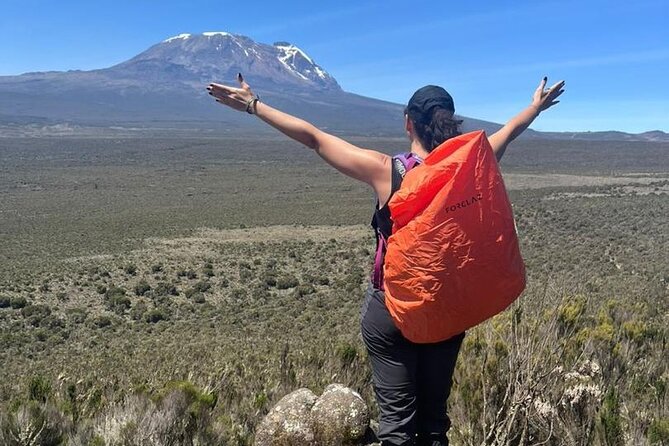
The Lemosho Route is a sensible choice for people who want a more gradual approach. You begin on the western side of the mountain, walk through forest, cross the Shira Plateau, and then join the southern circuit. That circuit lets you gain height, sleep at a slightly lower camp, and give your body time to respond.
I especially like the Day 3 plan. You climb toward Lava Tower at 4,650 meters, then descend to Barranco Camp at about 4,000 meters. That climb-high, sleep-lower pattern is useful because it exposes you to greater altitude without making you spend the night at the highest point reached that day.
The private format also matters. With a maximum of five people, you are less likely to be dragged along by a faster group or held back by a much slower one. Your guide can watch your pace and condition more closely. That does not remove altitude risk, but it can make the experience feel more controlled.
More Private Tours in Moshi
- Private Kilimanjaro Hike 7 Day Lemosho Route
★ 5.0 · 60 reviews - Private Tour to Materuni waterfalls, coffee tour & Kikuletwa hot- springs
★ 5.0 · 49 reviews - 4 Day Private Tour Throughout Tarangire, Serengeti and Ngorongoro
★ 5.0 · 42 reviews
Day 1: Lemosho Gate to Mti Mkubwa
Your first mountain day starts after breakfast and a briefing in the Moshi area. A 4WD vehicle takes you to Lemosho Park Gate and onward along a forest track to Lemosho Glades. From there, you walk through montane forest to Mti Mkubwa, meaning big tree, campsite.
The figures are friendly for a first day: about 6 kilometers, two to three hours of walking, and an ascent from roughly 1,830 to 2,650 meters. You receive lunch and dinner, so the day is short enough to let you settle into the routine of walking, eating, and sleeping outdoors.
The forest is an important part of the route’s appeal. It gives you a softer introduction than beginning immediately in open high country. You may find the track damp or rough, and the 4WD transfer is part of the access arrangement rather than a sightseeing ride. Keep your day bag organized, since you will want water, rain protection, and a warm layer close at hand.
Day 2: Shira Ridge and a long moorland crossing
Day 2 changes the character of the climb. After breakfast, the trail steepens and enters giant heather moorland. Several streams are crossed as you continue over Shira Ridge, pass Shira 1 Camp, and reach Shira 2 Camp beside a stream.
This is a much longer day: 16 kilometers and roughly seven to eight hours, rising from 2,650 to 3,850 meters. Lunch and dinner are included, but you should expect this to be a tiring walking day even if the trail itself is not highly technical.
The reward is the open high-country setting and broad views across the Shira Plateau. The route no longer feels like a forest hike. You are walking among heather and moorland vegetation, with the mountain beginning to look bigger and more exposed.
A practical point: do not judge the climb by distance alone. Ten miles at altitude can feel far harder than ten miles at home. Walk slowly, drink regularly, and keep your clothing easy to adjust. The private group helps here because the guide can set a measured pace instead of treating speed as a contest.
Day 3: Lava Tower, Shark’s Tooth, and Barranco Camp
This is one of the most useful days in the entire schedule. From the Shira Plateau, you head east along a ridge, pass the junction toward Kibo, and then turn southeast toward Lava Tower, also called Shark’s Tooth. The tower reaches about 4,650 meters.
The day covers about 8 kilometers and takes five to six hours. You begin around 3,850 meters and finish at Barranco Camp near 4,000 meters, but the important point is the much higher altitude reached along the way. After Lava Tower, you descend toward Barranco.
The surroundings become semi-desert, with fewer plants and a harsher feel underfoot. This is where you begin to understand that Kilimanjaro’s difficulty is not just physical distance. The air is thin, the sun can be strong, and temperatures can change quickly.
I would treat this day as a serious test, not a warm-up. If you feel unwell, tell your guide early. The listed inclusion of an oxygen bottle provides an extra safety resource, but it should not encourage you to ignore symptoms. Your guide’s judgment and your willingness to speak up are more important than trying to look tough.
More Kilimanjaro routes and climbs:
- Kilimanjaro climb by Lemosho Route (7-day)
★ 5.0 · 651 reviews - Kilimanjaro climb, Machame Route (7-day)
★ 5.0 · 262 reviews - Kilimanjaro Climbing Lemosho Route 8 Days.
★ 5.0 · 186 reviews - Climbing Kilimanjaro – Machame Route
★ 5.0 · 170 reviews
Day 4: The Barranco Wall to Karanga Valley
After breakfast, you leave Barranco Camp and climb the Barranco Wall. The route continues along a steep ridge into Karanga Valley, then reaches the junction connecting with the Mweka Trail.
The distance is only 5 kilometers, with three to four hours of climbing. You rise from approximately 4,000 to 4,050 meters, so this is not a major altitude-gain day. Its challenge comes from the steep ridge and the need to use your hands and feet carefully in places.
The Barranco Wall is one of the route’s memorable sections because it feels more like a mountain climb than a long trail walk. The supplied information does not describe technical equipment or ropes, so you should not assume a technical climbing course. Expect a steep trekking section under guide supervision.
Because the day is relatively short, it gives you time to rest at camp and prepare for the next stage. That matters. Kilimanjaro rewards steady energy management, not heroic bursts followed by exhaustion.
Day 5: Barafu Camp and the final preparation
Day 5 takes you from Karanga Valley to Barafu Camp. The distance is about 4 kilometers, with three to four hours of climbing, but you gain roughly 650 meters and finish near 4,700 meters.
The habitat is alpine desert, and the surroundings become stark and exposed. You have now completed the southern circuit, with views of the summit from different angles. The route’s earlier changes in direction and height have prepared you for the final push.
At Barafu, the schedule calls for camp, rest, dinner, and summit preparation. This is not a normal evening. You will need to organize clothing, water, snacks, headlamp supplies if you bring one, and anything else you need before sleeping. The summit start comes between midnight and 2 a.m.
The short walking distance can be misleading. You are already high, and sleeping at 4,700 meters may be uncomfortable. Follow the guide’s instructions and use the afternoon for quiet rest rather than wandering around camp.
Day 6: Stella Point and Uhuru Peak
Summit day is the heart of the trip, and it is also the hardest part. You leave Barafu between midnight and 2 a.m., heading northwest between the Rebmann and Ratzel glaciers. The trail rises through heavy scree toward Stella Point on the crater rim.
The information provided lists about seven hours for this section, but it does not give a complete distance or a full elevation breakdown. You should understand the day as a long summit effort followed by continued descent, not simply a seven-hour outing.
The climb to Stella Point is mentally and physically demanding. You walk in darkness, on loose ground, at very high altitude, often after little sleep. The guide’s role becomes especially important here. Several accounts place strong emphasis on Sebastian’s encouragement and ability to support people who struggled with altitude, while Paschal, Evans, and Kessy are also praised for their guiding and care.
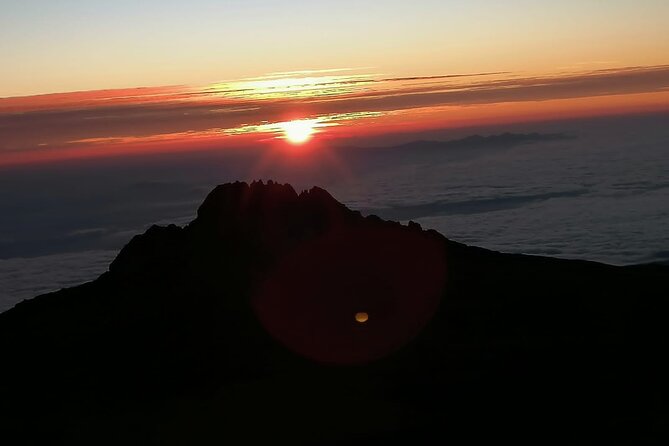
At Stella Point, you stop briefly and may see sunrise over the crater rim. Faster climbers might reach Uhuru Peak in time for sunrise, but that is not something to chase. Your goal is to move safely and steadily.
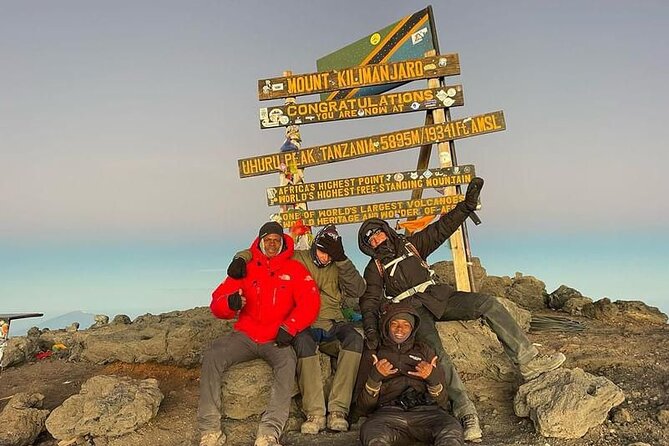
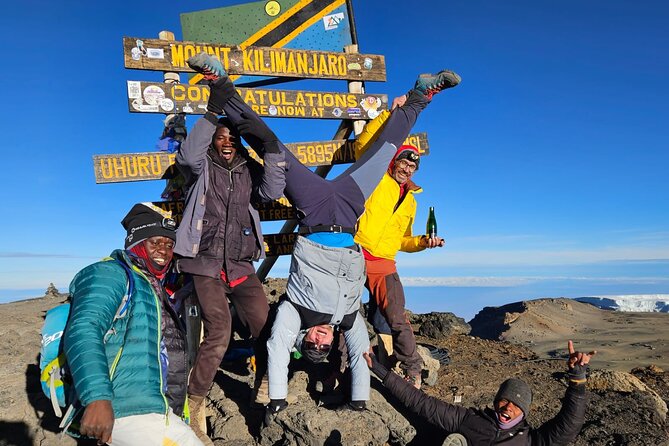
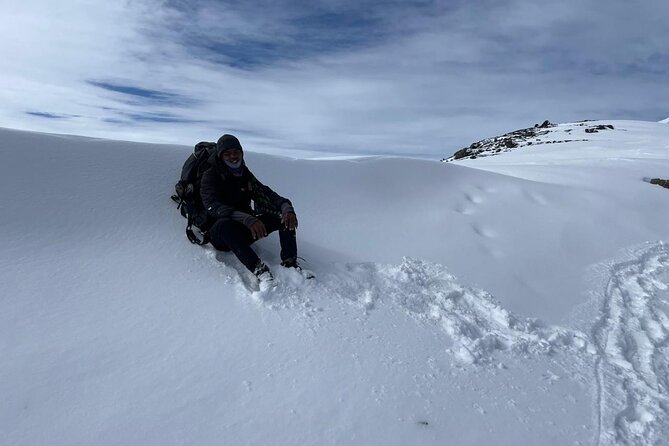
From Stella Point, the final ascent to Uhuru Peak takes about an hour according to the schedule. Snow may appear along this section. At 5,895 meters, Uhuru Peak is the highest point on Mount Kilimanjaro and the highest point in Africa.
Do not expect a leisurely summit celebration. Take your photographs, enjoy the achievement, and follow the guide’s advice about moving down. Fatigue and altitude remain serious after reaching the top.
Day 7: Descent through forest to Moshi
After breakfast, you descend from the mountain toward Mweka Park Gate. The route drops from about 3,090 meters to 1,680 meters, covers roughly 10 kilometers, and takes three to four hours.
The habitat returns to forest. Lower elevations can be wet and muddy, so gaiters and trekking poles are useful. Shorts and a T-shirt may be comfortable lower down, but keep rain gear and warmer clothing within reach because conditions can change before you reach the gate.
At Mweka Gate, you receive summit certificates. An African Trek & Travel vehicle then drives you back to your Moshi hotel, a journey of about 60 minutes.
This final day is easier on the lungs than summit day but can be hard on tired knees. Trekking poles are not just a comfort item here. They help with balance on slippery ground and reduce some strain during the long descent.
What the $2,800 price buys you
At $2,800 per person, this is not a budget walk. The value depends on how much you place on a private group, a full support crew, park access, meals, and organized transport.
The price includes all fees and taxes, porters, a cooker, an English-speaking live guide, and guides who can also work in Spanish, French, German, Italian, and Simplified Chinese. You receive six breakfasts, six lunches, and six dinners, plus an oxygen bottle.
That food provision is important because the mountain routine is demanding. You do not need to solve every meal yourself after a long day. The repeated praise for the cook, waiter, guide, and porters suggests that service is a major part of the experience, not an afterthought.
You still need to budget for tips, a Tanzanian visa, flights, and laundry. The listing does not state hotel nights, personal equipment rental, or airport transfers beyond the described vehicle service, so ask the company to clarify those points before paying.
The package offers pickup, and the listed meeting point is M84R+V94, Shantytown 7582, Tanzania. The activity ends back at the meeting point, although the Day 7 plan specifically describes transport to a Moshi hotel. Confirm the exact pickup and return arrangement in advance.
Guides, porters, and the human side
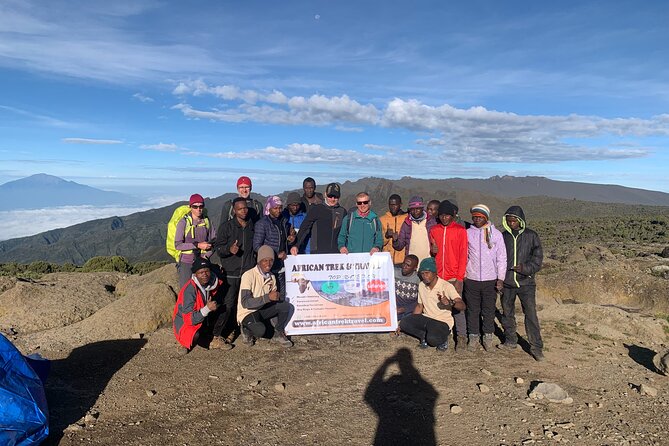
The strongest praise is directed at the people supporting the climb. Sebastian is repeatedly singled out for careful communication, gear checks, practical advice, good humor, and support during hard sections. Paschal is praised for guiding a smooth Lemosho climb, while Evans and Kessy are also described as helping lead a memorable trip.
One account describes 23 porters supporting seven hikers. Your group may be smaller or arranged differently, but that detail gives you a sense of how much work sits behind a supported Kilimanjaro climb. Porters carry camp equipment and supplies, while guides, cooks, and other staff keep the group moving and fed.
Tipping is not included. Since the porters and guides are central to the experience, ask for the company’s current tipping guidance before departure. It is better to understand that cost early than to make a rushed decision at the gate.
The language range is another practical strength. English is listed, along with Spanish, French, German, Italian, and Simplified Chinese. Confirm your preferred guide language at booking, since the information does not promise every language for every departure.
Who should book this climb?
This trip suits you if you have moderate physical fitness, can manage repeated full days of walking, and are prepared for cold, high-altitude camping. You do not need to be an elite athlete, but you do need patience and the discipline to walk slowly.
It is a good match for people who value close guide attention, a small group, and a longer route plan. It also works well if you want the scenery to change gradually rather than rushing to the upper camps.
I would think twice if you want a relaxed holiday, dislike camping, or have not prepared for a midnight start followed by a summit ascent. The package includes support, but no operator can guarantee that you will reach the summit. Altitude affects people differently, even when they are fit.
Service animals are allowed, and the meeting point is near public transportation, but this remains a demanding mountain activity. Those details should not be mistaken for an easy-access sightseeing tour.
Booking advice and cancellation terms
Confirmation is provided at booking. The experience is scheduled to operate from August 21, 2024, through June 18, 2026, with opening hours listed as midnight to 11:30 p.m. daily. Those broad hours reflect the fact that summit day begins in the middle of the night.
Free cancellation is available if you cancel at least 24 hours before the local start time. Cancellations made less than 24 hours before the start, and changes made inside that window, are not accepted for a refund.
Before booking, I would ask three direct questions: what hotel pickup is included, what personal gear is available or rentable, and how the summit-day schedule is handled if weather or altitude causes a delay. Those answers will help you compare the $2,800 cost fairly.
FAQ
How long is the Kilimanjaro Lemosho climb?
The experience lasts approximately seven days. The route begins at Lemosho Park Gate and ends at Mweka Gate, followed by a drive back toward Moshi.
How many people can join the private climb?
The activity has a maximum of five travelers.
What meals are included?
The package includes six breakfasts, six lunches, and six dinners.
Is a guide included?
Yes. A live guide is included, with guiding available in English, Spanish, French, German, Italian, and Simplified Chinese.
Is transportation included?
Pickup is offered. On Day 1, transport takes you to Lemosho Park Gate and Lemosho Glades. On Day 7, a vehicle drives you from Mweka Gate back to your Moshi hotel in about 60 minutes.
What is not included in the price?
Tips, a Tanzanian visa, flights, and laundry are not included.
Should you book the seven-day Lemosho Route?
I would book this climb if you want a private, carefully supported attempt at Kilimanjaro and are willing to pay for a small group and full mountain logistics. The strongest reasons are the gradual route, the Lava Tower acclimatization day, the experienced support team, and the repeated praise for personal care from guides including Sebastian and Paschal.
I would not choose it for a quick or inexpensive mountain holiday. The climb demands preparation, the summit day is severe, and extra costs remain outside the headline price. Ask a few practical questions before booking, prepare for altitude rather than just distance, and treat the summit as a goal rather than a promise. That is the right mindset for this seven-day route.
More 7-Day Experiences
- Climbing Kilimanjaro through 7 days Machame Route
★ 5.0 · 151 reviews - 7 Days Kilimanjaro via Machame route affordable price
★ 5.0 · 110 reviews - 7-Day Magical Tanzania Safari -Premium High End Package
★ 5.0 · 53 reviews - 7 Days Machame route – Kilimanjaro
★ 5.0 · 45 reviews
Just added around Moshi
- Moshi: Lake Chala Tour: Hiking &/or Kayaking★ 4.5 · 3 reviews
- 3 Days Tanga Exclusive Beach Holiday★ 5.0 · 3 reviews
- Serengeti Wildebeest Migration.★ 5.0 · 3 reviews
- Chemka Hotpsrings E-Bike Day Trip★ 5.0 · 3 reviews
- Explore 1 day Ngorongoro Crater Budget Group Safari from Arusha★ 5.0 · 3 reviews
- Explore the 360° of Kilimanjaro★ 5.0 · 3 reviews
- Affordable Short Tanzania Safari (2 Days Camping Safari)★ 5.0 · 3 reviews
- Rongai Route 7 Days★ 5.0 · 3 reviews
Kilimanjaro Treks, compared.



8-Day Small-group Lemosho Kilimanjaro Summit Trekking
Read our review →


Climbing Kilimanjaro through 7 days Machame Route
Read our review →

Browse the lists this tour appears in