
Reviewed · KILIMANJARO TREKS
#1. Best 7 days kilimanjaro trek Machame route join group
Africa’s highest summit demands more than strong legs. This 7-day Machame Route trek gives you changing scenery, a sensible acclimatization profile, and a dramatic summit night on Mount Kilimanjaro. I like the passage through rainforest, moorland, and alpine desert, and I like the built-in climb high, sleep lower day at Lava Tower. The main concern is price clarity: the advertised $900 does not appear to cover all park fees, porter and guide charges, or tips.
The route is well organized on paper, and the short fourth day gives you time to recover before Barafu Camp. You should also know that the description refers to hut accommodation, while the itinerary names camps and the inclusions list camping equipment and a sleeping mattress. Confirm the sleeping setup and the full cost before paying.
In This Review
- Key points to know before booking
- Why the Machame Route earns its reputation
- Day 1: Machame Gate to Machame Camp
- Day 2: Moorland views on the way to Shira Camp
- Day 3: Lava Tower and the descent to Barranco
- Day 4: The Barranco Wall and Karanga Camp
- Day 5: Barafu Camp and the wait for midnight
- Day 6: Uhuru Peak and the longest day
- Day 7: Mweka Gate and the return to Moshi or Arusha
- What the $900 price really means
- Food, water, equipment, and daily comfort
- Who should choose this seven-day trek?
- Should you book Kilinge Adventures?
- FAQ
- Where does the Kilimanjaro trek take place?
- How long is the Machame Route trek?
- What is the highest point reached?
- What habitats will I pass through?
- Is the summit attempt made at night?
- How long is summit day?
- Is the Barranco Wall part of the route?
- What is included in the price?
- Are national park fees included?
Key points to know before booking
- Seven days gives you a useful acclimatization rhythm: The Lava Tower high point followed by a descent to Barranco Camp is one of the most important parts of the plan.
- The Machame Route changes habitat every day: You move from montane rainforest to moorland, alpine desert, and the arctic summit zone.
- Summit day is long and demanding: The Barafu to Uhuru Peak to Mweka Camp section covers 17 kilometers and can take 10 to 14 hours.
- The listed $900 is not the likely final cost: One cost account puts park and related entrance fees at about $950, with tips listed separately at about $350.
- The Barranco Wall is a hands-on section: You should expect a rocky scramble rather than a simple walking path.
- The tour has a strong basic package: Transport from a Moshi hotel to the gate, meals, drinking water, equipment, and guiding are included, but key fee details need checking.
Why the Machame Route earns its reputation
The Machame Route is appealing because Kilimanjaro does not look the same from start to finish. You begin beneath tall rainforest growth, then climb into open moorland, cross the dry alpine desert, and finally walk through the cold summit zone. That change gives the seven days a clear sense of progress.
You also get more than a direct uphill march. The route climbs to Lava Tower at 4,600 meters, then drops to Barranco Camp at 3,900 meters. That climb high, sleep lower pattern helps your body adjust to altitude better than a route that simply rises every day.
I would not treat the route as easy. The summit reaches 5,895 meters, and the final push begins around midnight. The itinerary calls for 10 to 14 hours on summit day, including the descent to Mweka Camp. Fitness helps, but pacing, hydration, warm clothing, and careful attention to your guide matter just as much.
More Kilimanjaro routes and climbs:
- 7 Days Kilimanjaro via Machame route affordable price
★ 5.0 · 110 reviews - Kilimanjaro Airport taxi to/from Moshi town/Arusha town
★ 5.0 · 60 reviews - 6 Days Climbing Mount Kilimanjaro Machame Route
★ 5.0 · 40 reviews
Day 1: Machame Gate to Machame Camp
Your trek begins at Machame Gate after registration. From there, the path enters the montane rainforest, where the air is cooler and the setting is shaded and green. The itinerary gives a starting elevation of 1,800 meters and an ending elevation of 2,835 meters.
The listed hiking time is five to seven hours. The distance is written as 1 kilometer, followed by 7 miles, which is clearly inconsistent. You should ask the operator to confirm the actual distance before you set expectations for the day.
This first section is special because it introduces Kilimanjaro as a living mountain, not just a summit to be conquered. You might see colobus monkeys and colorful birds, along with unusual forest plants. The day ends at Machame Camp, where you eat dinner and rest in the rainforest setting.
Bring a light jacket and keep rain protection accessible. The supplied packing advice includes a jacket, socks, hiking pants, a daypack, snacks, and trekking gear. You will want your daypack arranged before leaving the gate, since digging through larger luggage during a long climb is no fun.
Day 2: Moorland views on the way to Shira Camp
Day two leaves the rainforest behind and enters moorland. The trail becomes steeper and rockier, with the route rising from 2,835 meters to 3,750 meters. The listed distance is 5 kilometers, with four to six hours of hiking.
The reward is a wider view toward the Shira Plateau and Kibo Peak. This is one of the days when the changing vegetation makes the route feel worthwhile. The forest canopy gives way to open ground, and you can better appreciate how high you have climbed.
Shira Camp is also an important adjustment point. You are sleeping higher than the previous night, so do not race ahead simply because the distance is short. Walk slowly, drink the provided water, eat even if your appetite is fading, and tell your guide if you develop a headache or feel unwell.
Day 3: Lava Tower and the descent to Barranco
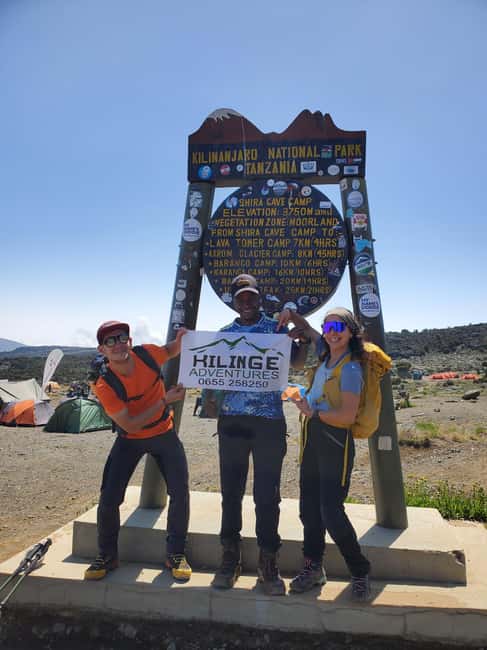
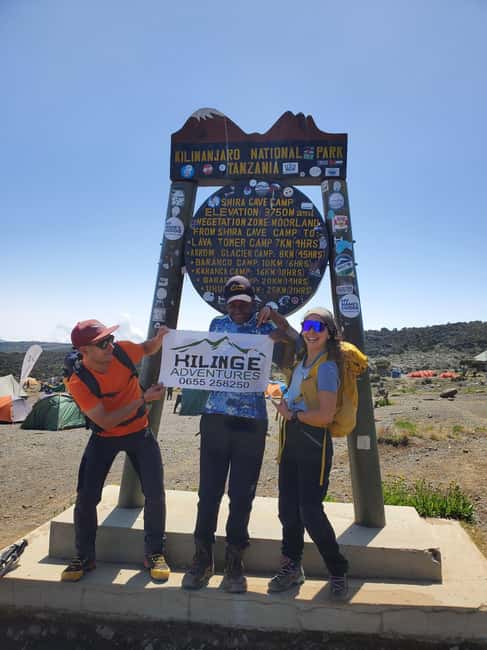
This is the route’s key acclimatization day. You leave Shira Camp at 3,750 meters and climb through alpine desert to Lava Tower at 4,600 meters. After a break, you descend to Barranco Camp at 3,900 meters.
The day covers 10 kilometers and takes seven to eight hours. The high point at Lava Tower may feel tough, but that is part of its value. You get your body used to a higher altitude, then sleep lower at Barranco.
The descent also changes the mood of the day. Barranco Valley comes into view, along with giant senecio plants that give the area a distinct Kilimanjaro character. This is a long day, so snacks are not optional. Pack food you will actually want to eat when you are tired, along with a power bank for keeping essential devices charged.
If you begin to feel sick, do not hide it to protect your summit hopes. The itinerary has a strong acclimatization structure, but no schedule can remove altitude risk. Your guide needs accurate information to make safe decisions.
A few more trips of this kind worth comparing:
- 8 Days Kilimanjaro Hike via Lemosho Route
★ 5.0 · 39 reviews - 6 Days Machame Route Kilimanjaro Trekking
★ 5.0 · 13 reviews - 8-Day Small-group Lemosho Kilimanjaro Summit Trekking
★ 5.0 · 186 reviews - Mountain Kilimanjaro Day Hike
★ 5.0 · 102 reviews
Day 4: The Barranco Wall and Karanga Camp
Day four is shorter, but it is not a soft day. You climb the Barranco Wall, a famous rocky section that requires an energetic scramble. You then cross ridges and valleys before reaching Karanga Camp at 4,035 meters.
The listed distance is 5 kilometers, and hiking takes four to five hours. That leaves more time to rest than the longer days, which is useful before the climb to Barafu. The Barranco Wall also gives you a change from ordinary uphill walking. You use your hands in places and need to pay attention to where you put your feet.
The route description presents this as an exciting part of the trek, and I agree, with one practical warning: people who dislike exposed or awkward rock scrambling should ask for a clearer description from Kilinge Adventures before booking. The supplied information does not give a technical difficulty grade.
At Karanga, focus on food, water, dry socks, and sleep. You are already above 4,000 meters. The next morning takes you to the summit base camp, so this is not the day to spend all your energy taking photographs.
Day 5: Barafu Camp and the wait for midnight
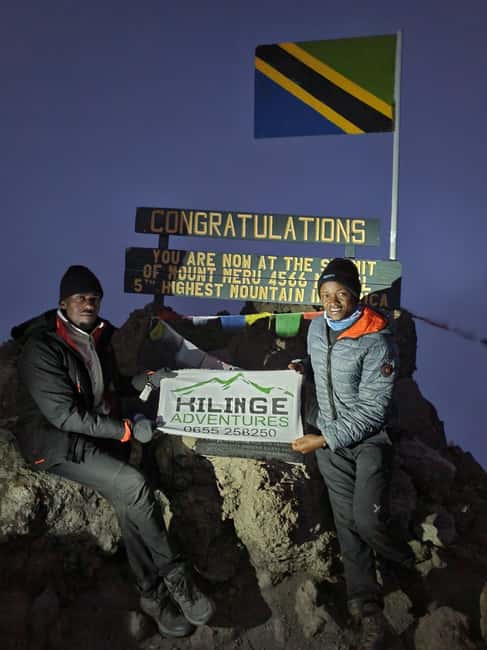
From Karanga Camp, you climb 4 kilometers to Barafu Camp at 4,640 meters. The itinerary allows four to five hours, making this another fairly short walking day, but the altitude makes it serious.
Barafu is the launch point for the summit attempt. You should expect to rest, hydrate, eat, and prepare for a midnight start. The afternoon may feel strangely quiet because the major effort is still ahead. Use the time to organize your flashlight, gloves, warm layers, snacks, and daypack.
A flashlight is specifically included on the suggested packing list, and it is essential for the night ascent. Gloves and a warm jacket are also named. Add your sleeping bag and climbing gear to the checklist, since the operator does not list a sleeping bag among the included items.
The sleeping arrangements deserve special attention here. The experience description says you stay in huts, but the route itself uses named camps, and the inclusions mention camping equipment and a mattress. Ask whether you sleep in huts, tents, or a mixture of both, and ask what camping equipment is supplied. Do not assume the phrase hut accommodation covers everything you need.
Day 6: Uhuru Peak and the longest day
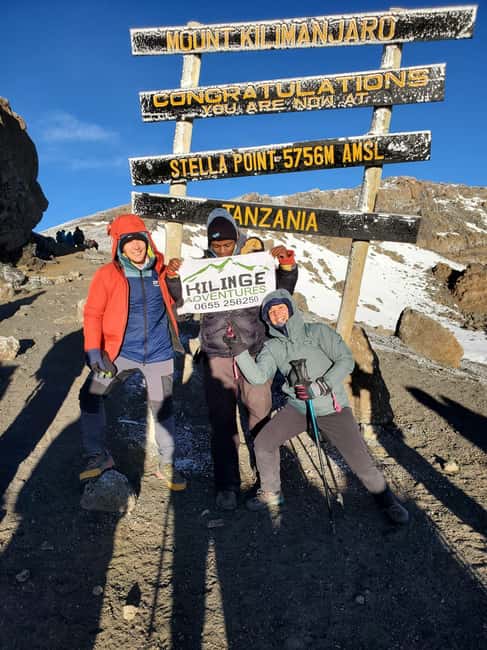
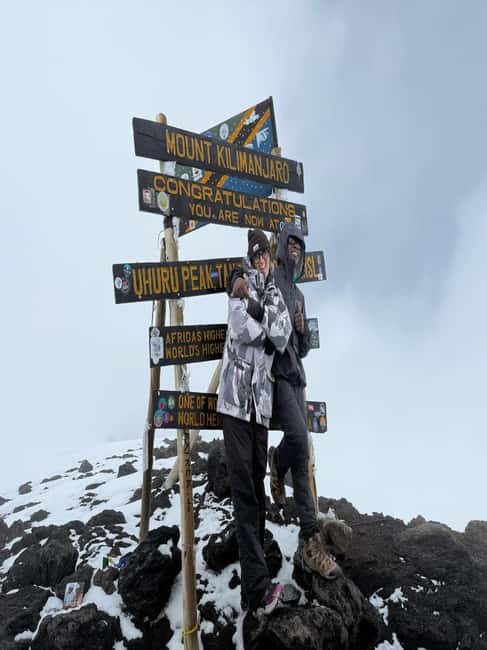
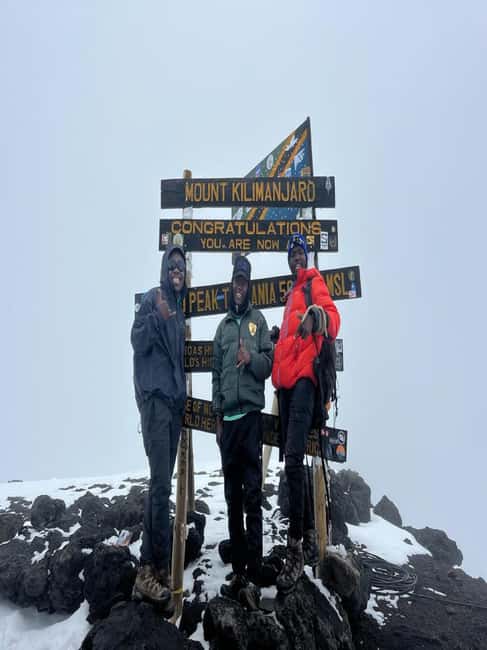
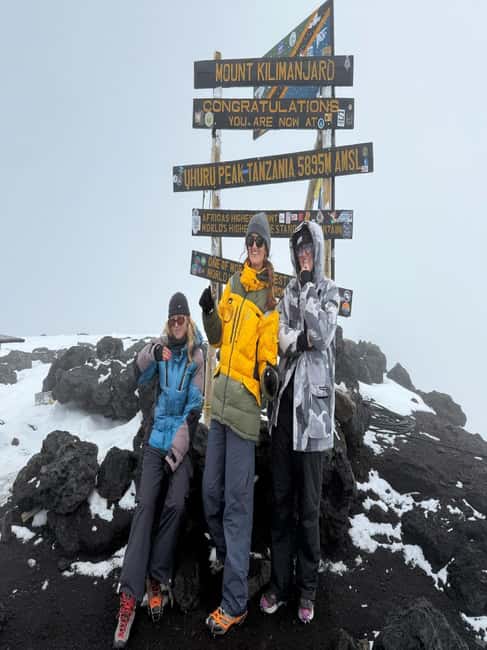
Summit day begins around midnight. You climb from Barafu Camp at 4,640 meters toward Stella Point, then continue to Uhuru Peak at 5,895 meters. After celebrating at the summit, you descend to Mweka Camp at 3,110 meters.
The total distance is 17 kilometers, and the expected hiking time is 10 to 14 hours. That figure includes both the ascent and the long descent. You should view this as the hardest day by a wide margin.
The final stretch to Uhuru Peak is cold, dark, and slow by design. The itinerary describes an ascent to the Roof of Africa, but the real achievement is managing your effort for many hours at altitude. Move at the guide’s pace. Small steps are better than an early burst followed by exhaustion.
At the summit, you get the high point of the trip in every sense. The arctic zone at 5,895 meters is very different from the rainforest where you started. After photographs and a short celebration, you descend. Do not linger too long at the summit. Mweka Camp is still far below, and your legs will feel the descent.
This is where your clothing system matters. You need layers that can be adjusted as you move from freezing summit conditions toward warmer forest air. The packing list includes a jacket, gloves, socks, hiking pants, flashlight, and daypack. Keep spare socks and snacks easy to reach rather than buried in your main bag.
Day 7: Mweka Gate and the return to Moshi or Arusha
The last morning takes you from Mweka Camp at 3,110 meters down to Mweka Gate at 1,640 meters. The distance is 10 kilometers, with three to four hours of hiking through rainforest.
After the stark upper mountain, returning to trees feels like a reward. The descent is not technically described as difficult, but tired knees can make downhill walking unpleasant. Take short steps and keep your balance, especially if the path is wet.
At Mweka Gate, you collect your certificate of achievement. The included transport then takes you back to Moshi or Arusha, where you can rest or continue with other plans.
The transfer matters because you should not need to arrange a separate ride from the gate. The information specifically includes transportation from your Moshi hotel to the gate at the start and a return to Moshi or Arusha at the end. Confirm the exact pickup and drop-off details before the trek.
What the $900 price really means
The advertised rate is $900 per person, which looks attractive for a seven-day Kilimanjaro trek. It includes accommodation, meals, drinking water, transport, a professional guide, camping equipment, and a sleeping mattress. For a week on a major African mountain, that package could offer good value if the cost is truly complete.
The warning is substantial. A cost account attached to this experience says participants must cover entrance fees for themselves, the guide, and porters, with a total of about $950 for seven days. It also lists tips at roughly $50 per accompanying person, calculated as $350 for seven guides. That would bring the stated total to about $2,150 when combined with the $900 price.
You should not treat $900 as your final budget until Kilinge Adventures gives you a written breakdown. Ask these exact questions:
- Are national park fees included?
- Are porter and guide entrance fees included?
- How many guides and porters are assigned to the group?
- Is the $950 figure current and mandatory?
- What camping or hut equipment is supplied?
- Are tips expected, and are they paid individually or as a group?
The supplied information itself says national park fees are not included. That single line changes the value calculation. A low headline price is less useful if major required charges appear later.
Food, water, equipment, and daily comfort
Meals and drinking water are included, which makes the seven-day schedule simpler for you. You still need snacks, especially on the long Lava Tower day and the summit push. Choose compact food that travels well and matches your own preferences.
A sleeping mattress and camping equipment are listed, but a sleeping bag is not. Bring your own sleeping bag unless Kilinge Adventures confirms one is supplied. The same applies to climbing gear. The packing guidance tells you to bring it, but does not define what the operator provides.
Your core personal list should include:
- Sleeping bag
- Jacket and gloves
- Hiking pants and spare socks
- Flashlight
- Daypack
- Snacks
- Trekking and climbing gear
- Power bank
A power bank is a small but useful addition. Seven days away from ordinary hotel facilities can make battery planning important. Keep the flashlight and warm clothing in your daypack for the summit night, not in luggage that you will not reach during the climb.
Who should choose this seven-day trek?
I would recommend this route to you if you want a scenic Kilimanjaro climb with a clear seven-day structure and enough time for a proper acclimatization day. The varied habitats, Barranco Wall, Lava Tower, and summit night give the trip a strong sense of progression.
It suits people who are comfortable with long walking days and basic mountain conditions. The summit day alone can last 10 to 14 hours, and the route reaches 5,895 meters. You need patience more than speed.
I would be cautious about booking if you need a fixed, all-inclusive price or if you expect a guaranteed hut stay. The description is unclear on accommodation, and the fee information needs reconciliation. You can still choose this experience, but only after receiving the final amount and sleeping arrangements in writing.
The experience has earned a full five-star average from three submitted ratings, including praise for the organization and a brief note calling the trip very nice. That positive signal is useful, but the detailed cost warning is more important for planning. Good organization cannot make an unexpected $1,250 difference disappear.
Should you book Kilinge Adventures?
Book this trek if the operator confirms the real price, explains the hut and camping arrangement, and gives you a clear list of included equipment. The route itself is strong: seven days, varied mountain zones, a climb high and sleep lower section, and a shorter recovery day before Barafu.
I would not book based on the $900 headline alone. Set aside time to verify park fees, porter and guide charges, tips, sleeping bags, and the number of staff assigned to your group. If those answers are clear and the final price fits your budget, this Machame Route plan offers a demanding but rewarding way to reach Uhuru Peak.
You can reserve now and pay later, and cancellation is allowed up to 24 hours in advance for a full refund. Those terms give you some flexibility, but they do not replace the need to check the cost details first.
FAQ
Where does the Kilimanjaro trek take place?
The trek takes place on Mount Kilimanjaro in Tanzania, using the Machame Route.
How long is the Machame Route trek?
The experience lasts seven days, from the start at Machame Gate through the return to Mweka Gate and transfer to Moshi or Arusha.
What is the highest point reached?
The summit is Uhuru Peak, which reaches 5,895 meters, or 19,341 feet.
What habitats will I pass through?
The itinerary includes montane rainforest, moorland, alpine desert, and the arctic zone near the summit.
Is the summit attempt made at night?
Yes. The summit attempt begins around midnight from Barafu Camp.
How long is summit day?
The route from Barafu Camp to Uhuru Peak and then Mweka Camp covers 17 kilometers and takes about 10 to 14 hours.
Is the Barranco Wall part of the route?
Yes. On day four, you climb the Barranco Wall before continuing to Karanga Camp.
What is included in the price?
The listed inclusions are accommodation, professional guides, transport from a Moshi hotel to the gate, transportation, meals, drinking water, camping equipment, and a sleeping mattress.
Are national park fees included?
No. The provided information specifically says national park fees are not included. One cost account also lists about $950 in entrance-related fees for seven days and about $350 in tips, so you should confirm the current final price before booking.
More 7-Day Experiences
- 7-Day Machame Route Kilimajaro
★ 5.0 · 28 reviews - 7 Days Highlight of Tanzania Mid-Range Standard
★ 5.0 · 22 reviews - 7 Days Wildebeest Migration – Ndutu Calving Season
★ 5.0 · 18 reviews - 7 Day Grand Tanzania Safari
★ 5.0 · 13 reviews
Just added around Kilimanjaro
- 5 days Serengeti Wildebeest Migration Safari★ 5.0 · 3 reviews
- Tanzania Safari and Kilimanjaro Climb Multi-Day Experience★ 5.0 · 3 reviews
- 9 Days – Best of Tanzania Safari★ 5.0 · 4 reviews
- 7 Days Mountain Kilimanjaro climb Machame Route★ 5.0 · 4 reviews
- 8-Day Tanzania Migration Footsteps – Midrange★ 5.0 · 4 reviews
- 4 Days Lake Manyara National Park, Ngorongoro Crater , Serengeti National Park.★ 4.0 · 4 reviews
- 6 Days Mara River Crossing – The Great Migration★ 5.0 · 5 reviews
- 6- Day Adventure Lodge safari to see Migration★ 4.5 · 5 reviews
Kilimanjaro Treks, compared.



8-Day Small-group Lemosho Kilimanjaro Summit Trekking
Read our review →


Climbing Kilimanjaro through 7 days Machame Route
Read our review →

Browse the lists this tour appears in